
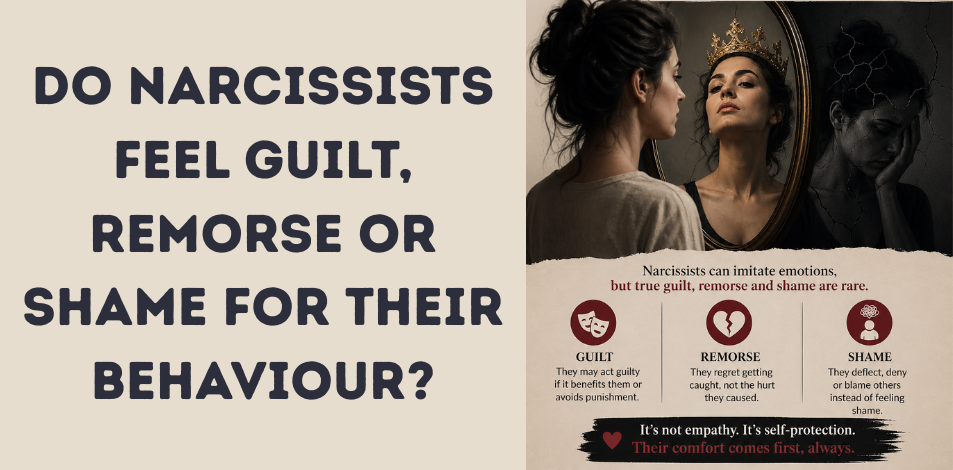
For anyone who has been in a relationship with a narcissist, or who is still experiencing narcissism in their life, one question inevitably arises: Do narcissists feel guilt, remorse, or shame for their words and actions?
Narcissists lack the capacity for guilt because they are incapable of feeling pity or empathy for others (though they often feign it). To feel remorse, they would have to take responsibility for their actions, which is impossible for them.
However, a narcissist might occasionally feel remorse, simply because they are experiencing the loss (or imminent loss) of the source of narcissistic gratification they need for psychological comfort.
As for shame, arrogant narcissists never feel it, while covert narcissists feel it constantly!
Let’s delve deeper and explore these questions: Do narcissists feel guilt, remorse, regret, or shame?
A Look at Narcissism
Narcissism is a personality disorder that arises from a traumatic childhood environment or event. It develops as a defense mechanism against intense feelings of shame, unworthiness, inferiority, rejection, and/or abandonment.
Narcissism from a Spiritual Perspective
Spiritually, the individual simply couldn’t bear the pain of their inner wounds and unconsciously chose to deny that part of themselves. They severed ties with their true self.
By separating themselves from their true self, their life was driven solely by their ego. To protect themselves from their wounds and flaws, this ego created a false self.
This split in consciousness is called “narcissism,” which varies in severity from moderate to high.
The role of the false self is to create a reality in which the narcissist feels superior, special, and perfect.
The problem is that the narcissist’s continued existence of this false reality requires constant nourishment and validation from the outside world. This is why narcissists need constant attention, as it feeds their vanity and their false sense of “excellence.”
Related : Narcissist Primary and Secondary Supply Explained
What a narcissist naturally craves is the vital energy they feel they lack. It acts as a temporary anesthetic, easing the pain of the dark emptiness that pervades their inner world.
The narcissist needs attention and validation from others to draw on the vital energy they so desperately crave, to nourish their false self and their fabricated reality.
Types of Narcissists
There are four main types of narcissists: the malicious, the philanthropist, the overt, and the covert.
However, to determine whether narcissists feel guilt or remorse, we will categorize them into two groups: the arrogant and the vulnerable.
The Arrogant Narcissist (Overt)
As the term suggests, arrogant narcissists are characterized by openness, self-confidence, and charisma, and they possess an excessive sense of self-importance.
Openness
Excessive self-esteem
A sense of superiority
A sense of entitlement and arrogance
Arrogant narcissists are easily recognizable. They have an exaggerated sense of self-importance and constantly seek attention, especially at social events.
Their delusion of self leads them to believe they are the best at everything and deserve to be the center of attention simply by existing.
The arrogant narcissist sees themselves as a god who should be worshipped, believing that no one can surpass their genius.
The Covered Narcissist
The covert narcissist is the complete opposite of the overt narcissist, making them much harder to detect.
- Introverted
- Low Self-Esteem
- Inferiority Complex
- Extreme Sensitivity to Criticism
Covered narcissists are not confident. They are more introverted and suffer from extremely low self-esteem. Their shyness may be mistaken for humility, which allows them to manipulate people and remain hidden, even while being narcissistic.
Unlike the overt narcissist, who pursues their desires and demands praise, the covert narcissist sits complaining about not achieving anything.
They will not realize that their failures are due to their own shortcomings or unwillingness to try. Rather, their failures are the result of a world that has never been fair to them.
The common denominator among all narcissists, regardless of their classification, is their absolute selfishness. All that matters to a narcissist is themselves; everything else is worthless, merely a nuisance!
Do narcissists feel guilt?
Let’s explore the question: Do narcissists feel guilt on any level? First, we need to understand what guilt is.
Guilt: A feeling or sense of having done something morally wrong that goes against your ethical principles.
Related : 6 Ways Narcissists Lack Accountability in Relationships
What people feel guilty about, or don’t feel guilty about, varies greatly, depending on their moral compass. For example, religious, societal, and family beliefs influence what one considers right and wrong.
This wide variety of standards makes guilt a fluid experience, not subject to a one-size-fits-all rule.
Guilt is your conscience watching over you.
Problem #1: Narcissists lack a conscience.
When narcissists deny their true selves, they cut off their ability to experience everything that makes us human.
Without a conscience, narcissists cannot experience:
Love
Compassion
Empathy
So, if narcissists don’t have a conscience, that unconscious part of their mind won’t send signals to their emotional core that they’ve violated their moral principles.
In fact, people with Narcissistic Personality Disorder (NPD) are amoral. This means they don’t have moral principles and are therefore unaffected by right and wrong.
They may feign morality if it serves their narrative or agenda in some way, but it’s not genuine. A narcissist is nothing more than a parrot of others’ morals or culture as a means of feeding their ego.
Narcissists also lack empathy; that is, they lack the capacity to understand and empathize with the feelings of others.
In the narcissist’s distorted world, everything revolves around them. They lack the compassion, empathy, love, and care necessary to see others as living, breathing beings with their own independent lives.
For them, others are merely tools to obtain resources, energy, attention, and admiration to feed their ego. That’s all there is to it.
Problem_Two: Narcissists Lack Empathy
Do narcissists feel guilty if they lack empathy? A significant part of feeling guilty about what you’ve said or done stems from the ability to empathize with others.
Narcissists have very low levels of empathy, meaning they may sometimes understand the feelings of others, but, lacking a conscience, they are indifferent to their own. In other words, a narcissist’s empathy is neither genuine nor sincere.
They may feign empathy to play the victim or to manipulate others, but without delving into their own inner selves, they cannot experience true empathy.
Related : 14 Signs of a Narcissistic Friendship Cycle
Because a narcissist is incapable of genuine empathy for others regarding their own actions, they are also incapable of seeing anything from anyone other than their own perspective.
Without the ability to see any point of view outside their own world (where they are the center of attention), guilt is nonexistent.
The third problem: Evading all feelings of guilt
If a narcissist experiences a narcissistic wound (an internal wound is triggered), they may briefly feel something resembling guilt.
But the narcissist cannot tolerate this feeling because their ego prevents them. Remember, the role of ego is to protect the narcissist from any truth that reveals their flaws.
So, what the narcissist feels at that moment is criticism—the pointing out of their mistakes. This accusation of imperfection directly contradicts their fabricated reality, and therefore, it is now perceived as a direct attack on them and their false image.
Their false ego will try to eliminate this perceived attack as quickly as possible to protect itself.
The ego sees you as the one criticizing it, and therefore, it becomes the threat. The ego will focus on you and try to eliminate you (the threat). The narcissist needs to return to a state of calm, where they are the center of the universe, and all energy and attention is directed toward them.
Here, the narcissist might explode in anger, blaming you for everything they do. They will project all their repressed wounds onto you to avoid feeling guilty or upset. Or, they might resort to complete ignoring you, refusing to communicate with you as punishment for your actions.
Narcissists justify the most heinous actions, distorting the truth and always portraying themselves as the victim. No matter what happens, you will always be the one at fault.
Narcissists always blame others for their actions, justifying everything they do and avoiding any guilt.
Do Narcissists Feel Regret or Remorse?
Now that we’ve discussed whether narcissists feel guilt, let’s address the logical next question: Do they feel regret or remorse?
Remorse and remorse are two very different feelings, so a narcissist may experience one without the other.
Remorse vs. Remorse
Remorse
Remorse embodies the ability to take responsibility for one’s actions and mistakes. It is often accompanied by guilt and pain resulting from harming others.
A person who feels genuine remorse usually offers a sincere apology and strives to avoid repeating the behavior.
Regret
Regret is wishing you hadn’t done something or that it hadn’t been revealed. If someone regrets something, it’s often because they suffered a personal loss or harm as a result of that action. Remorse may manifest as sadness, grief, or even anger, but it is usually a personal feeling directed at oneself, not others.
Narcissists and Remorse
Given what we know about narcissists and their self-centered lives, it’s easy to see that they don’t experience true remorse, yet they do.
The narcissist’s ego plays a role in denying any responsibility for negative behaviors. Accepting responsibility would mean admitting their imperfections, which would shatter their fragile ego.
For a narcissist to feel remorse for any of their words or actions, they would need to be capable of empathy, something we know they lack.
Related : 21 Stages of a Narcissist Relationship with an Empath
However, a narcissist may feel remorse for some of their actions and choices. This isn’t because they feel bad about hurting others, but because their access to power, resources, sex, money, or attention has become threatened.
Narcissists feel remorse for what they have lost or are about to lose. Their remorse is always solely for themselves, never extending to anyone else.
From this, the narcissist will learn to lie, manipulate, and conceal their behavior with even greater skill in the future.
Don’t be fooled into thinking that a narcissist won’t use feigned remorse as a tool for manipulation. In fact, it’s one of their well-crafted tricks to exploit people’s pity and sympathy, hoping to be allowed back into their lives.
But the narcissist has no interest in teamwork or spiritual growth. All that motivates them is narcissistic gratification to feed their false ego and fill their dark inner void.