Stockholm syndrome is a fascinating phenomenon. If your life is in the hands of your violent captor, and you accept their capacity to inflict unspeakable suffering, terror will completely overwhelm you. You will go mad. Fortunately, the brain has a mechanism to stop it. It floods you with positive emotions, making you attached to your captor, and you use this attachment to persuade them not to harm you. By transforming yourself into an ally, the opposite of the threat, you regain a sense of power in a helpless situation.
The same thing happens to a child living with an abusive parent. Even in a loving family, a child subconsciously understands that their life is in their parents’ hands. The child’s chances of survival increase if they are obedient, cooperative, and loving. Furthermore, the child idealizes their parents and convinces themselves that they are infallible and harmless. The parent is perfect, absolute good, and therefore, safe.
A child’s veneration of their parents in this way is one aspect of a phenomenon known as “schizophrenia,” a tendency to see others as either absolutely good or absolutely evil. They are either hateful, wicked people deserving of hatred, or they are perfect and incapable of causing harm. There is no middle ground.
Children in their vulnerable stage cannot bear to see their parents capable of evil. So they see them as wonderful, strong, and wise to the extreme. They do this even if they have to deny reality. This is essential for the child’s psychological and emotional well-being.
In the case of abusive parents, the child’s terror escalates dramatically. As a result, the schizophrenic defense mechanism intensifies to match this terror, along with the child’s delusions. More terror means more psychological instability. With their fragile minds and extreme vulnerability, the child has no choice. They are swept away by their imagination and cling to the idea that their abusive parent is absolute good.
As this child grows into adulthood, the schizophrenia remains deeply ingrained in their subconscious. They continue to see their father as a kind-heated person, to the point of denial. Even when they realize their father was and still is abusive, they try to justify it. They profess their love for their father irrationally, knowing deep down that they are doing so to protect their sanity. And that’s understandable.
Many people don’t allow themselves to see their father for who he truly is because of the emotional storm that will engulf them upon realizing this truth. Anger. Sadness. Depression. Despair. Shame. Shock—all the emotions they suppressed to feel good about their father. It will be incredibly difficult to process. It takes courage, energy, patience, and effort to weather this initial storm. In some cases, denial may be the only thing that protects you from psychosis and madness.
Danger lurks for those who dare to approach the truth. You will need to move at a pace that suits you to avoid a breakdown. Shock is not a game. But beyond the danger lies opportunity.
Related : How to Become Bulletproof to Abuse
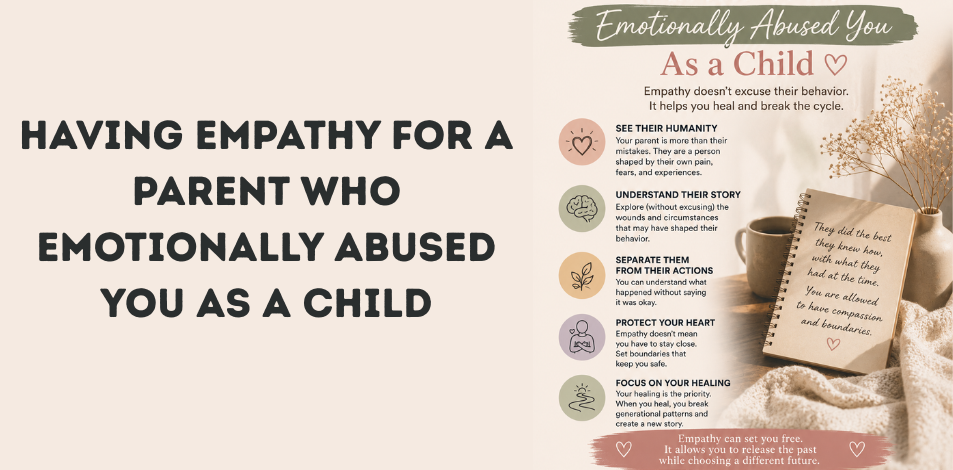
One of the most remarkable outcomes of healing childhood wounds and confronting the truth is the ability to overcome psychological defenses. The truth unfolds, revealing its many facets. You begin by seeing the situation from your parents’ perspective. Through empathy, you not only see, but also feel, the pressure of not having the necessary parenting skills. The exhaustion from sleepless nights trying to provide for their material needs. The desire to give your child everything, yet being unable to control your temper while eating breakfast. The feeling of inadequacy compared to other “perfect” parents in society.
Through empathy, you also gain a broader perspective, witnessing what life was like for your parents as children, facing horrific abuse. You see how they weren’t given the opportunity to process their trauma, how they were suddenly forced to ignore their own needs and be the perfect parents. Our generation today has opportunities for healing that our parents could only dream of.
Your empathy helps you understand your parents’ ordeal. It should also enable you to realize that it wasn’t your fault. It wasn’t about you. The truth is far more complex than your superficial view of absolute good and absolute evil allows. It’s true that your father’s behavior was sometimes terrible, and can even be described as awful. But the reality behind it is much deeper. It was real. It hurt. And it still hurts.
This shouldn’t be an excuse for your father. Be careful not to let your sympathy blind you to the truth. Your father was abusive, and it had serious consequences for you. Acknowledge that. Process it at your own pace. Determine what you need to do to heal.
If your father is still alive, decide what your relationship with him will be like for the rest of your life. But only do so after you’ve processed your past and the truth has dawned on you.
Humans are capable of both good and evil. But ultimately, we have to decide how much good they possess. Can they be reformed? Can you work with them by setting boundaries, accepting limitations, and demanding mutual respect? It’s difficult to assess this when you’ve spent your life with a distorted view of your parents. Without the truth, you cannot determine their essence.
Don’t rush into things. Your father might be stubborn and only feigning love, wanting to keep you open and engaged so he can exploit you to feed his narcissism. He’ll turn your sympathy against you without ever showing weakness. Be aware of this.
Empathy isn’t a tool for denial; it’s a light that illuminates the details of reality. It will help you gain the perspective needed to see the truth from both your point of view and your father’s. It will help you forgive, heal, move past the past, and live the life you deserve.