There comes a day when someone with complex PTSD looks back at the wreckage of their love life, overwhelmed with despair and regret. Happy memories that felt like paradise, moments filled with joy and love, missed opportunities, devastating mistakes, and shattering breakups—for someone with complex PTSD, relationships often combine all of this, layered with the pain of separation and suffering.
As you look back, you might wonder what your past relationship would be like if you could relive it with what you’ve learned now. If only you had known the details, understood what to expect before taking that step. If only you had a dating guide for someone with complex PTSD.
People with complex PTSD rarely choose their partners carefully. They don’t take their time, they don’t slowly build intimacy and trust from a safe distance, gradually approaching commitment. Instead, they rush headlong into it, swept away by a wave of intense emotion.
The first few months of the relationship are filled with euphoria, constant companionship, and complete honesty, without any constraints, frustrations, or pain. The person with complex PTSD believes they have finally found their soulmate. The one.
But the reality is much darker.
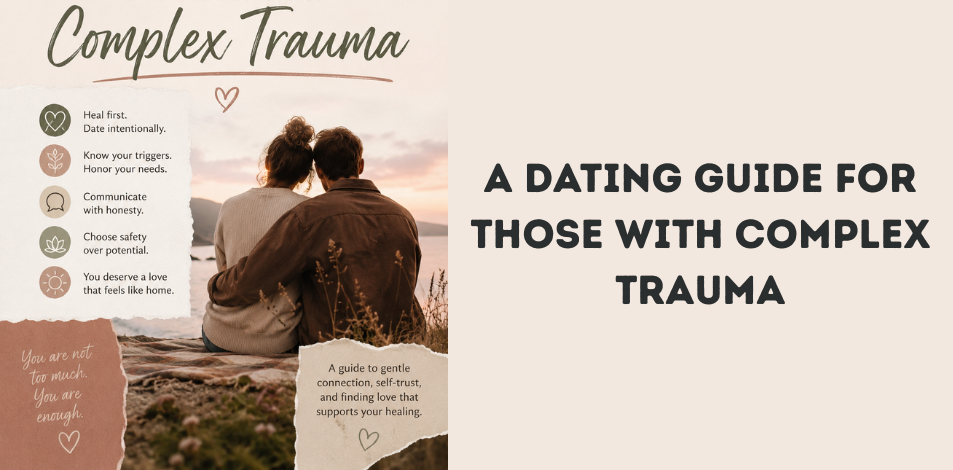
Here are some guidelines to keep in mind when dating someone with complex PTSD:
- You are not attracted to each other, but rather to each other’s traumas.
People who have experienced trauma have an innate attraction to one another. Not everyone who has experienced trauma, but those whose deep wounds resonate with the other person’s.
While trauma has predictable patterns, such as neglect, abandonment, abuse, shame, and humiliation, each person develops a unique combination of these elements. Complex trauma leads to a myriad of symptoms, including ADHD, developmental delays, temper tantrums, rigidity, immature thinking, insecure attachments, and more. These “flaws” make it difficult to form and maintain relationships with those who haven’t experienced trauma, who are often bewildered by the traumatized person’s behavior and worldview.
But life always finds a way. Evolution doesn’t exclude anyone. To help you on your healing journey, life will bring you closer to people who understand your pain and share your perspective. Therefore, we can say that our worst relationships play an evolutionary role.
Related : Having Empathy For a Parent Who Emotionally Abused You As a Child
Furthermore, people who have experienced trauma tend to live life to extremes; excessive enthusiasm can quickly turn into despair. “Ordinary” people rarely trigger the intensity of the trauma in the affected individual, which can make them seem dull.
Finally, people who have experienced trauma need to heal. This can only be achieved by activating and acknowledging the trauma. Often, your subconscious mind has already identified the perfect person to pull you out of your distractions and addictions, while simultaneously pushing you back into the depths of your wound.
However, no sane person would willingly embark on such a painful experience. To entice you to take this perilous journey, life tempts you with fantasies and promises of bliss.
- It’s not a perfect match; it’s merely an illusion and a projection of trauma.
Trauma is unbearable, and being with someone capable of triggering such trauma often guarantees the relationship’s demise before it has a chance to develop.
This is why people with complex trauma experience a kind of high, almost like a drug, during the initial, exhilarating months. While a “honeymoon period” is common in all new relationships, complex trauma imbues it with a strange, almost primal allure. You’ll explore the world together, overcome every challenge, and build a life like never before. You rarely realize how wild this fantasy is. Everything feels so real, so inevitable.
You might have doubts about your wild plans, but the surge of dopamine and serotonin in your body quickly dispels your fears. Enjoy this phase of the relationship; it helps you bond with your partner and lays the foundation for what’s to come.
It prepares you for the challenges ahead.
- Expect predators lurking in unexpected places and at unexpected times.
Complex trauma lies at the heart of all personality disorders. Cluster B disorders such as psychopathy, narcissism, borderline personality disorder, and histrionic personality disorder are very common. They are accompanied by codependency, paranoia, and detachment from reality. You may remain oblivious to this during the first few months of a relationship. Your partner sees only you, and their gaze is tender, warm, and loving.
But beneath this glittering surface lurks predators. Your partner may have a specific personality disorder, such as narcissism or borderline personality disorder. They may be a full-blown psychopath. In most cases, they may simply fall within the personality spectrum, exhibiting traits from various disorders.
While categorizing someone with a single diagnosis may offer some comfort, remember that complex PTSD is a combination of psychological wounds. Therefore, the resulting personality structure is unique. Your partner may be avoidant or emotionally anxious. They may be experiencing a subtype of antisocial personality disorder, where they only act violently and deceitfully when provoked in specific ways. At other times, they may be needy and loving, or fluctuate between warmth and coldness when expressing their borderline disorder. Their self-confidence may even increase in the presence of the narcissist. Anything is possible with complex trauma.
These “subtypes” can feel like predatory sea monsters, suddenly emerging from the calm waters of your relationship, terrifying and hurting you before sinking back into the depths, leaving you in shock and confusion for days or weeks. To make matters worse, your trauma is often triggered at such moments, making the experience even more destabilizing and painful. These events become more frequent as you move beyond the honeymoon phase, triggered in a variety of seemingly mysterious ways.
- Not everything that seems real is real.
Imagination has the power to cloud our perception of reality, and this is especially true for those suffering from complex trauma.
Those with complex post-traumatic stress disorder (PTSD) often experience a detachment from reality and a loss of memory. Because reality can seem too terrifying to bear after experiencing trauma, they may create an abstract image of their loved one and react to it instead of the real person. In this way, they ignore the real person and what they are going through. The idea is to create a “perfect” image in their minds that cannot harm them.
Those suffering from trauma also feel that something is wrong deep down. However, they want to feel normal and appear normal to others. This means they need to hide the truth and keep secrets. Furthermore, this detachment from reality often leads to a lack of awareness of the truth. Reality is a complex mix of events with gaps, so they fill these gaps with their imagination, believing in their illusions.
This situation leads to extremely damaging results in the relationship. Two people suffering from trauma are lost, unsure of who they are, who their lover is, or even what is real and what is not. As the illusion gradually fades, the relationship between these two traumatized individuals descends into chaos. This can lead to heated arguments, confusion, deception, betrayal, cheating, and even domestic violence. A relationship fueled by trauma can spiral into madness before tragically collapsing. It can devastate both lives, leading to re-trauma, financial ruin, job loss, the loss of friends or family, and much more.
- To Love or Not to Love?
With all this, it’s not surprising that those who have experienced complex and severe trauma might consider giving up on love. Why endure all that pain and suffering, only to end up destitute, depressed, or worse?
The short answer: Love is about embracing life. Giving up on love significantly hinders life.
Life wants you to heal, to gain clarity and self-knowledge, and to move forward as much as possible with what you have. That’s why it inevitably pushes us into these painful relationships. Life’s role, like a matchmaker, is to arrange things so you can pick up where you left off when the trauma occurred. We all learn something from our relationships, even when we’re drowning in them and being thrown out into a new traumatic experience.
For someone with trauma, every relationship gives them an important piece of the puzzle. It gives them opportunities for love, even if those opportunities are slim, even if that love is doomed to fail. Love is life. Unfortunately, the life of someone who has experienced trauma is one crushed by pain, and amidst this devastation, they are reborn, hoping for a better future.
The healing journey for someone who has experienced trauma is never over. The road ahead is arduous, and circumstances are often against them. Often, the solution may be to do everything possible before handing the reins to the next generation (if they choose to have children). But even without children, every step toward healing, every plunge into the depths of your wound followed by a small victory, will have a positive impact on all your relationships, even with those you know. Your healing makes the world a better place.
And best of all, every ounce of healing, every glimmer of hope and wisdom, will stay with you as you dare to love again, leading you once more to a potential hell, but also offering you an unprecedented opportunity to discover a more real and enduring form of paradise.