If you’ve ever been in a relationship with a narcissist, you know all too well how damaging their irresponsibility can be.
You’ll find yourself arguing over the smallest things, even defending yourself against accusations you know you never made! The slightest incident can drag you into a maze of confusion and anxiety.
The truth is, narcissists lack the capacity for self-reflection and accountability that healthy individuals do. Healthy people strive to improve themselves as much as they strive to nurture the dynamics of the relationship.
“The problem isn’t my behavior, it’s that you’re criticizing me!”
- The Narcissist
A narcissist isn’t interested in personal growth or self-improvement. All they want is for you to blindly follow their ridiculous, delusional fantasies.
Therefore, if anyone is going to change to meet the needs of another person, it will be you, never them. And so we end up surrendering ourselves more and more to the narcissist in a desperate attempt to improve things—an attempt that will never succeed.
Let’s explore what lies behind narcissism and why those with it lack the desire or resources to take responsibility in relationships.
Understanding Narcissism
A narcissist is so completely selfish that everyone around them is merely a tool to achieve their goals.
Narcissists often develop from trauma, frequently in childhood. Their circumstances left them with deep feelings of shame, rejection, and unworthiness, leading them to create a distorted version of themselves.
They subconsciously realized that enduring these intense negative feelings was neither safe nor comfortable. Therefore, they decided to eliminate the part of themselves responsible for their deepest emotions—their true selves.
By severing their connection with their true selves, all that remained was their ego. But this ego is not genuine; it’s merely a self-created illusion, a false self.
To maintain their ego, they need constant attention, affirmation, and approval, constantly repeating: “I am amazing. I am perfect. I am a god.”
Related : 14 Signs of a Narcissistic Friendship Cycle
The narcissist lives in a false reality, where they genuinely believe they are superior. Anything or anyone that dares to challenge their reality must be eliminated to protect their distorted world.
In truth, beneath their mask, they are still frightened children, suffering from stunted emotional maturity, afraid to return to their true selves. Because they refuse to acknowledge this broken inner child, their only option is to continue inflating their ego.
The ego is a harsh internal critic, so once it stops receiving validation from the outside world and the constant repetition of how “great” it is, it will immediately turn on the narcissist.
The Ego Whispers…
“Unless you’ve slept with five different people this week, you’re disgusting and undesirable.”
“If you haven’t earned a certain amount of money, you’re worthless and a failure.”
“If no one has seen you doing sexy things, you’re pathetic.”
…And so it goes.
You can understand why, in the world of a narcissist, it’s so crucial to avoid anything that might trigger feelings of shame, guilt, and unworthiness.
In other words, a narcissist’s lack of responsibility in relationships is a direct result of their constant need to bolster their illusion of perfection, to protect their fabricated reality.
If a narcissist were to take responsibility and admit any mistake during the relationship, even a minor one, it would directly threaten their existence.
You’re dealing with a ruthless individual who will stop at nothing to protect their false self.
It’s important to understand that when a narcissist disconnects from their true self, they also disconnect from the capacity to feel everything that makes us human. These feelings include empathy, compassion, kindness, and authenticity.
Their survival strategy relies on delusion and manipulation, and they completely lack the moral compass that would prevent them from caring about the impact on everyone else, without exception.
Narcissist Irresponsibility In Relationships
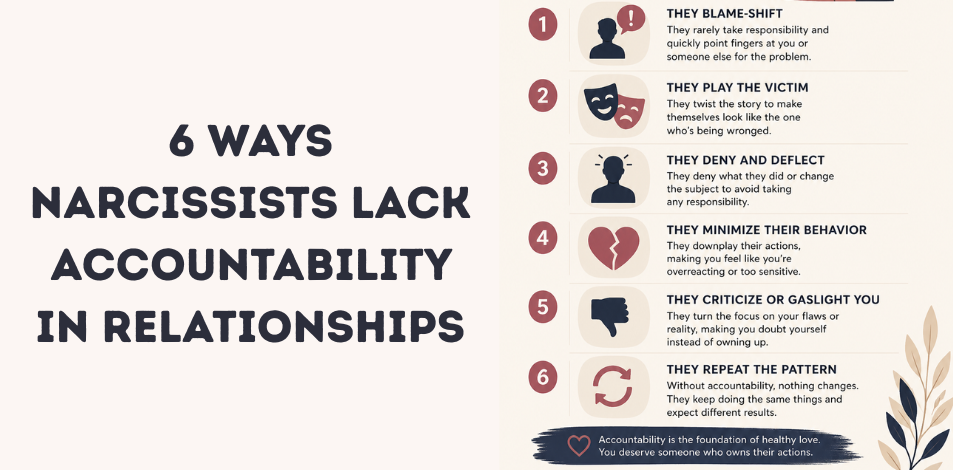
Narcissists completely evade responsibility in relationships in various ways, but they all serve one purpose: to deflect attention from themselves and blame you, no matter what.
You can present all the evidence you want, but it won’t change anything. If all other arguments fail with the narcissist, and they can’t deny their words or actions, they will play the victim to prove their innocence.
Here are some ways narcissists demonstrate their evasion of responsibility in relationships.
Projection
Projection is one of the most common methods narcissists use to avoid responsibility in relationships. Do you remember those times when a narcissist blamed you for their actions? That’s projection.
Related : Are Narcissists Afraid of Empaths? (Love vs. Fear)
You’re left wondering, how can they accuse you of doing something you know they just did? Your head spins, and you exhaust all your energy trying to defend yourself. You try to convince the narcissist that you’re a good person and that you would never do those things.
But their anger escalates as your self-esteem plummets.
Narcissists reveal their true intentions when they project their actions onto you. They will accuse you of the actions they are doing or about to do. To avoid feeling shame and guilt for their own actions, they will project them onto you.
Examples of projection:
“I know you’re cheating on me. Why were you so late yesterday?”
—When they are cheating or planning to cheat.
Examples of projection:
“I know you’re cheating on me. Why were you so late yesterday?”
—When they are cheating or planning to cheat.
“It’s all about you, isn’t it?”
—In those rare moments when it’s not about them.
“What have you been doing all week? This place is a complete mess.” – After they spent the whole week procrastinating.
“Why are you lying?”
– And they lie blatantly and repeatedly.
What actually happens when a narcissist projects themselves onto you is that they are projecting their reality onto you. In other words, they can’t allow any accusations to tarnish their fabricated image, so they quickly deflect them and throw them back at you.
Accepting responsibility means that the narcissist must admit their mistake and acknowledge that they are not perfect.
Taking responsibility means exposing the image the narcissist relies on to alleviate their inner pain. They need their fabricated image to manipulate people and give them what feeds their narcissism, which is like a drug for them.
So, when you try to force a narcissist to take responsibility for their actions, their ego immediately perceives you as a threat. The ego seeks to eliminate this perceived threat to protect itself and maintain its false sense of self.
The narcissist’s ego cannot bear any responsibility, so it blames you. Now, the narcissist actually sees you as the one who committed those heinous acts.
As absurd as this thinking is, there is no way to reason with a narcissist or convince them with logic (even if you have irrefutable evidence). They live in a distorted world and are incapable of seeing things from another perspective. Once they adopt their delusional version of “truth” and repeat it to enough listeners, it becomes the accepted truth in their world.
Blaming_Others_and_Accusations
Lacking responsibility in relationships, the narcissist will not only avoid personal accountability but will actively seek out anything to blame you for.
This tactic is used to deflect attention from themselves and fabricate a completely negative story about someone else.
You’ll be so preoccupied with defending yourself against their accusations, whether true or false, that you’ll completely forget the original issue.
Accusing you is also a great way for a narcissist to justify that everything they said and did was your fault, not theirs. It’s a complete evasion of responsibility.
Examples of blaming others:
“If you weren’t always so moody, I wouldn’t have to come home so late every night.”
← Meaning: “You’re the reason I work late or stay out late with my friends.”
“I wish you’d remind me of our anniversary.”
→ Meaning: “You’re the reason I forgot.”
“If you took better care of your appearance, maybe I’d pay more attention to you.”
→ Meaning: “You’re the reason I haven’t shown you love and affection.”
Psychological_Manipulation
Psychological manipulation is one of the most dangerous aspects of a relationship with a narcissist. The narcissist deliberately manipulates your reality to make you feel insecure and self-doubtful.
A narcissist’s resort to psychological manipulation stems directly from their lack of responsibility in relationships. They will deny things happened, claim your memory is faulty, and minimize your fears and feelings to make you feel self-pity or desperate.
The goal is to portray you as the troubled, unbalanced person, incapable of fulfilling their responsibilities. In short, you are the one at fault, the cause of the problem, and thus the narcissist avoids taking any responsibility.
You can take a psychological manipulation test if you are unsure whether you are experiencing this type of manipulation.
Examples of psychological manipulation to avoid responsibility:
“I never said that.”
“I never did that.”
“Your memory is terrible. It never happened like that.”
“You’re too sensitive. Just get over it.”
You’re making up all this nonsense.
This is the first time I’ve heard of it.
I don’t have time for your games.
Blocking And Punishing
Another common way narcissists avoid responsibility in relationships is by withholding from you as a form of punishment.
If you try to hold a narcissist accountable for something they’ve done, they’ll completely ignore you as punishment for daring to point out their flaw.
During my relationship with a narcissist, I regularly had to set my alarm every morning (much earlier than I needed to) just to make sure they woke up and went to work. One morning, after trying for over half an hour to wake him up, and after I’d prepared his lunch and coffee to encourage him to go out, he turned his back on me and said, “I told the manager I’m not going.”
Well, I was completely fed up. He never appreciated the effort I put into helping him every day. He was actually quite pleased that I woke up early and worked hard while he was lounging around. He exploited my fears about not having enough money to pay the bills in many ways. When I confronted him about his disrespectful behavior, he ignored me… for a week!
Related : 21 Stages of a Narcissist Relationship with an Empath
Seeing nothing wrong with his actions, he decided to punish me by cutting me off completely. Ironically, by the end of the week, I had nothing left to say to him, so I told him I was leaving. Unfortunately, he dragged me back into a cycle of guilt, and I was back in a cycle of suffering before I was finally able to break free from his abuse.
Narcissists resort to withholding everything you value to punish you for your “bad” behavior (anything that goes against their ego). This could be affection, intimacy, money, services, or communication—anything that gives them a means of controlling you.
Then, when the narcissist sees fit, they act “normal” as if nothing happened. You’ll feel very comfortable because everything seems fine, and you’ll likely go along with it and not even address the original problem, knowing it’s unsafe to do so in the first place.
Thus, the narcissist avoids taking responsibility, and no problem is solved.
Falsifying History
One of the most insidious tactics narcissists use to evade responsibility for their actions is to completely rewrite history.
They’ll tell you your memory or experience is wrong, then recount how it actually happened in a way that completely discredits you, all while serving their own interests.
They’ll fabricate their false narrative for others (friends, family, colleagues, etc.) so you can’t tell your side of the story. They’ll even distort the story in a way that makes you look even crazier if you try to refute their lies.
The more you try to defend yourself against a narcissist’s rewriting of history, the more likely they are to succeed. By directing all your energy toward them, you’re giving them an enormous amount of support, making them feel incredibly important and powerful.
They create conditions so that you can’t do anything to clear your name or tell the story any other way, and thus they win, while you lose. When a narcissist receives external validation from others that they are “right,” it greatly fuels their ego.
Playing The Victim
When all tricks fail, and the narcissist can’t deny being exposed, they resort to playing the victim. Playing the victim is the perfect way to evade responsibility because it boils down to: “But it’s not my fault. I’m just a victim of things beyond my control.”
This was my narcissistic ex-boyfriend’s favorite refuge when he couldn’t escape responsibility any other way. As a covert narcissist, he could feign tears at any moment. And being highly sensitive… I fell for his trick nine times out of ten. I even comforted him and reassured him that everything would be alright, “We’ll get through this together.”
Related : TRUTH: Can an Empath Be a Narcissist?
If I had known then what I know now, I would have realized that he was portraying himself as a victim to escape punishment, while simultaneously exploiting my sympathy against me.
You can’t reason with a big child in an adult’s body who genuinely believes you’re the one at fault for not fulfilling their every whim.
Will a narcissist ever take responsibility?
A narcissist will never take responsibility—that’s a given.
For a narcissist to take responsibility for the aspects of their personality that don’t feed their ego would mean taking off their mask.
They would have to stop lying, and they don’t know how yet.
They would have to completely abandon their false selves, which goes against their survival instinct.
They would have to admit to the world that they are not superior, arrogant, or special. This would mean admitting to everyone, and to themselves, that they are, in reality, just a scared, lonely little child who doesn’t know how to take care of themselves.
The entire facade of a narcissist is nothing but a fragile house of cards, built on nothing but lies and illusions. If one card were to fall, the whole thing would collapse.
Without their false selves, they wouldn’t be able to manipulate the life force of healthy beings with whom they still maintain a deep spiritual connection. Without their narcissistic supply, they would slip into a spiral of despair and misery, hiding behind their mask.
The narcissist protects their ego and avoids accountability until death, which is why narcissists get worse as they age. Their youthful charm, income, and other methods of draining their energy diminish as they grow older and weaker. Eventually, all that remains is themselves.
What does a narcissist really mean when they say “I’m sorry”?
While a narcissist’s irresponsibility in relationships is obvious, they may apologize occasionally. But a narcissist’s apology is nothing more than a sham.
Any love, kindness, or empathy you might feel from a narcissist is merely a ploy to achieve their goals.
What does a narcissist really mean when they apologize?
“I’m sorry I was exposed.”
“I’m sorry you’re so sensitive.”
“I’m sorry your actions drove me to do that.”
“I’m sorry I didn’t manipulate things more.” I’m sorry you feel this way.
You might be forgiven for believing a narcissist’s apology. You weren’t the first, and you won’t be the last.
After a 20-year marriage to a narcissist, I had to leave him and walk away from the relationship to clear my mind and see through his lies.
They’re so good at their game, and they’ve mastered feigning empathy (including tears). A narcissist can look you straight in the eye and offer a fake apology without batting an eye. They’re even said to be so good they can fool lie detector tests!
The only real apology is a change in behavior, and that’s when the narcissist completely collapses.
Why you shouldn’t try to hold a narcissist accountable?
If you express to a narcissist your desire for them to apologize or acknowledge the harm their behavior has caused you, you’re actually giving them more ammunition.
A narcissist needs to elicit a strong emotional response from you because that energy and attention feeds them into their narcissistic fantasies.
They enjoy watching you squirm. You shower him with attention while trying in vain to get him to admit his mistake and take responsibility. He feels incredibly powerful when he can block something you desperately want.
Moreover, a narcissist needs an external victim on whom to unleash all his frustrations. Arguing with him and trying to convince him to act like a mature person, as you thought, only gives him the opportunity to manipulate you psychologically, project your flaws onto him, blame others, and use all his other manipulative tactics.
The main goal of arguing with a narcissist is to drag you deeper and deeper into his cycle of abuse. The more you try to communicate with him constructively, the more insane the situation becomes. He will trap you in a spiral of vague statements, blame you for things that never happened, drag others into his agenda (even if it’s completely fabricated), and then attack you viciously.
The narcissist will exploit your need for accountability against you every single time.
You will reach a point where your well-being (emotional, psychological, and perhaps even…) becomes compromised. Even the physical aspect is severely threatened, forcing you to withdraw. The narcissist has completely drained you and broken you to a much worse place than you were in the beginning.
You just wanted a little appreciation, and now you’ve ended up with a host of additional abuse traumas added to your toll.
Reclaim Your Power
The best thing you can do when dealing with a narcissist’s irresponsibility in a relationship is simply to end it completely.
I understand your pain, your despair, and your sense of injustice, but listen to me.
I don’t mean you can just ignore everything and walk away peacefully. Unfortunately, after a relationship with a narcissist, you’ll be left with open, bleeding wounds.
The first step is recognizing that a narcissist is a narcissist and always will be. Educating yourself about narcissistic personality disorder is incredibly helpful in understanding their behavior.
However, don’t give in to despair without addressing the deep wounds that desperately need your attention.
The truth is, it’s time to take full responsibility for those inner parts of yourself that have been crying out for attention.
Narcissists are masters at identifying those deep wounds and dragging them out of your core. This is how they force you to surrender your precious vital energy.
But now, it’s time to confront those wounds and expel them from your body so they no longer control your beliefs and experiences here on Earth.
Once you begin working on yourself and become the source of your own love, appreciation, acceptance, and security, the narcissist will have nothing left to control you with. You will no longer fear them, and your harmony with yourself will expose their false illusions.
This is how you achieve all the accountability you’ve been seeking. You will radiate energy in a world of self-empowerment, something the narcissist can only dream of!