The relationship between a narcissist and an empath is a unique dynamic, where the dark and bright sides of human nature are drawn to each other like moths to a flame.
But it’s also one of the most toxic relationships one might have to endure.
Fortunately for the empath, there’s an opportunity to learn and grow after overcoming their ordeal; the narcissist, however, is destined to remain trapped in a cycle of self-destruction until death.
This raises the question: Do narcissists fear empaths? In short, yes, they may, especially when the empath reaches a certain stage in their development. Let’s delve deeper to discover why.
Narcissists and Empaths
Who is a Narcissist?
Narcissists often develop as a result of childhood trauma. This trauma might stem from neglect (physical or emotional), abuse, a traumatic event, or excessive flattery, leading to an unhealthy and inflated self-image.
This childhood trauma leaves them with deep feelings of shame and self-loathing, which are often overwhelming.
As a reaction to the trauma, they unconsciously decided to permanently sever their true selves, because these selves were the source of all their painful wounds.
The narcissist felt the need to completely amputate their trauma as a matter of psychological survival.
By severing their true selves, they also severed their connection with the Creator. It is through this connection that we can experience unconditional love, empathy, compassion, and kindness.
In other words, the narcissist severed their conscience.
The narcissist didn’t realize that they were replacing their true self with an empty black hole. Nor did they realize that this black hole would evoke even greater feelings of disgust and shame, because nothing authentic remained within them.
Related ; 21 Stages of a Narcissist Relationship with an Empath
The narcissist found no way to move forward in life except by allowing their ego to take control. Because the ego is nothing more than a “non-self,” subject to change at any moment, it understands that, for its survival, it needs to conceal the narcissist’s true nature from themselves: a fearful, weak, and flawed individual, devoid of any merit.
To achieve this, the ego weaves a false image of the self, based on perfection, superiority, and a near-divine quality. As the narcissist’s new master, the ego deceives them into believing that this false image is their reality.
To maintain this false image, the ego constructs a complete fantasy world. In the narcissist’s imaginary world, they are a god at the center of the universe, and everyone around them is merely a pawn to be manipulated, exploited, abused, and discarded at will.
For the narcissist, other living beings are nothing more than tools to be exploited and their resources drained.
The problem with this strategy is that their illusion is nothing but a deception created by the ego. Therefore, the only way for this delusion to remain real is to receive constant confirmation from the outside world of his perceived superiority, exceptionality, and worthiness. This is known as “narcissistic supply.”
Examples of narcissistic supply:
Seeking admiration and praise
Creating problems to feel powerful
Playing the victim to elicit sympathy and attention
Controlling and manipulating people
Sex
Fame and a bad reputation
Appearing successful financially, emotionally, professionally, and materially.
The narcissist maintains their delusion by seeking out sources to gratify their narcissism, much like a drug addict.
But if people knew that by enabling the narcissist, they are allowing their precious energy to be drained, they would never agree. So, like a devil in disguise, the narcissist must manipulate, coerce, and deceive people to get them to do so.
To ensure the narcissist’s psychological survival, their delusion must be constantly fed.
Without constant feedback from the world around them confirming that their false self and imaginary reality are “real,” this delusion will quickly begin to fade, leaving the narcissist to fall into their inner void. And the narcissist will stop at nothing to prevent this; they are a being without conscience.
Who is an Empath?
The defining characteristic of an empath is that they are born with a unique gift: the ability to feel the emotions of others as if they were their own.
Some empaths are also highly sensitive, possessing a highly sensitive nervous system. This means they can feel the pain of others as if it were their own.
Since empaths are capable of experiencing high levels of empathy, the natural consequence is a high degree of compassion for others.
Empaths can easily see beyond people’s words and appearances, naturally grasping their innermost feelings.
Empaths feel a desire to heal everyone or at least alleviate their pain. Because of their heightened awareness and sensitivity, they can easily become overly generous. Unconscious empaths are more prone to this because they haven’t yet learned that it’s not their responsibility to “fix” others and that not everyone has their best interests at heart.
Narcissists and manipulators will repeatedly exploit an empath’s empathy against them.
What an empath may not realize is that their desire to solve other people’s problems is often a way to alleviate their own emotional distress. This is especially common when an empath struggles to distinguish between their own energy and that of others.
Are Narcissists Afraid of Empaths?
When a Narcissist Loves an Empath
Narcissists love empaths intensely for their kindness and generosity. Not because they value these qualities, no, but because they can easily gain the empath’s trust and exploit their kindness to manipulate them, get them to do their bidding, and give them their resources.
The narcissist loves seeing their own false reflection in the empath’s kind eyes.
They love it when the empath believes and validates their false image.
They love what the empath offers them.
They love what the empath does for them.
They love how easily they connect with the empath’s vital energy.
They love how much the empath trusts them despite their deceit and lies.
And above all, they love it when the empath is there to serve them with unwavering loyalty.
They gain all of this from the unconscious empath who goes out of their way to be a good person and help others.
Once the relationship between a narcissist and a sympathizer develops, the sympathizer gradually begins to be abused by the narcissist, without realizing what is happening.
Over time, the sympathizer ends up living in a defensive state, constantly trying to either “fix” the narcissist or return to the way things were initially. They don’t understand why the narcissist is being so cruel now, when all they are trying to do is help them become a better person.
Related : TRUTH: Can an Empath Be a Narcissist?
The sympathizer constantly tries to appeal to the narcissist’s conscience, unaware that their own conscience was destroyed long ago.
The more the narcissist pushes them away with punishments, then pulls them closer for further abuse, the more the sympathizer gives up, hoping things will improve.
The narcissist enjoys being in control of the sympathizer’s emotions. They crave a constant source of positive energy, as well as someone willing to unload all their unhealed wounds onto them.
When the narcissist fears the sympathizer
The narcissist sits arrogantly on their throne of deceit, looking down on the empath.
Their vanity leads them to believe they have secured the empath’s loyalty for life (or until they are completely exhausted and can be discarded and replaced).
What the narcissist fails to realize is that the empath will eventually see through the narcissist’s lies.
This may only happen after years of being trapped in the cycle of abuse, time and time again. It may not even happen after the narcissist has abandoned the empath.
Sometimes, it might take a triggering event, orchestrated by the universe. But somehow, the empath awakens when they are fully ready.
For the empath, realizing that the entire relationship was nothing but a grand deception is devastating.
The most painful experience for the empath is realizing that the narcissist never loved them. They were simply exploiting them to drain their energy and resources.
The empath must accept that the narcissist has no conscience, that they are nothing more than a skilled manipulator who has deceived them for a long time.
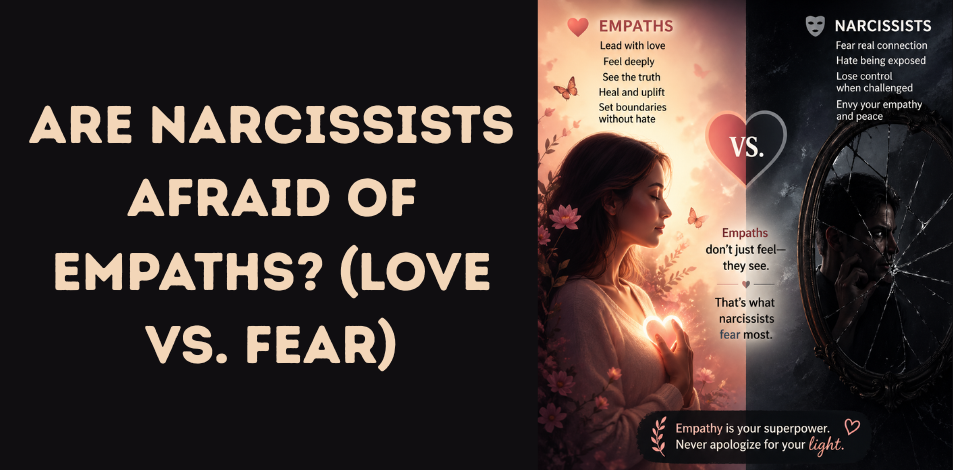
If you’re wondering, are narcissists afraid of empaths? The answer is yes. This is the crucial moment when the balance of power can shift.
As the empath tries to overcome the profound pain of being completely betrayed by the narcissist, this pain begins to fuel their justified anger. This anger gives them the strength to break free from the narcissist’s web of lies.
Once the empath can see beyond the fog they were living in, they can see the narcissist’s true nature through their mask, not the persona the narcissist had cultivated through manipulation and guilt—a manipulation that exploited the empath’s kindness and compassion.
Now, the empath feels pain and anger because their empathy has been used against them. They realize that no matter how much they love, it will never fix the narcissist.
Related : 17 Things to Expect After Dating a Narcissist
The empath embarks on a difficult journey to break free from the narcissist, enduring further abuse as the narcissist’s ego seeks to destroy them. The narcissist senses the empath’s growing strength and fears that the empath will shatter their fragile existence.
The narcissist is terrified of being publicly exposed by the empath, of having the truth revealed behind their mask.
Once the empath has drained all of the narcissist’s energy and cut off its source, the narcissist is gripped by intense fear. They have completely lost control over the empath and feel a shift when the empath sees through their facade.
As the empath now prioritizes channeling all that energy into healing their wounds, they grow stronger. Soon, the narcissist has no more wounds to exploit and reopen. Their arsenal is exhausted.
Without the empath’s wounds and blind trust, the narcissist has nothing left to control.
But what frightens the narcissist most about the empath is their honesty.
Narcissists are artificial beings, devoid of identity. They possess not a shred of authenticity, and this is something they cannot imitate or fake. Yet, this seems perfectly natural to the empath.
On a subconscious level, the narcissist knows that the genuineness of an empath is enough to expose and completely unmask them.
Darkness cannot hide in light.
Ultimately, narcissists fear empaths when they reach their full potential and rise to a level far beyond what the narcissists ever dreamed of.