If you find yourself dealing with a narcissist and researching the topic to learn more, you will undoubtedly encounter the term “narcissistic supply.”
So, what exactly is narcissistic supply?
Narcissistic supply is the energy a narcissist draws from the world around them (other people) to fill their emotional void. They lack access to the positive energy that emotionally healthy individuals possess, so they need to extract it from others. This comes in the form of admiration, attention, and arguments, as well as projecting an image of being successful, wealthy, and well-connected, as if they are living a perfect life.
Narcissistic supply is the reaction and emotions directed toward the narcissist, which they then use to feed their false self or ego.
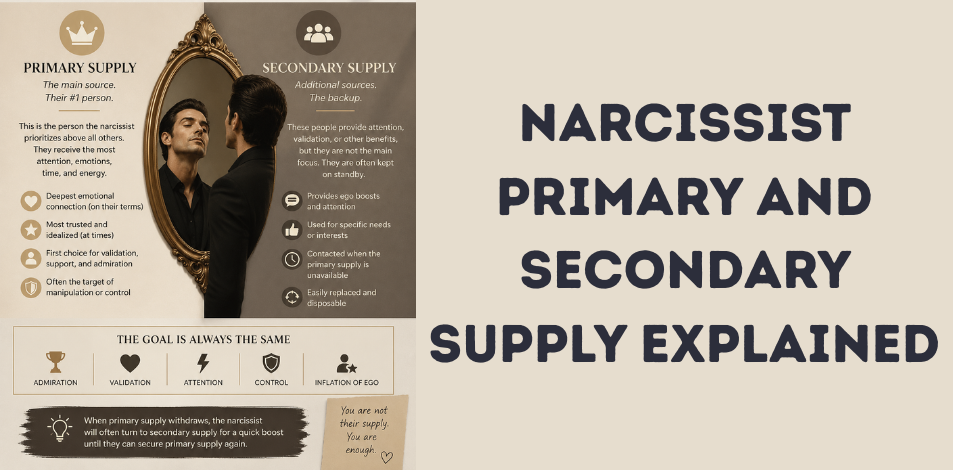
Interestingly, there are two types of narcissistic gratification: “primary gratification” and “secondary gratification.”
In short, primary narcissistic gratification comes from attention, while secondary narcissistic gratification is derived from appearances.
Let’s delve deeper into primary and secondary narcissistic gratification to explain how the narcissist works.
Definitions of Narcissistic Supply
Below are some of the different terms used in this article. Understanding them will help you get the most out of the information.
What is Narcissistic Supply?
Narcissistic supply is essentially a currency in the form of energy—the divine life force that flows through us all.
Emotionally healthy people have direct access to this divine life force from within. Narcissists, however, do not have this internal source of energy, meaning they are always thirsty for it and seek it in the external world.
Related : 6 Ways Narcissists Lack Accountability in Relationships
To quell their inner feelings of self-loathing and unworthiness, narcissists have to steal life force from others. Worryingly, the energy they absorb from others only temporarily alleviates these feelings. It’s like self-medicating with drugs, alcohol, shopping, or food. Before they know it, the inner emptiness returns, as it cannot be completely eliminated.
Narcissists are like a black hole that can never be filled; they represent a massive emotional void.
You are completely mistaken if you think you can “fix” or improve a narcissist. No one can fix someone who is incapable of helping themselves. The energy you expend on a narcissist is a complete waste; you will only emerge exhausted, and they will only find temporary relief.
Their lack of emotional and vital energy usually stems from a traumatic childhood, or a harsh event or circumstance that severed their connection to their true selves.
From a young age, this person unconsciously decided that if no one else would meet their needs, they would take matters into their own hands.
Narcissists are energy vampires who have learned that the only way to get what they want is to extract it from others. They know no other path and lack the empathy necessary to feel remorse or guilt for the impact of their actions on those around them.
They simply don’t care. They see life as a relentless struggle, and their sole concern is themselves.
How do narcissists get their narcissistic gratification?
There are hundreds of ways a narcissist can get gratified, but they all boil down to one thing: attention.
A narcissist presents a false image of themselves, which we call their mask. This mask is nothing more than a cover, a false identity they project to the world to obtain narcissistic gratification. The mask shows how they want to be seen, but it doesn’t reveal who they truly are.
It’s essentially a massive cover-up.
And let me tell you, they’re incredibly adept at hiding this mask when they need to. They practice it their entire lives.
However, maintaining the mask is extremely exhausting for a narcissist; so, it soon falls off.
When the mask falls, it’s difficult for our minds to accept that the person they’re unwittingly revealing is their true self, not the fabricated persona they’ve been using to deceive us. This is where cognitive dissonance comes in, which explains how narcissists manage to get away with it.
Read on to delve deeper into the primary and secondary sources of narcissistic gratification.
Basic Narcissistic Supply
Basic narcissistic supply is centered around attention. It doesn’t matter to the narcissist whether the attention they receive is positive or negative.
Any Attention = Narcissistic Supply
Attention can come in the form of endorsement, flattery, meddling, gossip, drama, arguments, etc.
Basic narcissistic supply usually comes from those closest to the narcissist (partners, children, close friends, etc.).
Here are some examples of basic narcissistic supply in the form of attention.
Admiration and Flattery
One of the most hypocritical experiences you can have with a narcissist is when they force you to praise them. Even if you’re not aware of the narcissistic dynamics at the time, you’ll inevitably feel the uncomfortable discomfort of forced flattery.
They are simply cornering you to feed their ego. They need admiration. They don’t care if it’s fake; after all, their entire existence is built on a false self.
At the beginning of a narcissistic relationship, during the “love bombardment” phase, you’ll notice that the narcissist showers their victim with excessive praise. It’s not that they’re offering genuine, heartfelt compliments (though some might initially think so), but simply because they expect similar compliments in return.
As the relationship develops, if you don’t shower them with compliments, they’ll punish and manipulate you until you reciprocate.
The narcissist needs compliments to maintain their self-esteem. Their self-confidence is so low that they would completely collapse without constant support and encouragement from others.
Arguments and Stirring Up Trouble
If there’s one thing a narcissist can’t stand, it’s a quiet, peaceful world. Sounds strange, doesn’t it?
When there’s peace and quiet and nothing to distract them from their inner selves, the narcissist will inevitably slip into a spiral of self-loathing and despair. The focus will be on their internal wounds and traumas, which they are forced to constantly deny in order to remain psychologically present in this world. This will lead to an internal explosion, because just thinking about confronting and feeling all of this is unbearable!
This is where the chaos and problems begin, which may appear suddenly and without warning.
To distract from their inner turmoil, they will create problems and chaos to drain their energy from those around them in the form of reactions.
They might provoke you and provoke you (which will make you angry) to elicit a reaction from you. My ex-husband used to constantly provoke me until I lost my temper, then claim I was crazy. He would involve the children in this “joke,” which is incredibly hurtful.
Narcissists often make hurtful comments or blame you for something without warning. Perhaps you sighed or gave them a look they perceive as odd, giving them the ammunition they need to start an argument. They might be walking down the street and trip, or someone might cut them off, which they take as a personal insult.
Related : 14 Signs of a Narcissistic Friendship Cycle
Before you know it, you find yourself a victim of psychological manipulation, caught in a vortex of their rambling words. You try to defend yourself against their baseless accusations, or you completely collapse from the intensity of the attack or from sheer exhaustion.
The purpose behind creating this drama is for the narcissist to feel important and powerful simply by being able to provoke and anger you. They need to feel in control of the world around them because they have no control over their inner world, which they constantly try to escape.
Now, anything you say, think, or feel as a result of the narcissist’s abuse will automatically feed their ego.
If you agree with them, it boosts and feeds their ego, which is what truly satisfies them.
If you disagree, they will escalate the argument and manipulate, constantly provoking you. Your provocation and resistance feed their ego, and they relish the experience.
You might end up giving in and letting them win, just to get it over with. Either way, you’re essentially feeding their ego.
Playing the Victim
Covered narcissists, in particular, love playing the victim. They are the ones who always seem to have some health problem, or an endless series of mishaps that keeps them perpetually in the role of the unfortunate victim.
When a narcissist plays the victim, they guarantee themselves an enormous amount of attention from sympathetic others who are willing to generously offer that attention.
This is one of the narcissists’ favorite strategies for manipulating empathetic people who struggle to maintain healthy boundaries. Narcissists use guilt and shame to keep people who are eager to please and give them their attention and energy.
Even on a grand scale, narcissists can derive gratification from the pity and kind words of others.
In addition to attention, playing the victim is a way for many narcissists to evade responsibility for their behavior. Whenever someone criticizes them, they immediately revert to the role of the pitiful victim. How dare you accuse them of anything wrong when they are in such a state of injustice!
Fame And Bad Reputation
Attention-seeking through fame or a bad reputation is a surefire way for a narcissist to gain gratification. And of course, fame comes in many forms.
Fame will provide a narcissist with a great deal of sustenance if they are talented or lucky enough to create it for themselves. It doesn’t matter whether what earns a narcissist fame is real or fabricated, as long as others believe it. What fuels them isn’t the act itself, but the energy (in the form of admiration, envy, or support) that flows to them from others as a result of that fame.
Examples of fame for a narcissist:
- Having a huge following on social media
- Success and promotion at work
- Owning a well-known business (even a local one)
- Leading a group or organization
- Appearing in the media due to a success or achievement
- Fame in social circles
- A prestigious reputation
- Receiving awards or recognition
- Being an actor, artist, musician, politician, or popular online content creator, etc.
Interestingly, even negative or bad fame is highly valued by them, as any attention is considered positive. In this case, they can create a rebellious persona, known as the “bad boy” or “bad girl,” which further inflates their ego, given their contempt for authority.
Control
Narcissists enjoy feeling powerful and are extremely domineering. They especially enjoy controlling others in their lives (partners, children, parents, neighbors, colleagues, and friends).
When a narcissist controls someone, it feeds their ego and reinforces their sense of self-importance, enabling them to exert control.
Control in relationships is an easy way for a narcissist to ensure they get what they want, when they want it. With a submissive partner, the narcissist knows they can easily manipulate them to achieve their selfish goals.
Related : 21 Stages of a Narcissist Relationship with an Empath
As mentioned earlier, when things are going well, the narcissist often explodes in anger for no apparent reason. They need to create problems to feel in control and reassert their power.
Ultimately, the narcissist feels completely out of control. Therefore, they feel a desperate need to control the world around them.
Sex
Yes, narcissists often use sex as a means to satisfy their desires. To achieve this, they resort to various manipulative tactics.
They might be so intimate that you feel a stronger bond with them, erasing any past abuse. This intimacy feeds the narcissist’s pleasure and reinforces their ego.
They might entice you one day, then withdraw the next, leaving you feeling insecure and confused. Then, when they return, you feel comforted and happy in their arms, thus satisfying their narcissistic desires.
The narcissist might want to hear you tell them how skilled and caring they are in the relationship. They will force you to say they are the best partner you’ve ever had.
Once you fall under their spell, they might withhold intimacy and affection as punishment. They might cheat on you or remind you of your past relationships to make you feel insecure. All these tactics evoke negative emotions, pushing you to submit to their demands.
But one thing is for sure: there is no such thing as “true love” with a narcissist. Even if they make you believe they are your soulmate and that you feel a deep connection, it’s just another way to drain your energy.
Narcissists are incapable of true love.