There are many examples of the blame-shifting tactics narcissists use to avoid taking responsibility for their bad behavior.
In short, blame-shifting is the act of shifting any blame directed at them back onto the person trying to express their concerns. Thus, the person originally being blamed avoids taking responsibility for their actions by directly blaming the “accused.”
The effects of blame-shifting in relationships are extremely damaging to self-esteem, identity, and the ability to make decisions confidently.
Blame-shifting is a malicious form of emotional abuse. Read on to learn more about how narcissists typically use blame-shifting to avoid taking responsibility for their words and actions.
What Is Narcissistic Blame-Shifting?
Blame-shifting is a manipulative tactic used by narcissists to shift any blame directed at them back onto the accused. By shifting the focus directly onto the other person, that person is immediately put in a position where they feel the need to defend themselves… even though they are the one being wronged in the first place.
Does it sound confusing? It does.
While blaming others may seem simple and malicious, the methods narcissists use to employ this manipulative tactic can be incredibly insidious.
Related ; Narcissist Gaslighting Checklist: 9 Obvious Signs
Blaming others can be a form of psychological manipulation, as narcissists possess a genuine talent for distorting reality to serve their own interests. This manipulation can cause the victim to question their own thoughts and memories of the incident, blurring the lines between truth and reality.
Narcissists will deliberately exploit your weaknesses and vulnerabilities, such as:
Your aversion to conflict
Your constant need to be a peacemaker
Your excessive empathy and compassion
Your dependence on them, whether materially or emotionally
Your low self-esteem
Your inability to make decisive decisions on your own
Your tendency to doubt your abilities
In short, the narcissist will portray you as the “victim” and the “perpetrator,” instead of the other way around. Initially, the narcissist will be the one at fault, but they will completely turn the tables on you.
Why do narcissists evade responsibility?
First, narcissists are self-absorbed. They see no problem with their selfishness and their treatment of others. They always see themselves as right, especially since they are highly competitive.
Reasons why narcissists evade responsibility:
Taking blame wounds their pride.
Avoiding responsibility.
The pursuit of power and control.
Reinforcing their false illusion of being “perfect.” A narcissist cannot accept a blow to their pride that exposes their mistake. It’s simply too much for them.
So, in an instant, they blame you. And if you’re not there to take the blame, they’ll blame the children, the dog, the world, or even God himself, before admitting their own fault.
It’s incredibly frustrating to watch this, and even more infuriating to be a part of it, because any rational, mature dialogue with a narcissist is impossible.
Imagine a tiny, inflated child trapped in an adult’s body.
Examples of Narcissists’ Attempts to Blame Others
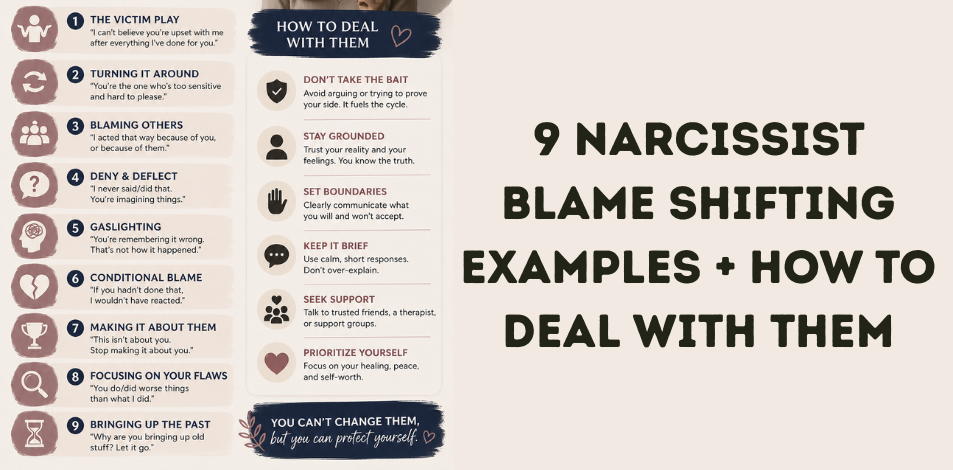
Refusal to Talk About the Past
Good luck trying to bring up anything from the past that the narcissist doesn’t want to take responsibility for. The past could be something that happened last year, last week, yesterday, or even this morning.
“Why do you insist on bringing up the past? You really need to move on. This is the main reason our relationship has deteriorated!”
In the narcissist’s world, you are effectively forgiven for everything that happened in the past simply by staying with them. Everything they did in the past is expected to stay in the past. You are only allowed to move on from now on.
Related : What Does a Trauma Bond with a Narcissist Look Like? (7 Stages)
But… when the narcissist wants to bring up things about you from the past, the rules are completely different.
If they want to manipulate you psychologically, they won’t hesitate to drag you into a vortex of past events, distorting them and throwing them back at you. Before you know it, you’ll find yourself trying to defend yourself against all sorts of things that shouldn’t even be problems in the first place.
Bringing Up the Past
Yes, I know this completely contradicts the previous point. But hey, this is the dynamic of a narcissist.
Narcissists are liars and hypocrites – “Do as I say, not as I do.”
If narcissists can bring up past events to blame you, they absolutely will.
If you accuse them of disrespect, they will immediately resort to a past event to smear you.
Let’s say you’re trying to tell a narcissist that you feel they aren’t listening to you properly. The narcissist will have three past examples of you not listening, ready to attack.
Whether their examples are real or fabricated doesn’t matter to the narcissist. As long as your confusion and need to defend yourself persist, as long as you continue to react, they will continue to receive support, inevitably feeding their false illusion of being perfect and infallible, always while blaming you.
Here, the narcissist often projects their own flaws onto you, making you responsible for much of what they do. They’ll keep you so confused that you won’t even remember what actually happened.
Portraying Themselves As Victims
A narcissist can easily shift blame from themselves to someone else by portraying themselves as a victim.
Here, they might feign extreme anger (crocodile tears) over perceived injustice, stigma, or unfair treatment.
The trick here is to manipulate the emotions of those around them, who will sympathize with their plight.
This narcissistic tactic of blaming others can be particularly effective in public settings, where the narcissist can accuse the other party. Most bystanders only see and hear what’s happening at that moment, so they often sympathize with the narcissist.
Since others are usually unaware of the details of the story or the manipulative tactics the narcissist employs, this can be traumatic for their victim, whose reputation is being publicly tarnished.
A similar incident happened to me with my ex-boyfriend, who told me in front of a group of our friends, “Shut up!”
I felt incredibly embarrassed, and all our mutual friends were shocked.
When I confronted him later and told him how humiliated I felt, he completely reversed his stance and pretended to be the victim.
Related : 4 Stages of Narcissistic Abuse + Cycle Chart
He said, “You felt humiliated? How do you think I did? You interrupted me in front of everyone!”
Honestly, I was completely baffled. How could he blame me for his own bad behavior? I was speechless. I was utterly shocked. Besides, I don’t even remember interrupting him. He completely turned the tables to serve his own interests.
I’m asking you to leave if you don’t like his behavior
Another tactic narcissists use to shift blame is to make you feel responsible for not liking their behavior.
Narcissists are extremely arrogant and automatically believe they have the right to act however they please. They don’t care about the impact of their actions on those around them. If you don’t like their behavior, that’s not their problem… it’s yours!
“I’m who I am. If you don’t like it, the door is open.”
For a narcissist, it’s not their fault you’re overly sensitive or don’t take a joke well. It’s regardless of how disrespectful, hurtful, and incredibly selfish they are.
Honestly, when a narcissist says, “If you don’t like it, leave,” we should all believe them and walk away immediately.
But the problem lies in our insecurities and inner wounds, which the narcissist knows all too well and enjoys manipulating.
Our inner fears, honed and aggravated throughout the narcissistic relationship, are what keep us trapped. Low self-esteem, fear of loneliness, the inability to support ourselves without them… the list goes on.
Take Control Of Your Relationships
A narcissist’s ego is like a fragile eggshell, easily broken at any moment. To protect his ego, he spends his life constructing false illusions about himself, which he then projects onto the world.
Those close to the narcissist will glimpse his true self through his dazzling facade. But he must manipulate these people, making them doubt their own reality so they cannot distinguish between truth and falsehood. This confusion protects the narcissist from discovering his true inner self—a frightened child, filled with deep shame and self-loathing.
Since their delusion is entirely built on fabricated stories of grandeur and perfection, they can’t stand the thought of anyone hearing their true, hidden side.
The narcissist’s game here is to try to reach others before you can. This way, they can tell their fictional version of events, which will ultimately make them the victim and you the perpetrator.
They will target mutual friends, family, colleagues—anyone who listens to their fabricated stories.
It’s important to remember that those who truly know you will support you, no matter what stories the narcissist makes up.
Self Manipulation
One of the most common tactics narcissists use to shift blame onto others is psychological manipulation. Psychological manipulation involves the narcissist making their victim doubt their own reality through subtle, manipulative methods.
Common psychological manipulation techniques:
Contradicting your memory of events
Denying conversations and facts
Blocking communication, love, and affection
Minimizing your feelings and fears
You can see in the example below how they can quickly shift attention away from themselves and directly back to the person blaming them. They take no responsibility for their role, blaming someone else and completely absolving themselves of any responsibility.
Examples of psychological manipulation by narcissists:
“You’re crazy. I never did that. I think you need help.”
“You know your memory is bad. I never said that.”
“It’s not my problem that you’re overly sensitive.”
“I don’t have time for your games.”
“If you hadn’t provoked me in the first place, I wouldn’t be in this mess.”
“You’re the one with the problem, not me.”
Guilt
Covered narcissists, in particular, are masters of guilt. They can shed tears over the smallest things if it will affect their victim’s feelings and absolve them of responsibility.
Although narcissists appear devoid of emotion towards others, they are actually the most sensitive people on earth! Any perceived slight is enough to send them into a rage.
When my ex-boyfriend crossed the line and couldn’t deny his actions, he would curl up on the bed, tears streaming down his face. Because I’m an empathetic and dependent person, this opened my heart, and I found myself comforting him while he played the victim and shirked responsibility for his behavior.
Before I realized it, he was completely blaming others, saying things like, “I don’t know why I do that, it’s like something’s controlling me.” I felt incredibly guilty towards him. Instead of focusing on his bad behavior, I felt sorry for him.
Guilt = Emotional Blackmail
I know another subtle narcissist who is adept at manipulating the emotions of those around her, constantly making them feel sorry for her. Therefore, she shirks all responsibility and makes anyone who tries to push her to do otherwise feel guilty.
I’m blaming you
Accusing others is the quickest way for a narcissist to shift blame. In no time, the focus shifts from the narcissist to the other person.
Examples of narcissistic accusations used to shift blame:
“If you cared more about me, I wouldn’t have had to cheat on you.”
“You invaded my privacy by looking at my phone”—after noticing suspicious text messages.
“I would have gotten you a birthday present if you hadn’t done that yesterday.”
“If you had done what I asked, I wouldn’t have had to yell at you.”
The narcissist needs to make it seem like the entire situation is the other person’s fault. If they had obeyed or not done something they didn’t like, the narcissist wouldn’t have acted that way.
A narcissist’s “love” is entirely conditional on you behaving exactly as they expect.
The narcissist takes no responsibility for their own reactions; they place all the blame on the other person.