
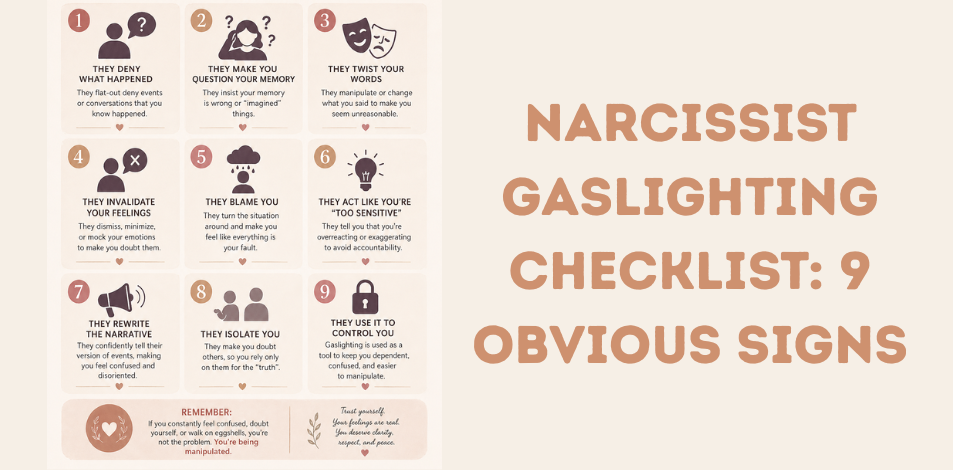
Psychological manipulation is the most common method used by narcissists and manipulators to harm their victims psychologically.
The goal of psychological manipulation is to confuse and exhaust the victim, causing them to lose self-confidence and become malleable in the narcissist’s hands. The narcissist can then twist events to suit their purposes and evade any responsibility for their reprehensible behavior.
When a narcissist engages in psychological manipulation, they portray themselves as either a hero or a victim (whichever suits their purpose). It’s all about feeding their distorted view of reality, where they believe themselves to be perfect, superior, and without flaws.
This narcissistic manipulation checklist will help you accurately identify the person you are dealing with, enabling you to educate yourself and protect yourself from their harm.
Narcissistic Manipulation Signs List
Here are some common signs of narcissistic manipulation to watch for when trying to distinguish between narcissistic and normal behavior.
Confronting Your Memory
Confrontation occurs when a narcissist vehemently disputes the details of events that took place.
When someone consistently contradicts your account of events or conversations, you begin to question your memory and reality. You start wondering if there’s something wrong with you or your mental state, because it seems to be repeating itself over and over again.
Related : What Does a Trauma Bond with a Narcissist Look Like? (7 Stages)
The narcissist is so confident in their version of events that they may sometimes exaggerate specific details. The result is that they can easily manipulate you psychologically into believing that their memory is correct, while yours is incorrect.
Examples Of Confrontation:
“Your memory is terrible.”
“It never happened that way.”
“You’re imagining things.”
“My memory is perfect.”
“You’re always daydreaming.”
Denying Conversations And Events
Deniing is when a narcissist denies entire conversations, events, and details.
They will claim that you’re making things up and that they never said or did that. No matter how clear your memory is, or how much evidence you provide to support it, a narcissist will deny everything.
With persistent denial, your confidence in your judgment and memory gradually erodes. The narcissist can more easily manipulate events to suit their agenda.
Denial is at the heart of narcissistic personality disorder. Their false self-image and delusional reality are built on distorting the truth and denying anything that contradicts their idealized self-image.
Examples of denial:
“I never said that. You’re making that up.”
“That never happened.”
“I wasn’t there.”
“I never did that.”
“This is the first time I’ve heard of it.”
Blocking_of_Communication_and_Emotion
Blocking is a narcissist’s deliberate withholding of communication, affection, or services as a form of punishment.
The most common form of narcissistic blocking is complete ignoring. The narcissist refuses to engage in any conversation with you or completely ignores your existence as a person.
This technique plays a key role in creating a painful bond. Here, the narcissist programs their victim to be an obedient servant through intermittent punishments and rewards.
Related ! 4 Stages of Narcissistic Abuse + Cycle Chart
Each time the narcissist punishes their victim (deprives them of something), the victim enters a state of extreme anxiety. The victim only feels relief when the narcissist rewards them (restores what was taken away). You can read more about painful bonds below.
Examples of Ignoring:
Completely ignoring them
Turning away when you try to communicate with them
Slamming doors
Leaving the conversation mid-conversation so you don’t get a chance to express your point of view
Disappearing for hours or even days at a time
Ignoring Your Feelings
The next step in a narcissist’s list of psychological manipulation tactics is ignoring your feelings. Here, the narcissist completely ignores and belittles your feelings or fears, even though they are entirely valid.
The primary tactic behind a narcissist ignoring your feelings is to minimize you and emphasize that your feelings and fears are unimportant. The narcissist needs to program your mind to believe that the only important person in the room is them, not you. This is a malicious way to reinforce their delusion of superiority.
Examples of Belittling Others:
“Oh my god, you’re so sensitive!”
“It was just a joke. Get over it.”
“Why do you always make a mountain out of a molehill?”
“There’s nothing wrong with you, stop clinging to other people.”
“You’re always playing the victim, aren’t you?”
Deflecting the Focus
Deflecting the focus is when a narcissist changes the subject and blames you or someone else to avoid taking responsibility.
Narcissists are masters at shifting the focus, either to themselves or away from themselves, whichever suits them best at the moment. When it comes to psychological manipulation or getting away with it, they can deflect attention from themselves in the blink of an eye.
If you start pointing out something the narcissist has done, they’ll accuse you of the very same things they do before you’ve even finished your sentence.
Related : 10 Types of Narcissists Explained
They’ll then drag you into a maze of side issues until you’re so far removed from the original topic that you won’t even remember what you were talking about. You’ll be so busy trying to defend yourself against the narcissist’s baseless accusations and past grievances that you’ll be completely exhausted and admit defeat.
Examples of Deflection:
“Why are you being so defensive?”
“If you hadn’t made me so angry, I wouldn’t have had to insult you.”
“I’m not arguing, I’m just having a discussion.”
“So, now you’re accusing me of lying?”
Because you’re perfect, right! What about the time you did…?
Lying To Change The Circumstance
Narcissists are pathological liars, meaning they lie compulsively to gain sympathy or social status, and to protect the delusions of grandeur and superiority that control their false selves. In addition, narcissists lie to psychologically manipulate their victims, so they can change the course of events and influence their mental state.
Examples of Lying:
Exaggerating their achievements and successes
Feigning love to push your boundaries
Lying about details to avoid punishment
Lying about details to destabilize your reality and memory
Falsely portraying themselves as either heroes or victims
Generalizations to Belittle
Generalization is when a narcissist uses stereotypes and broad statements to belittle others. They might say things like, “All women are the same!”
When a narcissist categorizes you and belittles you because of it, they are questioning your humanity.
They blame an entire culture, gender, belief, or even a false assumption about you as a way to diminish you. And because you’ll likely remain part of that minority or category, there’s no way you can regain your standing in the narcissist’s eyes, no matter how much you protest or present evidence to the contrary.
Generalization can also work in reverse, with the narcissist reinforcing and perpetuating their false image by attributing positive qualities to others.
Examples of Generalization:
“All men/women are the same.”
“You have problems with intimacy.”
“That’s because I’m a great parent/partner/employee.”
“Everyone agrees with me.”
“You’d be nothing without me.”
Exploiting Your Wounds
The most dangerous tactic narcissists use to control their victims is exploiting their weaknesses. This is clear evidence that narcissism is a key element of psychological manipulation.
Anyone who cares about you and has a conscience wouldn’t intentionally hurt you. A narcissist, however, would do so daily.
A narcissist discovers your deep emotional wounds early on and exploits them at the perfect moment to control you.
Examples of exploiting emotional wounds:
A narcissist knows you desperately want children, but every time you refuse their demands, they threaten you with a vasectomy or say you’ll be a terrible parent.
A narcissist knows your father abandoned you when you were young, so whenever they need to regain control, they resort to the “I’ll leave then” tactic.
A narcissist is aware of your lack of confidence in a particular hobby, yet they make derogatory “jokes” to further intimidate you.
This manipulative technique is used to undermine your self-confidence and control you by exploiting your fears against you. In reality, the narcissist gives you an ultimatum: either do what they want, or they will make your worst fears a reality.
Playing The Poor One
In the world of a narcissist, there are only two roles you can play.
The first is “facilitator,” where you go along with the narcissist’s distorted reality without question. This role reflects the narcissist’s belief that they are superior, amazing, perfect, and deserving.
If you don’t master the first role, you will be forced to play the second, “perpetrator.” Here, the narcissist, in their distorted self-image, sees you as the one committing all the bad deeds, while they are the poor victim at their cruel hands.
Yes, the narcissist truly believes that you are the abuser if you don’t play along with their delusion.
The easiest way for narcissists to control these roles is by psychologically manipulating you to convince you that they are the poor victim, if not the hero.
In other words, if a narcissist is humiliated in any way (real or imagined) or if someone tries to hold them accountable for their behavior, they lose their ability to play the “hero.” So, the narcissist immediately transforms into the “victim” as a way to evade responsibility.
The narcissist stages an exaggerated display of pity to elicit sympathy from their victims. Through this, they can distort the story, evade accountability, and garner a massive amount of attention (narcissistic sustenance). Meanwhile, you find yourself forced to apologize for something you’re absolutely certain you never did. Ten points for the narcissist.
How to Deal with a Manipulative Narcissist
If you’re absolutely certain you’re dealing with a narcissist after reviewing the list of narcissistic manipulation signs, it’s time to prepare yourself with a plan.
Don’t Try to Convince Them
No matter how tempting it may be, don’t fall into the trap of trying to convince the narcissist or make them understand the devastating consequences of their actions.
The narcissist is fully aware of what they’re doing, but their lack of conscience means they simply don’t care.
Related : 6 Ways Narcissists Lack Accountability in Relationships
Anyone with narcissistic personality disorder will suffer for life. They’ll spend their days seeking attention and validation to support their false self and delusions. If you try to show evidence to the contrary, they will try to destroy you at any cost. It doesn’t matter who you are (family, friend, or partner); you will become their number one enemy.
Avoid_Falling_into_the_Trap
Now that you understand what the narcissist does and why they do it, you need to start practicing distance.
Don’t fall into the narcissist’s trap by trying to defend yourself, apologizing for something you didn’t do, or even engaging in lengthy conversations. Keep your interactions with them brief, kind, and objective.
If the narcissist starts attacking you with anger, accusations, and manipulation, make excuses to withdraw whenever possible.
The narcissist will begin to lose control when they realize they are losing their power over you.
Be strong and remind yourself that the narcissist is not your responsibility. They are an adult responsible for themselves.
Seek Support
One of the most prominent signs of psychological manipulation is a loss of self-awareness and a detachment from reality.
It is important to find someone you trust and can talk openly with about the psychological manipulation. Having someone outside the fog of abuse will be invaluable in gaining a healthy perspective on reality and the narcissist.
Support could come from a close friend or family member who is not connected to the narcissist in any way. It could be a therapist or even an online community that understands what you are going through.
Plan To Escape
While you must accept that this is the narcissist’s personality, it doesn’t mean you should become an outlet for their emotions anymore.
The only way to deal with a manipulative narcissist is to completely distance yourself and remove them from your life. While this isn’t always possible, having a plan for it will benefit you.
If you’re dealing with a narcissistic colleague or partner, you may first need to stabilize your financial situation so you can withdraw safely. Remember to document everything and plan your departure calmly.
If you’re concerned about your physical safety or the safety of others, don’t hesitate to seek help from the authorities or bring a support person with you.
SelfCare And Recovery
Once your physical situation is stable, it’s time to focus on your recovery.
The narcissist has worked slowly and subtly to undermine your self-confidence, self-worth, and even your ability to trust yourself. Self-care isn’t just nice; it’s essential for calming and regulating your nervous system.
After experiencing abuse and suffering from severe anxiety fluctuations, it’s not surprising that you might experience adrenal fatigue, depression, complex post-traumatic stress disorder, and other health problems.
Find some daily self-care rituals that nourish your soul, boost your self-confidence, and bring you peace after all this turmoil.
Once you catch your breath, you’ll also need to prioritize the deep healing of your inner wounds. Remember, the narcissist exploited those fears and insecurities to manipulate you in the first place.
The recovery journey can be a long and beautiful process where you are eventually able to rebuild yourself, regain your strength, and never fall prey to narcissistic behavior again.