Narcissistic abuse can occur in any type of relationship with a narcissist, whether it’s with a parent or caregiver, a coworker or manager, a friend, sibling, or romantic partner.
Often, we don’t even realize we’re dealing with a narcissist because the ups and downs of the relationship can be overwhelming.
In our society, the term “abuse” is still often used to refer only to physical abuse. However, there’s a growing awareness of the devastating psychological trauma caused by other forms of abuse, such as psychological, mental, and emotional abuse.
Fortunately, the term “narcissism” is becoming more widely used and understood, and it goes beyond simply being about vanity. People with high levels of narcissism are often not diagnosed with narcissistic personality disorder, which is incredibly damaging to those around them.
Any relationship with a narcissist is a turbulent and challenging journey, and certainly not a pleasant one!
In this article, we examine narcissism in detail, discuss its four stages, and review the narcissistic abuse cycle diagram.
What is Narcissism?
First, it’s important to understand how narcissists develop, which will help you understand their way of thinking more clearly.
How do narcissists develop?
No one is born a narcissist. Rather, this personality develops at a young age as a result of a painful experience or specific circumstances.
On a subconscious level, they decide that to survive in this world, they must repress their emotions because they are too painful and make them vulnerable. Spiritually, they destroy their true selves, leaving only their egocentric selves.
Related : 10 Types of Narcissists Explained
The following are the functions of the true self and the egocentric self:
The true self: kindness, empathy, compassion, authenticity, living according to truth, and direct communication with the divine life force.
The egocentric self: materialism, selfishness, greed, criticism, judgment, manipulation, a constant need for praise and approval, rigidity, and a sense of superiority.
When a narcissist severs their authentic self, they also sever their capacity for empathy and compassion towards others, depriving themselves of access to their true nature and essence.
Because all that remains is the ego, they live their lives driven by greed, judgment, manipulation, and selfishness. They are indifferent to the needs of others and unconcerned with them. Their sense of superiority makes them feel above everyone else.
One of the saddest aspects of the narcissist’s personality is that they will never experience love in this life. The ego cannot feel love; only the authentic self is capable of it.
Please understand that a narcissist, incapable of feeling true, unconditional love, is incapable of loving you or anyone else. Therefore, their love is highly conditional… because it isn’t true love.
The narcissist has become an empty vessel, with no way to access the life-giving energy from our Creator (whoever that Creator may be to you).
Now, the only way for them to access this energy is to steal it from others. Having lost all empathy and compassion, they no longer have a conscience. They will do as they please and take whatever they want from others.
Narcissists are energy vampires.
They are like wolves in sheep’s clothing, devils in disguise.
Deep down, a narcissist feels nothing but contempt, shame, and self-loathing. Their egos cannot bear to feel these gloomy shadows, so they spend their lives searching for an outlet from these inner feelings.
They are like drug addicts constantly seeking their next fix, even though the relief it provides is only temporary.
This narcissistic supply they deplete is called the “narcissistic supply.”
What is a Narcissistic Supply?
A narcissistic supply is the energy narcissists draw from the world around them. This energy feeds their ego and gives them a sense of satisfaction, which alleviates their profound emptiness.
Remember, a narcissistic supply only provides temporary comfort, so they’ll be back for more before you know it.
Nothing can permanently fill a narcissist’s void. You can’t fix them.
Trying to save or fix a narcissist will only damage your soul. They’ll drain all your resources with a smile, then move on to their next victim. They have no capacity for remorse for the harm they leave in their wake.
How do narcissists get their supply?
Admiration and flattery
Argumentation and creating problems
Fame and a bad reputation
Control and manipulation
Sex
Having the “perfect” partner and/or family
Acquiring material possessions
Appearing successful
Appearing financially stable
Narcissists don’t care if their desires and demands are met by force, as long as they get what they want. They don’t care if others resent them or if their giving is insincere.
Since authenticity has been lost in the narcissist for years, giving and receiving honestly means nothing to them.
What are the common traits of a narcissist?
Okay, now that you understand some of how narcissists develop and why they need to feed their insatiable ego, let’s look at the common traits of a narcissist.
Common traits of a narcissistic personality include:
Extreme selfishness
Egoism
Lack of empathy
A strong need for validation and admiration
Manipulation
Exploitation of others
A sense of entitlement
An inflated sense of superiority
Envy of others and the belief that they are envious of others
Delusions of power and intelligence
Stages of Narcissistic Abuse
The next piece of the puzzle is the stages of narcissistic abuse.
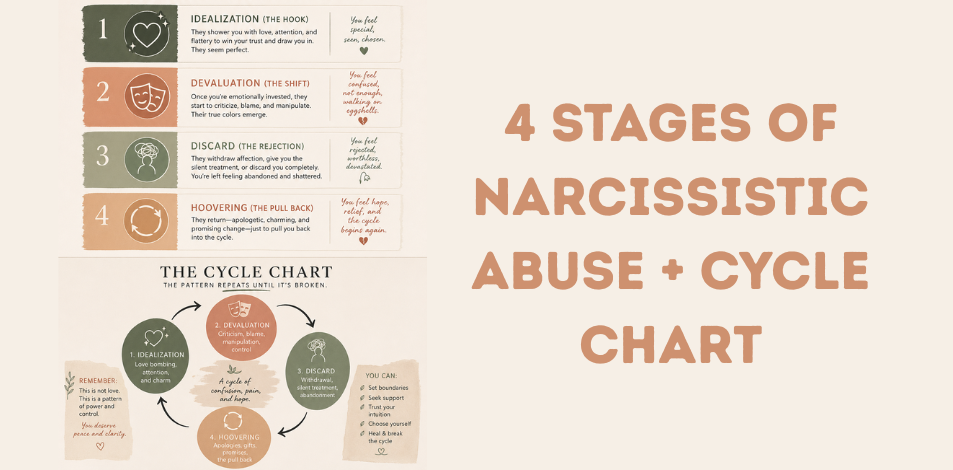
Looking at the narcissistic abuse cycle diagram below, you’ll notice that this vicious cycle repeats itself over and over again in all of the narcissist’s relationships.
Narcissists move from person to person, exploiting them and then discarding them as if they were yesterday’s trash, or bringing them back to repeat the cycle.
Related : 12 Traits of a Narcissist (A Destructive Fantasy)
It’s important to understand that narcissists don’t view relationships the same way healthy people do.
While a healthy person values honesty, teamwork, unconditional love, and respect, narcissists only value what they can get to satisfy their selfish needs. The other person is unimportant to them and can easily be replaced by someone more submissive and obedient at any time.
At this stage, the narcissist becomes a flawed individual who sees life only through the lens of “survival of the fittest.” For them, life is a merciless world.
Therefore, narcissists approach relationships through manipulation, as illustrated in the narcissistic abuse cycle diagram above.
The various stages of the narcissistic abuse cycle work together to keep you confused and in a volatile, push-and-pull relationship. You’ll find yourself questioning your own reality and completely ensnared in the narcissist’s web. And that’s exactly what they want.
Stage 1: Glorification
The glorification stage of narcissistic abuse is often referred to as the “love bombardment” stage. This glorification occurs at the very beginning of a relationship or friendship with the narcissist.
This is essentially a complete honeymoon phase where the narcissist truly believes they’ve found the perfect person (the source) and will place you on a pedestal.
The adoration phase with a narcissist can be incredibly seductive. They can be incredibly generous and attentive. You’ll feel like this person truly sees you, which will make you open up and share many of your dreams, desires, fears, and hopes.
What you might experience during the love bombardment phase:
Gifts
Luxury meals and extravagant experiences
Attention and admiration
Compliments and praise
Sharing stories
Sympathy
False promises (i.e., fabricating the future)
Without your knowledge, the narcissist studies you and encourages you to share as much information as possible.
In this way, they uncover your deepest psychological wounds to later use to provoke, manipulate, and ignore your vulnerabilities.
Undoubtedly, everything you say to the narcissist can be used against you in the future.
During the adoration phase, narcissists mimic the other person, making them believe they share the same interests, hobbies, beliefs, and so on. Adoration is another way to attract the other person, making them believe that “this is our destiny” or “we must be soulmates.”
People are often disappointed later when they realize it was all a charade. The narcissist never shared your interests or beliefs.
Stage Two: The Incident
Because the adoration phase is so intense, it becomes unsustainable.
There will inevitably come a time when you disappoint the narcissist or fail to meet their unrealistic expectations. No one can—it’s impossible, because deep down, they are never truly happy, and nothing ever satisfies them.
The next stage of narcissistic abuse is an incident that changes everything in an instant.
You might have a general idea of what the incident was, but more often than not, you won’t even know what happened to trigger this dramatic shift in the narcissist’s behavior.
Examples of incidents:
You disagree with him/her
You set boundaries
The narcissist gets bored with you
The narcissist looks for a “better” source of inspiration
You begin to see through the narcissist’s games
The narcissist starts to resent everything he/she did for you during the “love bombardment” phase
He/She feels you’re drifting away and needs to lure you back
You feel drained and like you have nothing left to offer
Things are too quiet (narcissists need drama to drain their energy)
You hurt the narcissist
Narcissists are extremely fragile beings, and this is what their mask hides and protects them from the world. They feel deep shame and utterly despise their inner selves, and they will stop at nothing to ensure no one can see their true nature.
It doesn’t take much to trigger a narcissistic wound in a narcissist.
This wound will trigger an immediate reaction from the narcissist, who will project all their pain and shame onto those around them or onto whoever caused the wound.
Since you don’t know what these triggers are, it’s like walking through uncharted territory riddled with landmines. You don’t know when you’ll step on one, you can’t avoid them forever, and when you do, the explosion is deafening!
Related : Narcissist Primary and Secondary Supply Explained
Narcissists lack the ability (or desire) to pause for a moment, reflect on themselves, and examine their wounds. It’s too painful for them. They prefer to unload them on the outside world rather than take responsibility for their problems.
Inevitably, this leads to the next stage of narcissistic abuse—deprecation.
Stage Three: Deprecation
You probably understand by now what I mean by narcissists’ tendency to punish ordinary people simply for questioning their authority and disobeying them.
They are also adept at tearing others down to bolster their own position. In other words, crushing others’ self-confidence is a way for them to feel powerful and self-satisfied.
The “love bombardment” phase aims to gain your trust, learn your vulnerabilities (your fears, insecurities, traumas), and lure you into their trap.
Now comes the “belittling” phase of narcissistic abuse. This is where many warning signs begin to appear, but we often ignore and justify them because of the false image we were presented with during the glorification phase.
Furthermore, at this stage, we have usually invested a lot in the friendship or relationship, making it difficult to sacrifice what we’ve invested by acknowledging that something is wrong.
We have internalized the image of the narcissist as generous, charming, and caring, not as the cruel, energy-hungry person they actually are. This is known as cognitive dissonance.
Once the friendship or relationship settles into a certain pattern, the narcissist begins to belittle the other person. This often happens subtly, making it difficult to notice. These insults might be disguised as “jokes” or inserted into “kind” words to mask their true meaning.
Belittling others is also evident in the narcissist’s behavior and how they treat you. Remember, actions speak louder than words.
Forms of belittling others:
Belittling, insults, and harsh criticism
Psychological manipulation
Rejection
Anger
Withholding affection, emotional intimacy, and physical closeness
Complete ignoring, disappearing, and the silent treatment
Blaming others
Disrespecting others and their possessions
Lying and manipulation
Why do narcissists belittle others?
The narcissist is a prisoner of their ego, which derives its power from projecting its inner wounds and pain onto the external world. The ego is unaware of itself and shows no interest in acknowledging its traumas or taking responsibility for healing them.
The ego’s words…
“You have to take away my pain.”
“You must obey my every whim.”
“You must fill my void.”
“You are required to meet my unrealistic expectations.”
“…and if you fail, I will punish you.”
But since these wounds are still there and constantly torment the narcissist, they project them onto you as if they were your own, not theirs.
Then…the narcissist tries to erase those wounds you now bear, which is why you end up becoming the target of their attacks. The narcissist lives in a delusion that makes them genuinely believe you are the one committing all the acts they project onto you, and then accuse you of them.
It’s sick and twisted, which is why extreme narcissism is considered a personality disorder. It goes far beyond someone telling a few white lies. For the narcissist, their madness is an absolute reality…they are unaware that they suffer from a mental disorder.
Stage Four (Part One): Abandonment
The next stage of narcissistic abuse is abandonment.
As you can see, because narcissists lack empathy and compassion, they don’t see others in a healthy light. To them, people are simply tools to be used and discarded when they’re done.
I know how painful it is, and it’s hard to believe that someone who claimed to care about you could see you this way, especially since they showed you love and kindness at various times.
It’s natural to take it personally, to feel like you’re the one at fault, or that you did something wrong that provoked this cruel behavior.
In reality, a narcissist’s abandonment of you has nothing to do with you; it’s entirely about them.
You see, you were only drawn into their inner circle to serve them and feed their narcissism. It’s that simple.
Narcissists expect the world to see them as wonderful beings, and they genuinely believe it. So, in their eyes, you must be incredibly lucky to have spent time with them! Once you stop serving them the way they expect, they’ll discard you and replace you with someone else they deem perfect. It’s no different than replacing a dead battery with a new one.
Narcissists see people as objects, not as independent, living, breathing beings.
Remember, narcissists see themselves as perfect and irresponsible, so they won’t even realize that being discarded has something to do with them. So, to add insult to injury, they not only throw you away but also blame you for everything that happens. You’re the one to blame for things failing or ending badly; it’s never their fault.
How a Narcissist Abandons You:
They completely ignore you or suddenly leave.
They start a fight and then blame you.
They introduce their new victim to you.
They launch a smear campaign against you.
They publicly humiliate you.
They become aggressive (physically, verbally, psychologically, and emotionally).
They drain you financially and emotionally.
Stage Four (Part Two): The Attempt at Possession
The final stage that a narcissist may or may not use in their vicious cycle of narcissistic abuse is the attempt at possession.
If you look at a diagram of the narcissistic abuse cycle, you’ll see that the final stage can be either abandonment or an attempt at possession, depending on whether the narcissist still believes they can exploit you further.
Related : 6 Ways Narcissists Lack Accountability in Relationships
Ultimately, once a narcissist has used a victim, they consider them their property forever, even if they’ve been completely used up and discarded.
Sometimes, a narcissist ends the relationship permanently, and that’s the end of it. But more often than not, he’ll try to win back many of his old relationships at some point. If he sees that you can meet his needs in any way, he’ll want you under his control, ready to leave at any moment.
If you’re in a relationship with a narcissist, after he’s inflated your ego, abused you, and then abandoned you, he’ll try to win you back when he senses you’re slipping away.
Then the cycle of narcissistic abuse begins anew, and the painful bond grows stronger over time (more on painful bonds later).
It’s also worth noting that, in the eyes of a narcissist, if you allow him back into your life after he’s abused you, you’re implicitly condoning all his previous toxic behaviors. You can’t bring yourself to confront him again, and you can be sure that the abuse will become more severe and intense each time he crosses more of your boundaries.
I can remember my twenty-year relationship with my secretive narcissistic ex-boyfriend, and see how he would push me to the brink of collapse, where I was completely broken… and then pull me back in. Things would get better for a short while (a few days, maybe a few weeks), then things would go back to being “normal”.
How does a narcissist lure you back?
Narcissists like to have multiple sources of support at any given time. They are known for maintaining constant contact with ex-partners, whom they consider potential backup plans.
Narcissists like to keep many people around them for various reasons. They might need to borrow money or find a place to stay, or they might need someone to confide in to so they can get something to feed their ego.
Ultimately, at this stage, the narcissist knows you very well and will know exactly which manipulative tactics will work on you. The first tactic is to exploit your feelings and emotions to win you back. The second tactic is to force you back through intimidation, psychological manipulation, and belittling you.
Examples of how narcissists manipulate people:
Sudden contact
Feigning remorse
Making false promises
Pretending nothing happened
Using an important occasion as an excuse to contact someone
Giving gifts or money
Proclaiming their eternal love (even though they didn’t when you were together)
Playing the victim
Provoking you through others
Starting to shower you with love again
Urgently asking for your help
Accusing you of something to elicit a reaction
Trauma Bond
When a narcissist repeats the cycle of abuse with someone over and over again, a trauma bond forms. Over time, the victim becomes so accustomed to the toxic behavior that it seems normal.
This is why outsiders often wonder, “Why do they stay with them?”
The narcissist simply alternates between abusive behaviors and positive experiences. When the abuser punishes you and then rewards you with what you need to feel better after their abuse, the bond between them and the victim deepens.
You find yourself searching for the love and appreciation you so desperately crave, even though they are the ones who withhold it.
When a narcissist withholds their love, affection, time, and energy, they are punishing you. And when they give you back a little, you feel a profound sense of relief, as if everything is alright, to the point that your body confuses the feeling of “relief” with “love.”
You become addicted to the cycle of abuse.
Over time, those gestures they give you gradually diminish until what you need to feel “relief” is so meager it’s heartbreaking.
A person in a painful attachment feels an excessive loyalty to the person who continues to hurt them. This attachment makes them feel trapped and unable to break free from the narcissist and the abuse. In fact, it can be difficult for them to even recognize that they are being abused.
Breaking The Riot Of Narcissistic Abuse
Recognizing that narcissists are masters of manipulation and know your deepest fears and vulnerabilities, they never make “getting out” clear or accessible in any way.
The first step to breaking free from the narcissistic abuse cycle is recognizing that the relationship or friendship is toxic and acknowledging it. I completely understand how difficult this is. I was trapped in this cycle for two decades before I was able to escape!
Once you recognize your need to break free, it’s important to develop a plan and seek support if possible. If you are in a relationship with a narcissist and planning to end it, be prepared to face their terrifying reality.
Make sure you have your own money to start a new life, and ensure you have a place to move or live after the breakup.
After you physically separate from the narcissist, you will face a profound recovery journey.
Realizing the true nature of the person you were dealing with is a huge shock! You thought they were someone who genuinely loved and cared for you, but now you’ve learned they are incapable of love.
You thought you were going to build a life together, but now you realize that all the narcissist planned was to drain your energy.
No Contact
If you can cut off all contact with the narcissist, I strongly advise you to make it your priority. Cutting off contact means absolutely no communication whatsoever, and you shouldn’t accept any contact from them.
It might be difficult at first, especially if the narcissist tries to push your new boundaries. They don’t like boundaries, and they certainly won’t expect you to set them.
But stand your ground. Eventually, the narcissist will get tired of you and look for another victim, if they don’t already have one.
Limited Contact
If you have children, shared property, or a business, cutting off contact completely might not be possible. In this case, I recommend limiting your contact with the narcissist.
This means minimizing contact as much as possible, and I strongly recommend sticking to emails or text messages.
Phone calls should not be written down if necessary. The narcissist will also use these conversations to draw you into vague talk, distract you, and gather information about you.
Make sure communication is limited to essential facts only, and don’t deviate from them. The narcissist will undoubtedly try to draw you into side conversations (feigning kindness) or make accusations against you. Don’t give in; stick to the bare facts, and that’s it.
Set Boundaries
If the narcissist in your life is someone you find difficult to distance yourself from, that’s okay; I understand. Sometimes narcissism manifests in family members, coworkers, or even mutual friends, which can make things much more difficult.
You need to set clear boundaries and tell the narcissist what you will no longer tolerate.
A clear boundary might be: “If you continue to belittle me, I will leave, and we will have to continue this conversation later.” Then, when the narcissist belittles you (which they inevitably will), walk away or hang up to firmly enforce your boundaries.
If you are strong inside, it won’t be long before the narcissist realizes you are serious and will stop treating you with contempt.
“Playing cool” is another useful tactic if you have to see the narcissist occasionally. This means being as bland and cold as possible (like a gray rock). This way, the narcissist will get bored with you and move on to someone else.
Heal Yourself And Be Free
The only true way to end narcissistic abuse permanently is to heal your inner wounds.
Unless you work on healing yourself, you will continue to seek love, appreciation, and security outside yourself. These are the things narcissists exploit to use you as a source of power.
The only way I found to heal successfully during my journey was through energy healing with Selena Hill. As a spiritual medium, she has access to healing and information far beyond what I could ever have in this life.
Honestly, I tried talking about it and reliving the abuse, and I tried to deal with it on my own. I even researched narcissism extensively in an attempt to heal my deep trauma. None of it worked. On the contrary, my PTSD worsened day by day, and panic attacks began to completely overwhelm me.
I was desperate and realized I had to try something, so I took a tip from an acquaintance and booked an appointment with Selena (an energy healer). Through her, I was able to release the deep wound that had been trapped inside me. The process is much faster than traditional therapy, and I experienced significant improvement after each session.
If this doesn’t work for you, seek out a qualified therapist who specializes in narcissism and make regular sessions a priority for your healing.