Have you ever had the miserable experience of caring for a sick narcissist? I sympathize; I know how difficult it can be!
So, let’s talk about how narcissists behave when they’re sick. There are many contributing factors, depending on the type of narcissist you’re dealing with, but they all serve one purpose: to feed their narcissism.
Narcissists need this feed like a vampire needs blood. In fact, feeding their narcissism is their lifeblood—their very blood.
A narcissist will exploit illness or ailment to the fullest extent possible, and even beyond!
Narcissists draw their lifeblood from others by seeking attention. Any attention is good because it reinforces their delusion of being superior, special, and perfect.
Because attention is so important to narcissists, it’s key to understanding their behavior when they’re sick.
Let’s explore this further.
How Do Narcissists Behave When They Are Sick
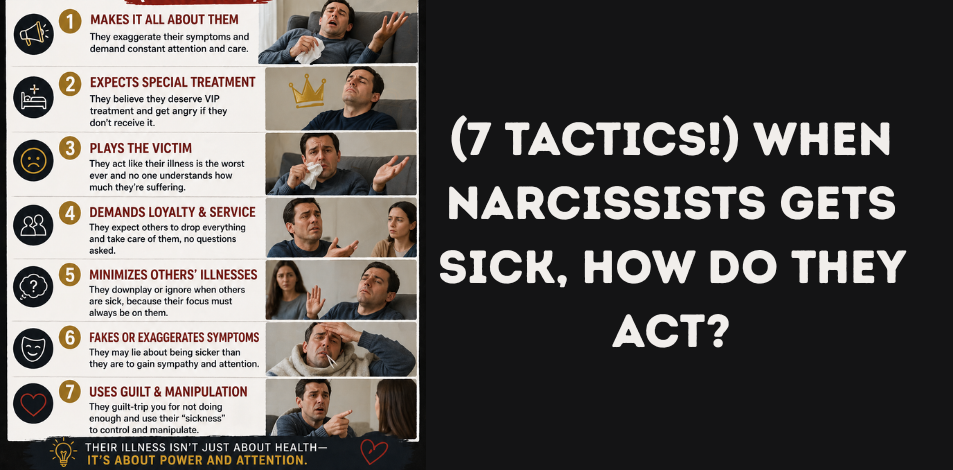
Playing the Victim
In the narcissist’s distorted view of reality, they are the center of the universe, around whom everything revolves. But as we know, there are billions of people on this planet, not just them. It’s unrealistic and delusional to believe that everything revolves around one person.
Related : Why Are Narcissists So Stingy with Money? (10 Reasons)
To ensure that everything continues to revolve around them, the narcissist needs to create situations that keep them constantly in the spotlight. They must remain at the center of attention to garner a continuous flow of attention.
So, how do narcissists behave when they are sick?
They play the victim with all their might. They exploit their illness or ailment to elicit sympathy from others, creating a huge fuss about themselves.
“I feel so tired and can’t sleep at night. This is making me feel down all day. But don’t worry about me, I know you have your own life to live…”
They say this while trembling, tears welling in their eyes, expecting you to stay with them all day.
Hidden narcissists are always sick, and they often use passive-aggressive tactics to manipulate those around them without explicitly asking for what they want. This way, if you give in to their whims and talk about them in the future, they’ll tell you, “I never asked you to.”
But if you don’t give in to the hidden narcissist, they will punish you in a roundabout way, insisting that your needs are unimportant and that you should always put them first.
It’s emotional blackmail, plain and simple.
When a narcissist plays the victim, they specifically target those around them who are highly empathetic. They then exploit this empathy to drain their energy through the attention they receive.
Act Of Complete Superiority
Narcissists suffer from a superiority complex even at their best. Looking at their behavior during their illness reveals their absolute sense of entitlement and their belief that they are more important than everyone else.
They might suddenly become experts on their illness, lecturing everyone about it, believing themselves to be “the most knowledgeable.”
They will exploit their illness to elevate themselves above everyone else, now part of an elite club of “survivors,” or believing they are exceptionally superior for having gone through this ordeal.
The narcissist will cling to the description of the illness and use it as part of their (false) identity to place themselves above the rest of humanity.
Use It For Manipulation
Another tactic narcissists resort to when they are ill is blatant manipulation of those around them.
They will deliberately make anyone feel guilty if they don’t respond quickly to their demands. They will severely shame anyone who doesn’t give them enough attention or try to meet their special needs. Caring for yourself doesn’t benefit the narcissist, so they will disregard your needs or desires while they are ill.
Never, under any circumstances, suggest that they are getting better or that they aren’t as ill as they claim.
Even if a narcissist is feigning illness, they will perceive it as a personal attack if confronted. Even if that was never your intention, what matters is how they interpret your comment. They will likely punish you for it.
“How dare you suggest I’m not so sick! The doctor said I need at least seven days of bed rest. But of course, you think you know better than the doctor.”
An Excuse To Avoid Responsibility
Let’s be honest, it must be difficult to pretend to be charming, caring, or tolerant all the time when that’s not who you truly are.
As a narcissist ages, their charm fades, and their resources (which they use to attract attention) begin to dwindle. Therefore, it becomes increasingly difficult for them to maintain their facade.
The same applies to narcissists when they are ill. They use their pain or symptoms as an excuse for their abusive and disrespectful behavior toward others.
They may lash out at their caregivers for no apparent reason. Then, if confronted about their behavior, they’ll say, “I’m just hurting, don’t take it personally.”
In fact, a narcissist might blame you for their behavior, even though you’re only trying to help. They might accuse you of not caring enough, or they’ll pressure you repeatedly, and then when you finally snap, they’ll accuse you of being rude.
In a narcissist’s world, they can’t take responsibility for any of their flaws or negative behaviors because that would mean admitting they aren’t as perfect as they think they are.
When a narcissist falls ill, they use it as an excuse for their many narcissistic traits, rather than taking responsibility for their words and actions.
A_Way_to_Gain_Sympathy
Narcissists enjoy being ill because it allows them to elicit sympathy from those around them.
Sympathy equals attention, which gives them the energy to feed their false egos.
Narcissists exploit their illness or ailment to elicit sympathy at home and in public.
They use social media to post self-pitying messages, receiving a dopamine rush with every interaction, like, and comment. Social media is an inexhaustible source of attention, and narcissists use it as a playground to obtain sympathy.
When a narcissist receives sympathy, they remain the center of attention, while others pretend to care about their well-being. This inflates their ego and reinforces their belief in their importance and specialness, justifying all the attention and care they receive.
An Excuse for Special Treatment
As a result of their superiority complex, narcissists expect special treatment when they are sick. Their ego deludes them into thinking they are gods deserving of reverence from everyone around them.
This manifests in them demanding that certain people perform specific tasks for them, or expecting others to do their simple chores under the pretext of being “too sick.”
A narcissist might call you from across the house just to ask you to hand them a bottle of water (you’ve seen this before!).
They’ll leave their plate on the table for you to take to the sink, or ask you to hand them the remote control, even though it’s right there in their hand! They’ll request a special blanket with their favorite meal for dinner, even if they know you can’t cook or provide it.
We could go on listing their ridiculous demands, but the bottom line is that if you refuse, they will belittle and humiliate you simply for saying “no.”
They genuinely believe they are superior to you, and that your refusal of any of their expectations is an insult on your part.
An Excuse for Laziness
Narcissists can be incredibly lazy whenever they want, especially covert ones. But nothing pleases narcissists more than having their followers play behind their backs while they relax and enjoy themselves.
They don’t want to exert any effort, even in the best of times, so a narcissist’s behavior when sick is simply to sit idly by.
They won’t hesitate to berate you, tell you what to do, or manipulate others into giving them attention and support. They enjoy not having to bother with housework, which, frankly, is beneath them anyway. They’re happy for their partner to do all the cooking, cleaning, childcare, pet care, etc., while they feign illness.
Dealing with a lazy narcissist who’s become even lazier because of illness can be extremely difficult. If you give them too much leeway, they’ll make it the new normal, even after they’ve recovered. They will undoubtedly invent or exaggerate a new illness just to keep pretending to be sick.
I know a woman who is a subtle narcissist and has maintained a cycle of illness for years, all to keep her husband “taking care of” her, constantly hounding her. She literally lurchs from one health problem to another, remaining the victim while he remains in the role of “slave.”
She is also the laziest woman I have ever met. If her husband asks her why she doesn’t do anything for herself, she insults him, which quickly brings him back to his senses.
Narcissists use illness as an excuse for utter inactivity.
4 Types of Pathological Narcissists
Interestingly, pathological narcissists aren’t all the same. Their methods of exploiting their illness to gain attention and support vary depending on each individual’s personality.
Here are four types of pathological narcissists I’ve observed:
The Hypochondria cal
The hypochondria cal is the narcissist who constantly feigns illness and exaggerates their reaction to even the slightest ailment.
If their hand itches, they’ll Google a strange illness they believe they caught at the supermarket yesterday.
Perhaps they have a minor ankle ache, but an hour later they rush to the doctor’s office, desperately trying to secure a last-minute appointment to find out what they’re “suffering from.”
Hypochondria cal narcissists are those who love to evade responsibility for themselves by blaming everything, big and small, on things beyond their control.
Related : 3 Signs the Narcissist is Preparing to Discard You
Hypochondria cal narcissists are typically introverted and lack the self-confidence to step out and project an image of importance to garner attention and support. Their surest way to get the attention they need to validate their importance is to constantly feign illness and play the victim.
The Expert
How does a narcissist behave when they are sick and believe they are an expert on everything?
They will blame the nurse for being incompetent.
They will blame the receptionist for scheduling the wrong appointment.
They will seek five different opinions from five different doctors because none of them know what they are talking about.
The expert narcissist will research their illness or ailment and suddenly believe they know everything about it. They will want to lecture everyone who will listen, further amplifying their sense of superiority.
The Competitor
Then there is the competitive narcissist, who must be the absolute winner in everything related to their illness.
He will boast that his doctor is the best in his field because he accepts nothing less than the best.
If the narcissist receives a wrong diagnosis, he will claim that his condition is far worse than everyone else’s. Even in matters of health, the narcissist must be the best!
For a narcissist, everything is a competition they must always win.
In another scenario, if the narcissist’s illness resulted from an accident or circumstance, they will claim that this circumstance was the most severe, or that they overcame the greatest obstacles on their recovery journey.
This narcissist, with their false sense of self, cannot accept that they are not the best or the greatest, otherwise their entire fabricated existence would be called into question, something they will never allow to happen.
The Negative Narcissist
Finally, there is the nitpicking narcissist. This is the person who makes everyone around them feel inadequate.
The narcissist will criticize those they care for for being slow, for the food not being hot enough, for the pillows being too soft, or for the room being too hot.
Related : 9 Narcissist Blame Shifting Examples + How to Deal With Them
Although the nitpicking narcissist refuses to do anything for themselves or to be a responsible adult, they will project their own inner flaws onto others.
No matter what you do, a narcissist will never be satisfied.
The nitpicky narcissist is filled with unhealed wounds that he refuses to acknowledge. Yet, his ego still needs to heal these wounds so they don’t disrupt his illusion of being special and perfect. Therefore, he projects these wounds onto those who try to help and care for him when he’s sick or hurt.
How to Deal with a Pathological Narcissist
Remember that a narcissist’s behavior reflects their personality, not yours. It’s essential to set healthy boundaries for yourself when assessing how to deal with a pathological narcissist.
You can empathize with their situation without giving in to their whims. If they accuse you of being bad and immoral for not agreeing with their agenda, you have every right to set your limits.
If they continue to mistreat you, you have every right to leave and let them go (regardless of who they are).
Example of a response to verbal abuse from a narcissist:
“If you continue to insult or belittle me, I will leave.”
Example of an appropriate response if the narcissist is exploiting you and imposing many conditions:
“I really want to help you, but I can only do what I can. After that, you have to see what you can do yourself or ask someone else for help.”
An example of a suitable response if a narcissist is emotionally blackmailing you by making you feel guilty:
“I’m sorry for what you’re going through. I’ll help as much as I can, but I need to make sure I’m okay first.”
How Does a Narcissist Treat You When You’re Sick?
Have you ever wondered how a narcissist treats you when you’re the one who’s sick instead of them? The surprising thing is, they don’t care! They won’t be there for you or support you when you need them most.
Those marriage vows you made, “for better or for worse…”, don’t apply to a relationship with a narcissist.