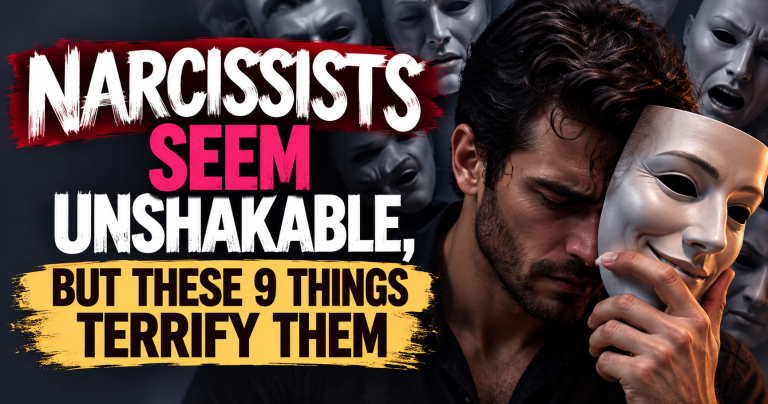
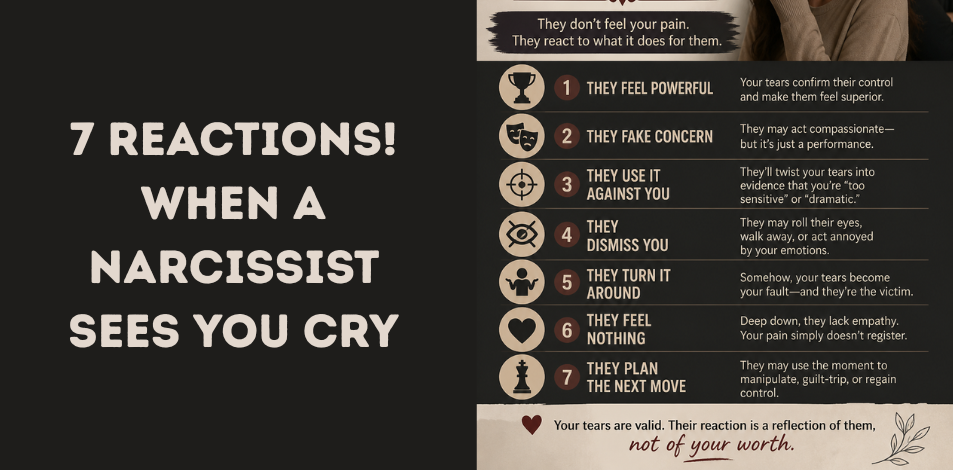
When a narcissist sees you cry, don’t expect any empathy. Instead, they’ll attack you with anger, indifference, silence, blame, projection, punishment, and psychological manipulation.
Narcissists lack the capacity for genuine empathy, kindness, and compassion; therefore, seeing you cry is a significant burden for them. This is especially true if the cause of your tears is someone else or a situation that doesn’t benefit the narcissist.
You’re not only draining their energy, but you also want them to give you even five minutes of their time? That’s not going to happen. Your sole purpose is to serve the narcissist, so don’t bother asking for a moment of their time when you need them most.
On the other hand, a narcissist enjoys seeing you cry if they are the cause of your tears. It’s all about power and control for them, and making you cry confirms their own strength and importance.
What’s Behind Narcissism?
Due to childhood traumas, the narcissist has long since severed their true self.
Despite maintaining contact with his true self, he was forced to feel everything he hated inside. Rejection, abandonment, and an utter sense of unworthiness were his deepest wounds.
His psyche simply couldn’t accept that he was an imperfect human being, like all of us. So, unconsciously, he abandoned his true self by refusing to acknowledge his pain and trauma.
Related : How Do Narcissists Treat Old Supply? (9 Tactics)
All that remained was his ego, which created a false self to protect him from the truth he utterly denied. In his false world, he was special and superior to everyone else, a complete contradiction of his inner reality.
The biggest problem with their false selves is that they are a fabricated reality, not a genuine one. Therefore, for this false reality to become clear to the narcissist, they constantly need confirmation from the outside world that their reality is “real.”
The narcissist keeps this false illusion inflated by seeking attention. Any attention (positive or negative) is welcome, because it confirms their existence.
This attention feeds their ego in a way that suggests: “I must be someone very important and powerful to receive all this attention and feedback from those around me.”
What lies behind this attention is life energy.
When the narcissist severs their connection with their true self, they also sever their access to divine life energy, which we can all access at any time.
In place of their former true self lies a dark void. The only way for the narcissist to escape this spiral of despair is to keep trying to fill it with life energy.
But since they don’t possess life energy of their own, they are forced to draw it from others.
Of course, no sane person would surrender their precious life energy to a dark soul incapable of filling its own emptiness. Therefore, the narcissist resorts to manipulating the attention and energy of others to get what they desperately need.
Compassionate souls find it difficult to comprehend their capacity for plunder and taking without the slightest remorse.
It’s crucial to understand that, disconnected from their true selves, they become devoid of conscience. Lacking empathy and compassion, they will never experience love. Thus, without these emotions, they can do as they please without bearing the burden of guilt or remorse.
The narcissist cares only about themselves and fulfilling their desires. In their delusional world, they are the center of the universe, and everything revolves around them.
With all this in mind, let’s delve into what to expect when a narcissist sees you cry.
Two Types Of Tears
There are two possible reasons for your tears, and both will elicit very different reactions from the narcissist.
Tears Because of Others or Situations
Interestingly, narcissists hate tears caused by external factors. If you’re crying because your pet died or because you’re having a problem with a coworker, the narcissist won’t care.
However, if you’re crying tears of joy because your friend had a baby or because your favorite band is playing in town, that’s unacceptable. If someone else is the reason for your happiness or joy, it doesn’t serve the narcissist in any way; so, you should hold back your tears.
And if you’re crying because of pain or illness, the narcissist will hate you intensely for it. With this illness or injury, they expect you to take care of it in some way.
A narcissist doesn’t want to help you when you need it because it’s a huge burden for them, and they’ll inevitably refuse.
Not only is your illness draining the narcissist’s precious resources, but you’re also asking or expecting them to give you something. A narcissist won’t give you anything unless it serves their interests in some way, or if they can unintentionally benefit from it.
Tears Caused By The Narcissist
However, if you’re crying as a reaction to something the narcissist said or did, that’s a different story.
Let’s take tears of joy as an example. If the narcissist is the reason you’re crying tears of happiness, it feeds their ego and reinforces their false image.
Your excessive display of happiness as a result of the narcissist’s words or actions shows them that you’re under their control because they’re capable of eliciting such emotions from you.
It also inflates their ego and reinforces their feeling of being amazing, special, and superior.
Narcissists revel in making you cry; it gives them a powerful, important, and completely dominant feeling.
When a narcissist causes you to cry in a negative way, the amount of vital energy they drain from you is far greater than tears of joy.
Related : 10 Reactions That Happen When a Narcissist Loses Control of You!
In a narcissist’s world, inflicting pain, anger, sadness, and frustration on someone they deeply love greatly enhances their sense of power.
It’s easy for someone we care about to make us happy, but we never expect them to cause us so much pain. For a narcissist, the ability to control you provides a significant boost to their emotional well-being.
Narcissist Reactions When They See You Cry
Anger And Resentment
Expect a narcissist to react angrily to your tears instead of empathizing.
Your intense emotions are not only completely incomprehensible to the narcissist, but they are also a source of irritation. Remember, everything in the narcissist’s world revolves around them, and your tears distract them from this, which is unacceptable.
Narcissists lack the capacity for genuine empathy, kindness, love, or compassion, so the only reason they cry is to manipulate others.
Since narcissists believe everyone acts like them, they will automatically assume you are crying to manipulate them.
If there is one thing a narcissist cannot stand, it is being controlled. They are, after all, in control, so how dare anyone try to control them!
The anger and resentment a narcissist feels when they see you cry stem from their own inflated ego, a reaction to their habitual vindictive behavior.
Even though you know your tears are born of genuine pain and sorrow, the narcissist can’t comprehend it because such authentic emotions don’t exist in their world.
Vanity and/or Thrill
While the narcissist doesn’t understand the emotional reasons behind your tears, there’s one outcome that gives them pleasure.
What I’m talking about here is power, the source of their strength—it makes them feel incredibly important.
If a narcissist can make you cry, they’ll think, “Wow, I’m so important that I can evoke such a powerful range of emotions in this person!”
So, if you happen to look at a narcissist and see them smiling smugly or appearing self-satisfied, it’s because your tears empower them.
But his smile isn’t necessarily due to power; it’s more likely the exhilarating feeling (the euphoria) he experiences from the overwhelming surge of narcissistic gratification he feeds on, which triggers the unconscious reaction of smiling.
Some narcissists may derive such a massive surge of gratification from inflicting pain on you that they may even feel aroused. This might happen if you have a particularly intense, cruel, and vengeful fight, but it almost always ends with a wonderful, intimate encounter after the reconciliation.
For an emotionally dependent person, any affection or desire shown by the narcissist after being abused triggers a surge of feel-good hormones (toxicity, among others) in their body. This rush of chemicals, which alleviates the pain you were experiencing just minutes before, is what might make you feel aroused.
This hurtful, yet gratifying, behavior reinforces the painful bond in the toxic relationship and keeps you loyal to the abuser.
Blame_Switching
The narcissist has created a false illusion to protect themselves from the truth: that they are imperfect, just like everyone else.
When the narcissist sees you crying and you tell them it’s because of something they said or did, it can trigger a deep internal wound. Any accusations directed at them will be immediately dismissed and thrown back at you.
In their delusional world, they are perfect and superior; therefore, if you’re crying, the blame lies solely with you, not them.
Their ego will recognize this inner turmoil and strive to eliminate its cause. Here, their ego projects their own actions onto you.
Related : (7 Tactics!) When Narcissists Gets Sick, How Do They Act?
Now, their ego sees you as the cause of the destruction, instead of them. The ego seeks to erase the problem as quickly as possible, which means getting rid of you by blaming you for everything.
No matter how much evidence you present to the narcissist to prove that they are the guilty party (and not you), you won’t be able to convince them logically—it’s psychologically impossible. He will continue to make excuses to justify his behavior, no matter how ridiculous they seem.
He simply wants to return to the previous situation, where you were the giver and he was the receiver.
Ignoring (Punishment)
To punish you for your momentary selfishness, which diverted the narcissist’s attention from you and focused it on you, expect to receive his usual ignoring.
When a narcissist sees you cry, unless they are the cause, you are exhibiting behavior they dislike and that doesn’t serve their interests in any way. Therefore, they will punish you for it, just to emphasize that you are not important. The only person who matters in the relationship is the narcissist.
Silent ignoring is an unspoken form of abuse in a narcissistic relationship, used to strengthen the psychological bond resulting from the trauma. Simply put, they withhold contact from you as punishment for behavior they dislike, then suddenly allow you to return as a “reward.”
What your body learns (without your logical mind being aware of it) is that during periods of intense anxiety (punishment), the narcissist is the one who provides you with relief (reward) from your pain and confusion. Unfortunately, your body fails to recognize that the narcissist is the very person causing your anxiety in the first place.
Fake Empathy
Depending on the stage you’re in within the abuse cycle, the narcissist might feign empathy if they see you crying.
They will specifically resort to feigning compassion during the “love bombardment” phase because they want you to believe they are genuinely kind and compassionate. However, this is nothing more than manipulation.
If the narcissist is the reason you’re crying and knows it, they might try to manipulate you psychologically into believing they are your savior. This will affect you psychologically, deepening the trauma.
For example, they might suddenly erupt in anger at you for no apparent reason, causing you to cry. Your nervous system becomes extremely overwhelmed as a result of their unpredictable and erratic behavior.
Then they come to you feigning sympathy, pretending to be your savior from your pain. During this process, they work to erase the memory of their abuse from your mind, the very abuse that was the root cause of your pain.
This scenario feeds the narcissist with enormous amounts of narcissistic energy, drawn from your vital energy and their ability to control your emotions.
Neglecting Your Pain
When a narcissist sees you crying, they are quick to minimize what you’ve been through. They need to diminish your feelings and worries, which, over time, programs you to believe that you are worthless.
Examples of Neglecting Your Pain:
“What’s wrong?”
“Oh, it was just a joke. Get over it.”
“You’re such a child.”
“Oh dear. Do you want my tissues?”
Constantly minimizing your feelings undermines your self-confidence, while the narcissist makes you feel lucky to have them in your life. Because of this low self-esteem, you end up feeling like this is the best you can get, and that you won’t get anything better.
This is all deliberately designed to keep you attached to the narcissist and prevent you from leaving, despite their emotional and verbal abuse.
When someone is subtly belittled for a long time, they subconsciously begin to believe those falsehoods, causing deep trauma and a recurring pattern of manipulation.
Psychological Manipulation
One of the most prominent tactics of a narcissist is psychological manipulation, a way to slowly and subtly manipulate their reality.
When a narcissist sees you cry, they will try to sow doubt in your mind to control their version of events.
They won’t want you to tell others that they said or did things that contradict their public image. So, they try to influence you and distort your perspective so you doubt your memory and believe their version of events.
How a narcissist practices psychological manipulation:
Contradicting your memory of what happened
Denying conversations/events that occurred
Withholding affection, conversation, and time from you
Minimizing your feelings, needs, and emotions
Redirecting attention from themselves back to you or someone else