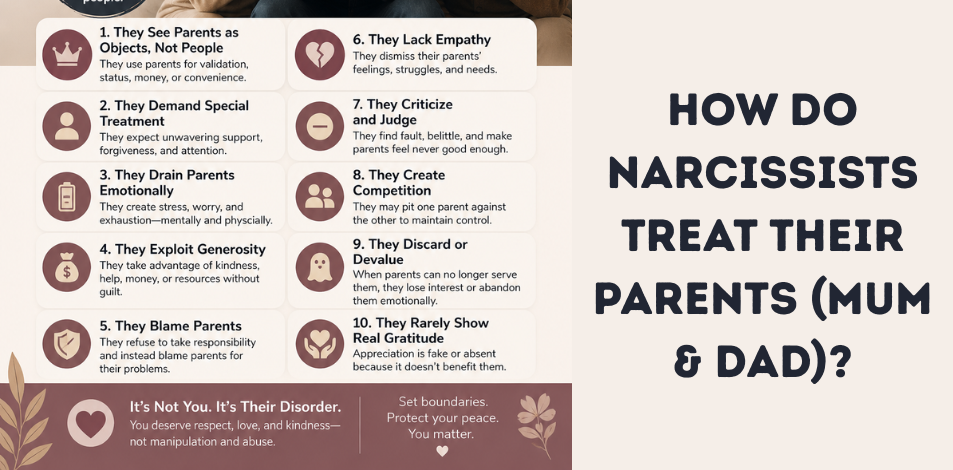
The way narcissists treat their parents varies depending on the dynamics of the relationship. However, just because they are the parents of a narcissist doesn’t necessarily mean they are less narcissistic.
Narcissists often exhibit specific behaviors and attitudes toward their parents, ranging from admiration and manipulation to exploitation and even complete disregard.
Narcissists tend to view their parents as they would their partners, siblings, or children. For them, parents are an extension of themselves or a means to fulfill their needs, rather than being recognized as individuals with their own feelings and desires.
Narcissists will always be selfish, as this is their nature, programmed by childhood trauma. Whether they flatter or fight, it will undoubtedly serve their self-interest.
Let’s explore the diverse ways narcissists treat their parents.
How Do Narcissists Treat Their Parents
Manipulating and Controlling Them
Narcissists often manipulate their parents to achieve their goals, regardless of their age.
Narcissists discover early on the most effective strategies for exploiting and focusing on their parents’ weaknesses.
They may resort to making their parents feel guilty, forcing them to take responsibility for their happiness or success. Alternatively, they might use threats or emotional manipulation to get what they want.
“If you loved me, you would do this for me.”
Narcissists are adept at portraying themselves as victims, exaggerating their suffering or challenges to elicit their parents’ sympathy. This technique aims to make their parents feel obligated to meet their needs.
Related : Covert Narcissist Father Checklist (11 Key Traits)
One common tactic narcissists use with their parents is to exploit their mother’s or father’s emotional vulnerabilities, using their knowledge of parental feelings of guilt, love, or insecurity to manipulate them into fulfilling their demands.
They will also resort to threats or emotional manipulation of their parents to get what they want.
“If you don’t help me, I won’t bother mowing the lawn this weekend.”
But it’s not all bad, is it? Sometimes, narcissists may use excessive flattery, affection, or charm to manipulate their parents into complying with their demands. They may also display intense feelings of love or admiration to win their parents’ affection.
However, nothing comes for free with a narcissist.
They can easily switch between showing affection and withdrawing it depending on how their parents respond to their wishes. This creates a vicious cycle of reward and punishment to control their parents’ behavior, much like a traumatic relationship.
This pattern clearly demonstrates that a narcissist’s love is conditional, meaning their affection is contingent on their parents fulfilling their demands or expectations.
It’s not just love and affection that a narcissist withholds; it may extend to communication, money, security, and support if the parents don’t comply with their wishes. His threats are used to reinforce his control over his parents’ actions.
Narcissists are completely indifferent to how exhausting and destructive these tactics are for their parents, because ultimately, all that matters to them is themselves.
Exploit Them
Narcissists are known to exploit their parents for personal gain, whether it’s financial support, access to their resources, or a constant need for attention and validation.
A common trait of a narcissist is a sense of entitlement. Because they see their parents as an integral part of themselves, they feel a strong sense of entitlement to everything they desire.
If something benefits a narcissist, they will pursue it relentlessly.
Examples of how narcissists exploit their parents:
Financial exploitation: Constantly asking for money, demanding unreasonable financial support, or expecting their parents to cover their expenses without reciprocating.
Living off their parents: Living with them for an extended period without contributing to household expenses or taking responsibility for their own.
Attention hoarding: Constantly seeking attention, appreciation, and praise from parents, using emotional manipulation to draw attention to themselves while ignoring the needs and feelings of others.
Exploiting health problems: Exploiting their vulnerability (especially if the parents are ill or elderly) by manipulating them to provide constant care, or using their illness as leverage to get what they want.
Taking credit for parental achievements: Boasting about parental accomplishments or successes, and using them to enhance one’s own image or status, exploiting the parents’ success.
Manipulating family dynamics: Instigating conflicts between siblings or other relatives against the parents to create a rift that serves their interests. Manipulating the dynamics for personal gain.
Pushing for control: Pressuring parents to give them control over family assets or decisions, and exploiting their trust or emotions to gain influence.
Exploiting emotional vulnerabilities: Using guilt or a strong sense of duty to manipulate parents and get what they want.
Glorifying Them And Devaluing Them
Narcissists exhibit a recurring pattern of glorifying and belittling others in many of their relationships, including their relationship with their parents. This is the narcissist’s signature attraction-repulsion dynamic, which they use to control and manipulate the people and situations around them.
Glorification
Here’s what glorification looks like for a narcissist and their parents…
Excessive Praise and Admiration
Initially, the narcissist showers their parents with excessive praise, admiration, and attention. They highlight their positive qualities, achievements, and merits to gain their favor or support.
Seeking Approval and Endorsement
During this stage, narcissists constantly seek their parents’ approval and endorsement. They may mimic their parents’ interests, opinions, or beliefs to gain acceptance and admiration.
Expecting Unconditional Support
Narcissists may view their parents as perfect and expect unconditional support and blind obedience to their wishes and decisions.
Viewing Parents as Role Models
When a narcissist excessively idolizes their parents, they may see them as perfect role models, mimicking their behavior or aspirations to reflect their own idealized image.
Devaluation
But in the narcissist’s world, there can be no idolization without a corresponding degree of devaluation. Here’s what devaluation looks like for a narcissist towards their parents…
Perspective Shift
Over time, or due to feelings of inadequacy or unmet expectations, the narcissist will eventually shift from idolization to devaluation. This shift is often sudden and abrupt. Ultimately, the narcissist’s parents will have disappointed them in some way.
Criticism
They may suddenly become highly critical, focusing on their parents’ perceived flaws, mistakes, and weaknesses. They will downplay their parents’ achievements and abilities, either overtly or passively and aggressively.
Withholding Attention and Affection
Narcissists often withhold their affection, attention, and support from their parents as punishment for what they perceive as injustice. This withholding of positive reinforcement can cause anxiety in the parents, which the narcissist is aware of and deliberately uses as a tool for control.
Blame and Shame
A narcissist may begin blaming their parents for their own shortcomings or failures, projecting onto them things they refuse to take responsibility for themselves.
They demonstrate a lack of empathy.
As a child, the narcissist experienced a traumatic event that was beyond their capacity to cope. This might have been the result of neglect (emotional or physical), excessive pampering (which fostered an unhealthy sense of entitlement), or even being raised by another narcissist.
Because of this painful experience, the narcissist decided to sever their connection with their true self. The true self represents everything that makes us human—love, kindness, compassion, and empathy.
Since the narcissist has completely denied this aspect of themselves, they have become a self-less being, ruled by their ego. This ego is what creates the false personas they use as tools for manipulation.
The narcissist lacks the ability (or desire) to take responsibility for themselves; therefore, they resort to stealing and manipulating others to satisfy their needs.
For this reason, the narcissist lacks empathy for anyone, even their parents.
While they may feign empathy when it serves their interests, they will never be genuine.
When it comes to empathy, narcissists downplay their parents’ needs and desires because they simply don’t serve their own interests.
Boundary Disregard
Narcissists are notorious for easily overstepping others’ boundaries because, frankly, boundaries are a hindrance to them.
Narcissists suffer from a superiority complex, a result of their inflated egos. They believe they are above the rules of others and society. In other words, they don’t believe their parents’ boundaries apply to them.
They might call their parents and expect an immediate response. Or they might suddenly appear at their parents’ doorstep uninvited, expecting attention, money, food, or whatever else they want without even a word of thanks.
Here are some ways narcissists might overstep boundaries with their parents:
Excessive interference in their parents’ lives
Ignoring their parents’ privacy
Expecting unreasonable support
Using them as an outlet for their emotions
Demanding excessive admiration and appreciation
Dominating their time
Psychological manipulation
Psychological manipulation of parents can be a painful tactic some narcissists resort to as they age and become more dependent on others.
The basic tactic is to deny and manipulate their parents’ reality for personal gain, whether it’s to push them into a nursing home or to try to exploit their parents’ resources (home, money, etc.).
Related : 6 Tips for Dealing with a Narcissistic Boss
Whatever the reason, one of the most favored manipulative tactics for narcissists is psychological manipulation to get what they want and rewrite the other person’s story.
Examples of manipulative phrases narcissists might use with their parents:
“That never happened. You must be misunderstanding.”
“You’re being overly sensitive. It’s not that serious.”
“I never said that. You’re making things up.”
“You’re imagining things. Maybe you should see a doctor or get help with your memory.”
“Everyone knows you tend to overreact. Maybe you should try to calm down.”
“You’re always trying to blame me for everything. Can’t you see how unfair you are?”
“You’re so suspicious. Why would I do something like that?”
“You’re the one causing the problems here, not me.”
“I was just joking. I can’t believe you take it so seriously.”
“I’m your son. You should trust me more. Why are you so suspicious?”
Ignore Them
The final method narcissists might use to deal with their parents is to ignore them completely.
Narcissists are so self-absorbed that when they grow up and start their own lives, what benefit would they derive from visiting their elderly parents?
If you have a wealthy or successful narcissist son or daughter who obtains everything they need from other sources, visiting their parents will be a burden.
As is always the case with narcissists, there must be a personal benefit for them; otherwise, they see no value in anything they do. Everything is a transaction to them.
Some narcissists may completely disregard their parents’ needs… until it’s time to inherit. Then they will want everything because they feel they are fully entitled to it.
Narcissistic children are more likely to instigate sibling rivalries and family problems regarding inheritance. They don’t care about fairness or equality; they want everything.
The narcissist genuinely believes they deserve a larger share because they see themselves as superior. They don’t care that their siblings were by their parents’ side in their final days, while they were preoccupied with their own life.
It’s all about winning at any cost, even if the price is the relationship with the rest of the family.
Protect Yourself From Your Narcissistic Child
Once you realize you’re dealing with a narcissistic child, it’s crucial for your own well-being to develop strategies to protect yourself from their harmful behavior.
First, it’s important to understand that if your child has narcissistic personality disorder, the damage has already been done and cannot be undone.
You can’t simply love them and cure them of this disorder; it doesn’t work that way. As a child, their reality was incredibly painful, allowing their true self to fade away while their ego completely took over.
Here are some tips for dealing with a narcissistic child:
Don’t label them as narcissistic.
Set healthy boundaries and enforce them consistently.
Stop encouraging their narcissistic behavior.
Set aside limited time for them.
Focus on your own needs instead of over-catering to theirs.
Seek therapy and address your emotional wounds.