Growing up with a covert narcissist father is perplexing. Outwardly, he appears helpful and humble, but there’s a hidden selfishness that’s often more apparent at home than in public.
They excel at playing the victim and using guilt to manipulate their family members into doing their bidding, while simultaneously undermining them with harsh criticism and belittling remarks.
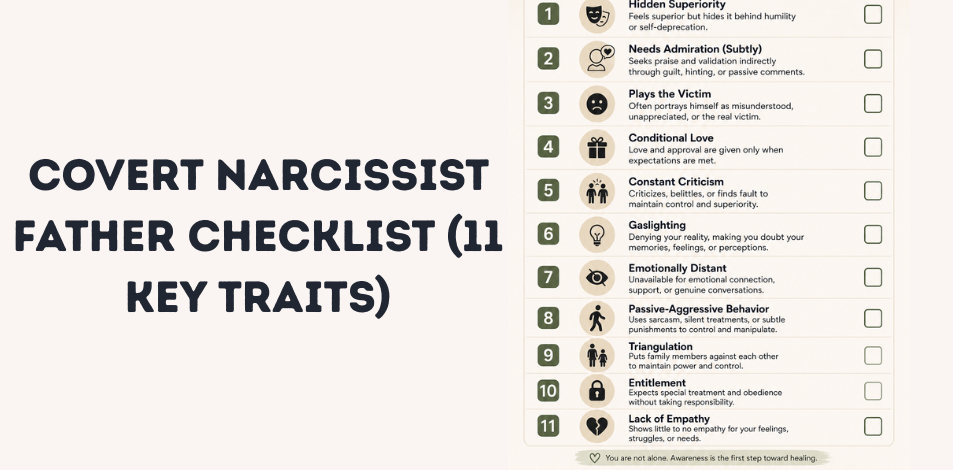
Use the Covert Narcissist Father Checklist for a deeper understanding of how these fathers operate.
Traits Of Covert Narcissism
Covert narcissism is characterized by a more subtle and self-centered expression of narcissistic traits compared to overt narcissism. However, the belief in superiority and exceptionalism remains as pervasive as in any other type of narcissism.
Overt (arrogant) narcissists have an inflated sense of superiority and self-confidence, and therefore feel entitled to special treatment. They feel no shame; in fact, they genuinely believe they are perfect, almost godlike.
In contrast, covert narcissists are regularly embarrassed and don’t display the same confidence as overt narcissists.
Related : 6 Tips for Dealing with a Narcissistic Boss
While overt narcissists believe that recognition should come to them automatically because of their self-perception, covert narcissists are the opposite. They need to receive validation from the outside world to boost their self-esteem and reinforce their belief that they are special and superior.
Common Traits of a Covert Narcissist:
Insecurity: Covert narcissists suffer from deep feelings of inadequacy and insecurity, despite projecting a more reserved or modest exterior.
Seeking Appreciation: They crave attention and admiration, but they often do so in a passive or subtle way. They may seek flattery, demand sympathy, or play the victim to gain attention and validation.
Manipulative Behavior: They may resort to manipulation, using tactics such as emotional manipulation, playing the victim, or passive-aggressive behavior to control situations or the people around them.
Lack of Empathy: Similar to overt narcissists, covert narcissists have difficulty with empathy. They lack the compassion necessary to care about the feelings of others.
Hidden Grandiosity: Although they don’t display arrogant behavior openly, covert narcissists may harbor delusions of grandeur, power, or uniqueness, revealing them only in private or to their closest confidants.
Fragile Ego: Covert narcissists are often extremely sensitive to criticism or perceived insults. They will react strongly to any form of rejection or negative feedback, even if it is constructive.
Difficulty Maintaining Relationships: Their emotional unavailability, manipulative tendencies, and lack of empathy can make it difficult for covert narcissists to maintain close, intimate relationships. They may frequently switch relationships and find it hard to form deep, meaningful connections.
Humility as a Facade: Covert narcissists project an image of humility and dignity, which contradicts their inner feelings of superiority or entitlement.
Passive Behavior: They may exhibit passive behaviors in social situations, preferring to remain in the background rather than seek the spotlight. However, they still crave appreciation and recognition.
Victim Mentality: Covert narcissists often view themselves as victims, using this to elicit sympathy or to justify their actions (avoid accountability).
List_of_Traits_of_a_Hidden_Narcissistic_Father
Now that you’ve learned about some common traits of a hidden narcissist, let’s see how these traits manifest in the father-child relationship through a list of traits of a hidden narcissistic father.
An_Inflated_Self-Importance
A hidden narcissistic father may harbor an inflated self-image that is difficult to detect. Behind a mask of humility, he hides a deep-seated belief in his own exceptionalism and superiority.
Inside, he constructs an elaborate world in which he sees himself as uniquely gifted, insightful, or superior to others. He doesn’t display this sense of grandeur openly, but rather reserves it for private moments or shares it selectively with those he trusts.
The hidden narcissistic father lives in a fantasy world where he believes he is superior, special, and deserving of everything. It’s a complete denial of reality because he cannot accept that he is an imperfect human being, just like all of us.
The covert narcissistic father imagines extraordinary achievements, resounding success, and the admiration of others, while concealing these ambitions behind a seemingly humble exterior in public.
This inflated sense of grandeur forms the cornerstone of his self-worth, despite his outward appearance of humility, subtly influencing his interactions with his children in often manipulative ways.
This behavior also suggests that the covert narcissistic father expects preferential treatment from other family members due to his sense of entitlement.
Interferes with his children’s identity
The covert narcissistic father often undermines his children’s growth and the development of their individual personalities by subtly imposing his expectations and desires upon them.
Through a mask of care and support, he skillfully manipulates their choices, opinions, and aspirations, steering them toward paths that align with his ideals.
For the hidden narcissist father, his children are merely an extension of himself—pawns to be manipulated to achieve his goals.
He may use guilt, emotional manipulation, or passive-aggressive behavior to discourage them from exploring their unique interests or independence, subtly conditioning them to prioritize his needs and opinions over their own.
Examples of interference with children’s identity:
Creating a perfect child to show off to the world and gain approval.
Living through the child and forcing them to do what he aspires to.
Suppressing the child’s dreams to keep him subservient.
Making the child a scapegoat to project his own unhealed wounds onto.
The hidden narcissist father creates a sense of dependency by building an environment where children feel obligated to seek his approval for their decisions, thus stifling their self-discovery and independence.
His subtle methods create a dynamic in which children struggle to distinguish their identity from his, shaping a childhood where his influence overshadows their personal development.
HeIs Passive Aggressor
The covert narcissistic father regularly resorts to passive-aggressive behavior as a subtle means of control and manipulation. Through this behavior, he avoids direct confrontation or overt hostility, while still expressing his resentment and exerting his influence over his children.
He may use tactics such as ignoring, sarcasm, veiled compliments, or subtle criticism to undermine or belittle his children. This behavior allows him to maintain an appearance of innocence or play the victim, while subtly asserting his control and power.
The covert narcissistic father keeps his children in a constant state of anticipation due to his passive-aggressive behavior. They are often confused about the true meaning of his words, which keeps them in a state of perpetual anxiety.
His passive-aggressive tendencies create an atmosphere of tension and confusion within the family, leaving everyone uncertain about his true intentions, yet still feeling the impact of his subtle attempts at control.
Examples of Passive-Aggressive Behavior:
Completely ignoring their failure to do what he wants.
Sarcastic comments.
Praise laced with belittling remarks.
Veiled criticism.
Mood swings and sulking to play the victim and manipulate his children into groveling.
A Controlling Personality
The covert narcissistic father exerts control over his children in subtle and cunning ways, shaping their lives according to his desires and expectations.
He uses emotional manipulation, guilt-tripping, or exploiting his role as provider to skillfully influence their decisions, choices, and behaviors.
He may resort to seemingly supportive tactics, such as offering guidance or feigning concern, but these actions always serve his goal of maintaining control.
The covert narcissistic father doesn’t want his children to grow up to be confident individuals outside his fantasy world, because then he won’t be able to control them for his own personal gain.
His basic strategy is to instill a sense of dependency and the need for his approval so that he can limit their independence and control them indirectly.
His control may extend to all aspects of his children’s lives, from their career choices to their hobbies and relationships, creating an environment where they feel obligated to comply with his wishes and hindering their ability to forge their own paths.
Examples of a Covert Narcissistic Parent’s Controlling Behavior:
Criticizing a child’s choices and decisions – undermining their self-confidence
Discouraging hobbies, careers, and relationships he doesn’t approve of
Openly expressing displeasure with choices that don’t align with his agenda
The covert narcissistic parent places the burden of managing his emotions on his children, expecting them to meet his needs while ignoring their own.
He expects his children to be responsible for his emotions.
The covert narcissistic parent often places the burden of managing his emotions on his children, expecting them to meet his needs while ignoring their own.
He skillfully manipulates their sense of responsibility by exploiting guilt and emotional manipulation, portraying himself as a victim to gain their attention and support. This makes them feel responsible for his happiness and comfort, creating a dynamic where their feelings and needs are marginalized in favor of his.
The expectation of fulfilling parents’ emotional needs can be stifling for children. It effectively programs them to downplay their own needs in all aspects of life, believing they are unimportant. As a result of this upbringing, the child becomes more prone to becoming overly dependent and reliant on others in intimate relationships in adulthood.
The Hidden Manipulator
The hidden narcissist parent doesn’t openly display their manipulation because they need to maintain an image of being “helpful” and “humble.” Instead, they use a range of subtle manipulative techniques to control their children’s thoughts, feelings, and actions.
Through emotional manipulation, they make their children feel guilty or exploit their empathy, subtly influencing their decisions while feigning support and concern.
“After everything I’ve done for you…”
- A common phrase used by the hidden narcissist to make their children feel guilty, forcing them to do what they want or to abandon them for hobbies and outside relationships.
They use praise cleverly, showering it on children when they comply with their wishes and withholding it when they assert their independence. This emotional manipulation by the father keeps his children constantly on edge, eager to do “the right thing” to gain his approval, which they desperately crave.
The father creates an atmosphere where seeking his approval becomes paramount, managing situations in a way that makes them feel indebted to him for his guidance and support.
Related : Letter From a Narcissist’s True Self (Behind the Mask)
Children of covert narcissists feel perpetually grateful for their father’s “kindness” and “support,” which amounts to emotional blackmail.
The covert narcissist’s manipulations often lead his children to question their own decisions, making them dependent on his opinions and “guidance” for decision-making, ultimately shaping their lives according to his desires.
Lacks Empathy
The covert narcissist father is incapable of genuine empathy for his children. There is a marked deficiency in understanding or appreciating their feelings and perspectives because, in his fantasy world, he is the only one who matters, while others are seen as mere tools for personal gain.
The emotional development of a covert narcissist father was negatively impacted in his childhood, rendering him incapable of genuinely meeting the emotional needs of others, including his own children. He will always prioritize his own needs, driven by an underlying belief in his own worthiness and superiority.
The covert narcissist father deliberately ignores his children’s feelings because they don’t serve his interests. He lacks the empathy to genuinely care about their emotions, so they are merely a source of annoyance to him.
His inability to connect with their experiences or show genuine interest makes his children feel unheard and unappreciated. This lack of empathy creates an emotional void, hindering the development of a supportive and nurturing parenting relationship and fostering feelings of isolation and emotional detachment in his children.
Performs a Positive Image in Public
The covert narcissistic father is adept at cultivating a positive public image, projecting humility, generosity, and kindness to those outside his immediate family circle.
He dedicates considerable energy to maintaining this facade because he needs external validation and admiration to bolster his self-esteem. This external validation fuels his delusion of being perfect and superior.
In social gatherings and public interactions, he presents himself as friendly, cheerful, charming, and helpful, earning praise and admiration from acquaintances and those outside his circle. This elaborate mask enhances his self-image and garners external validation, concealing his true manipulative and selfish behavior.
This stark contrast between his public persona and private conduct causes confusion and distress for the children of the covert narcissistic father. This makes it difficult for others to believe the children if they speak about their father’s true actions in private.
Refuses to Take Responsibility for His Behavior
The essence of narcissism lies in the refusal to accept reality—that they are ordinary, imperfect human beings, just like everyone else. This denial of reality has occurred at a deep, subconscious level since the narcissist’s childhood, leading to a split in their psyche.
The narcissist can only survive psychologically in the fantasy world created by their ego, a world in which they believe themselves to be perfect, superior, and deserving. They believe they are a god at the center of the universe, and that all other people are merely tools they use to achieve their personal gain.
As a result, the narcissist cannot accept any evidence that contradicts this fantasy. In other words, the hidden narcissist cannot take responsibility for any of their reprehensible actions or words, because doing so would mean admitting that they are not perfect or unique.
To evade this responsibility, the hidden narcissist resorts to devious tactics to avoid any blame or accountability.
How a Hidden Narcissistic Father Avoids Responsibility:
Psychological Manipulation: Manipulating his children’s perceptions and memories of events.
Blaming Others: Blaming his children for his actions.
Disjointed Talk: Engaging his children in unrelated topics to distract them from the original problem.
Denial: Completely denying statements and events.
Minimizing His Actions: Minimizing their significance and making his children feel overly sensitive.
Playing the Victim: Acting as a victim to gain sympathy and evade responsibility.
Guilt Manipulation: Making his children feel guilty simply for daring to hold him accountable.
The hidden narcissistic father skillfully manages conversations and situations to avoid responsibility, blaming others or external circumstances.
When confronted about his behavior, he resorts to tactics such as psychological manipulation, denial or minimizing the impact of his actions, or even blaming those who challenge him. He will resort to manipulating narratives to absolve himself of any wrongdoing, maintaining his self-image as either “infallible” or “victim.”
His refusal to acknowledge his behavior not only perpetuates the cycle of abuse but also undermines his children’s mental health, leaving them feeling neglected and frustrated by his refusal to take responsibility.
Makes You Feel Inadequate
The covert narcissistic father instills a deep sense of inadequacy in his children, leaving them feeling incapable of meeting his elusive standards.
Through subtle criticism, veiled compliments, or unrealistic expectations, he programs his children to constantly feel they aren’t doing enough and aren’t good enough.
The covert narcissistic father doesn’t risk his children surpassing him because they would abandon him. He would lose control over them, as well as his source of narcissistic gratification.
Despite their achievements, he may downplay their successes or highlight any perceived shortcomings, creating a dynamic where they constantly strive for his approval but rarely receive genuine appreciation. This perpetual cycle of inadequacy leads to a deep-seated belief that they will never live up to his expectations, contributing to a persistent sense of low self-worth and self-doubt in the children.
He Can Be Violent
Covered (and malicious) narcissists are more prone to violence than other narcissists. This stems from their belief that they deserve all the fame, glory, wealth, success, and admiration more than any other narcissist, but their low self-esteem and lack of confidence diminish their chances of achieving it.
The covert narcissist constantly sees evidence that he is not special, that he lacks talent or any particular superiority, but his distorted view of himself cannot accept this reality.
When he doesn’t receive confirmation to support his delusions, he quickly sinks into his dark inner emptiness, a deeply painful experience. Therefore, he must do something quickly to pull himself out of this void. He is then likely to erupt in anger as a way to project his unhealed wounds onto the person closest to him so that he doesn’t have to bear the burden himself.
Covert narcissistic parents may exhibit violence in many forms, but this doesn’t necessarily mean they physically hit their children (although this can happen in some cases).
Examples of covert narcissistic violence:
Punching objects (like the wall)
Throwing things in anger
Physical violence towards people and animals
Slamming doors repeatedly and forcefully, etc.
Using swear words (e.g., “I’ll hit you over the head if you don’t stop!”)
Verbal abuse (frequent swearing, using insulting language, etc.)