If you realize you’re dealing with an adult with narcissistic personality disorder, you’ll need to develop some strategies to protect yourself.
The first step is understanding that anyone with this disorder will only change after years of intensive therapy, and even then, the probability is less than 1%.
Due to the nature of this disorder, those affected are neither capable of nor willing to change. Their ego has created a completely fabricated reality in which they see themselves as flawless and the center of the universe.
To maintain this illusion, the narcissist must constantly seek external validation. Otherwise, this false reality will crumble because it is nothing more than a figment of their imagination (which they mistake for absolute truth).
The ego will fight fiercely to remain present and influential, meaning the narcissist will stop at nothing to maintain this illusion. This is essential; it’s crucial for your psychological survival.
Now is the time, as a parent, to equip yourself with some strategies (for your own mental well-being) to protect yourself from your narcissistic adult child’s selfish impulses.
Dealing with a Narcissistic Adult Child
Many situations can contribute to the development of narcissistic personality disorder in childhood. Their environment often presents them with conflicting emotions from caregivers, with the child experiencing a oscillation between extremes.
Related : How Do Narcissists Treat Their Parents (Mum & Dad)?
In short, when the child behaved in a way that pleased caregivers, they were met with praise, admiration, and appreciation. When caregivers were not pleased, the child was met with harshness, neglect, belittlement, or abuse.
This isn’t a judgment on how or why your narcissistic adult child emerged, but rather something worth reflecting on. Sometimes we can look back and see our role in the events, while other times we must accept what we had no control over.
Now, it’s time to develop strategies for dealing with your narcissistic adult son/daughter so you can maintain a relationship with them (if you wish) without losing yourself to their abuse.
Don’t Expose Their Narcissism
While it’s tempting to expose your narcissistic adult son/daughter for who they truly are, you won’t achieve the desired result.
Narcissistic egos don’t tolerate any criticism because it means shattering their illusion of being “perfect” and “divine.”
Therefore, whenever a narcissist is made aware of any negative trait, they suffer a narcissistic wound. To eliminate this evidence that contradicts their self-perception, that information must be destroyed. Here, the narcissist projects their own actions onto you, then makes you a target for their destruction.
The only expected outcome when confronting a narcissist is an escalation of abuse, increasing in intensity and frequency. They may even attack you, label you a narcissist, and then publicly tarnish your reputation, all to reinforce their fabricated narrative.
Set Boundaries
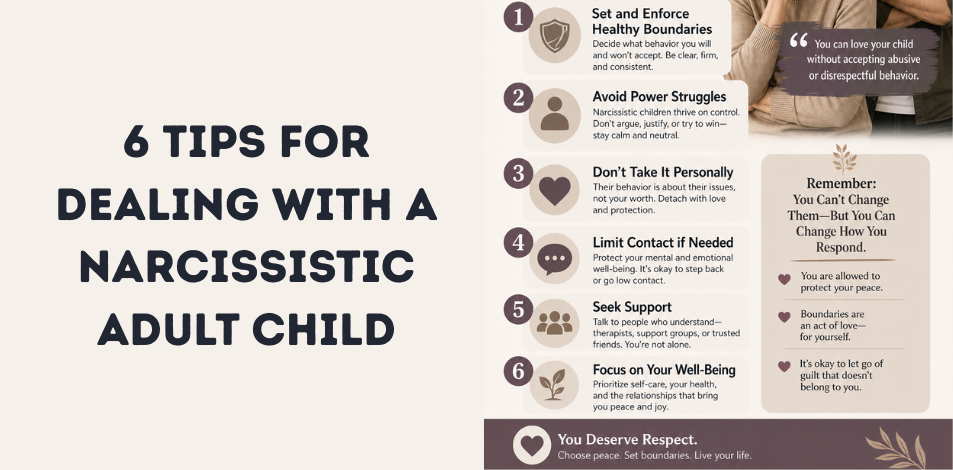
The best thing you can do when dealing with a narcissistic adult is to recognize that they won’t change and to set healthy boundaries for yourself.
Examples of setting healthy boundaries:
End the conversation if they belittle you or make you feel inferior.
Say “no” when you need to say “no.”
Be available when it suits you, not just because they expect you to be.
Only give resources if you are able and willing to, not because the narcissist is asking for them.
It’s important to note here that the narcissist will never appreciate you setting new boundaries. They are accustomed to exploiting your vulnerabilities, love, and empathy as weapons to manipulate you and get what they want.
“How dare you stop me from draining your resources? Don’t you know who I am?!”
If you allow it, the narcissist will continue to blatantly cross your boundaries. In their arrogant and superior world, they will now see you as the abuser because, how dare you deprive them of their resources?
That’s why you must continue to stand firm and enforce your boundaries repeatedly. By doing so, you are retraining them on how to expect to be treated and what you will no longer tolerate.
Stop Enabling Their Behavior
If we’re all being honest, the main reason narcissists get away with their awful behavior is that we allow it.
I’m not saying you’re responsible for what the narcissist does. No, they are an adult responsible (or should be) for their actions and reactions.
“I’m a perfect, flawless human being; I’m entitled to everything I want in life.”
But, given the nature of narcissism, they will never take responsibility for their behavior without years of intensive therapy, because that would completely shatter their false egos.
But this doesn’t mean that anyone else on the planet should accept the narcissist’s behavior or take responsibility for it simply because they refuse to do so.
We’re not doing the narcissist any favors by encouraging their bad behavior, even if the narcissist will make you feel like you’re offending them by refusing to do so.
That’s their fault.
How to Stop Encouraging Your Adult Narcissistic Child:
Cut off the relationship completely or reduce contact if their behavior is extremely toxic.
Identify the behaviors that are unacceptable and that you can no longer tolerate.
Set healthy boundaries and consistently enforce them.
Stop putting so much effort into their life.
Don’t take on their responsibilities.
Don’t believe their victimhood stories.
Disconnect from their behavior.
Don’t defend yourself to the narcissist (this is just a trap to lure you back into their cycle). Choose yourself (no matter how difficult that may be for parents).
Reduce your time with them
The more time you spend with a narcissist, the more opportunities they have to manipulate you, belittle you, and drain your energy to satisfy their needs.
Keep your time with the narcissist short and to the point.
Instead of seeing them all day, limit yourself to a quick coffee and then leave. Keep yourself busy so that you only have short periods to spend with them.
Related : Covert Narcissist Father Checklist (11 Key Traits)
This is important for setting your personal boundaries, and it helps you build an independent life away from the narcissist’s problems, demands, and expectations.
Put yourself first
You’ve always prioritized the needs of your narcissistic child over your own. After all, that’s what narcissists expect from all of us. But enough is enough!
They’re grown adults now, and if they haven’t had their own lives, it’s time to start.
It’s time to start putting your needs first and fulfilling yourself before anyone else. We’re not useful to anyone if we’re always exhausted.
The universe doesn’t reward self-sacrifice; it gives you more than you indicate you deserve.
Ultimately, we are all individuals on our own journey. Your first responsibility should always be to yourself, because if you don’t put yourself first, no one else will, and certainly not your narcissistic child!
Seek Health
If you’ve been dealing with a narcissistic child for a long time, you’ve likely experienced emotional, and possibly even physical, abuse.
As part of choosing yourself, it’s time to prioritize your healing. The parent-child relationship is complex, and you undoubtedly have many unanswered questions and traumas related to your situation.
You may or may not know what triggered your child’s split psyche and led to their narcissism. Therapy can help you gain knowledge, acceptance, and understanding.
Personally, the only strategy that worked for me in dealing with the narcissistic abuse I endured throughout my life was spiritual therapy. The complex post-traumatic stress disorder was debilitating, and the only way I could find relief and freedom was to completely release the trauma from my energy.
If spiritual therapy appeals to you, I highly recommend exploring the work of Selena Hill (more information below). If not, seek out a competent therapist who is knowledgeable about narcissism and with whom you feel comfortable.
It’s time for you to heal and move forward toward a more positive life, regardless of your child’s path.