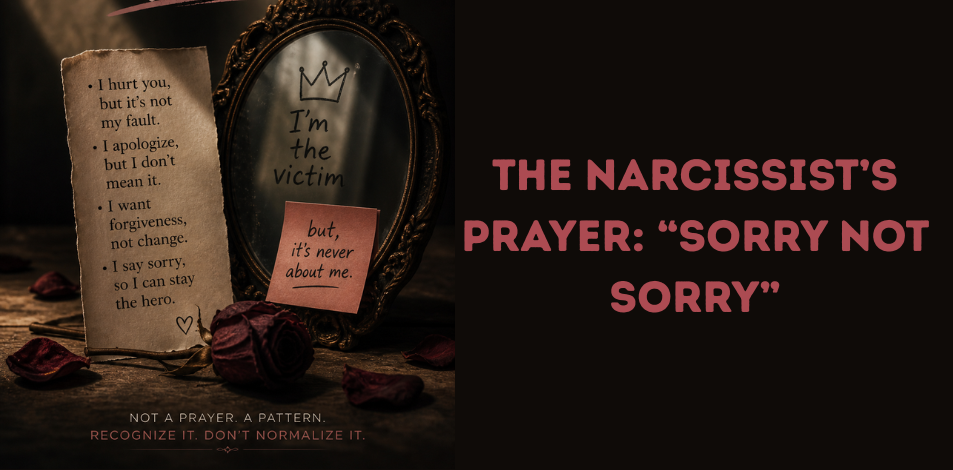
The “Narcissist Prayer” (also known as the “Narcissist Creed”) perfectly captures the mindset of a narcissist. The origin of this prayer is unknown, but you’ll find many satirical images and versions circulating online.
Narcissist Prayer
It didn’t happen.
And if it did, it wasn’t that bad.
And if it did, it’s okay.
And if it did, it’s not my fault.
And if it did, I didn’t mean it.
And if I did, you deserve it.
- The Narcissist
This short poem accurately highlights the various facets of Narcissistic Personality Disorder (NPD) and the abuse narcissists inflict on others.
Due to the nature of NPD, the narcissist ignores all of these aspects, while those around them suffer its devastating effects.
How does “The Narcissist’s Prayer” perfectly encapsulate this disorder?
Denying any reality outside their own perspective
Minimizing your experience
Ignoring your feelings
Refusing to take any responsibility
Psychological manipulation and distortion of facts
Blaming you for everything you’ve been through
The narcissist’s reality is fixed, selfish, illogical, and fiercely avoidant.
No amount of sound logic can change a narcissist’s perspective, no matter how hard you try. They are flawed as a result of the way they (unconsciously) choose to cope with trauma.
Let’s examine the true meaning and logic behind the “narcissist’s prayer.”
The Narcissist Prayer
Denial – “It didn’t happen”
The first thing a narcissist does when confronted with negative or harmful behavior is deny it completely.
They will either look you in the eye and claim it didn’t happen, or they will make up other statements to suggest your memory is faulty.
Common denial phrases:
“I never said that.”
“It didn’t happen.”
“I wasn’t there.”
“I never did that.”
“You didn’t tell me.”
“This is the first time I’ve heard of it.”
“You’re obviously confusing me with someone else.”
Why Do Narcissists Denial?
Narcissists are controlled by their egos, which see them as perfect in everything. If they receive any information that contradicts this illusion of “perfection,” they categorically reject it.
Related : 12 Reasons Why Narcissists Ruin Special Occasions, Birthdays & Holidays!
The narcissist’s entire world is based on a false image of the self, created by his vanity. He constantly creates an existence based on the image he wants to be seen as, believing that his false reality is the truth.
So, if a narcissist denies any wrongdoing or harmful or destructive behavior on their part, then, to them, it simply doesn’t exist.
Minimizing: “Even if it happened, it wasn’t that bad.”
The second line of the “narcissist prayer” is about minimizing your experience. If the first denial tactic doesn’t work, they’ll resort to minimizing your account of events.
If you try to express anything you’re feeling, they’ll downplay it because it’s simply unimportant to them. Anything that doesn’t amplify their sense of “special,” or give them attention or admiration, and thus feed their ego, is truly unimportant to them.
Common phrases used to minimize things:
“This isn’t important right now.”
“It was just a joke.”
“You’re being too sensitive.”
“You’re making a mountain out of a molehill.”
“Stop making a big deal out of nothing.”
“You’re acting like a child.”
Why do narcissists minimize things?
Narcissists exert a powerful control over the lives and perspectives of those around them. They constantly manipulate everything to appear important and superior.
They work tirelessly to control your reality to fit their own agenda and reinforce their sense of self-importance. Therefore, they downplay anything that threatens to portray them negatively or incompletely, so that it doesn’t become the focus of their attention.
In their world, your thoughts and feelings don’t matter.
All that matters to them is manipulating your reality so that you and others see them in the best possible light. In this way, you will treat them like gods, showering them with the attention and energy they crave. Anything that distracts them from their deep wounds of shame, humiliation, and unworthiness will be detrimental.
Ignoring – “If it happens, so what?”
Ignoring comes in the narcissist’s mantra: “If it happens, so what?” This is simply another phrase that reinforces the downplaying of the issue and aims to make you question your own perspective. Common phrases used to dismiss someone:
“Why are you making such a big deal out of it?”
“You’re being unreasonable.”
“Why are you letting something so trivial ruin the relationship?”
“You’re so needy.”
“Poor thing, just get over it.”
When a narcissist constantly tries to manipulate you, telling you that you’re overreacting, that you’re too emotional, and that you’re acting like a child, you genuinely start to question your own version of events.
A rational, self-reflective person will eventually begin to think: “They’ve commented on the intensity of my emotions time and time again… maybe I’m overreacting.”
Why do narcissists minimize other people’s feelings?
It’s never really about your feelings or reactions being “overreacted” or “excessive.” It’s always the narcissist’s attempt to deflect attention from their own behavior and back onto you. They shame you and make you feel like there’s something wrong with you to avoid taking responsibility for their behavior.
Furthermore, to maintain control over you, they need to undermine your self-worth, self-confidence, and ability to make sound decisions. They aim to emphasize that you don’t matter to them, that you exist only to serve them because they are the most important.
Irresponsibility – “If that’s the case, it’s not my fault.”
A narcissist cannot admit fault in any way! This directly threatens to expose the entire falsity of their personality, built on a flimsy foundation of lies and manipulation.
Anyone who has dealt with a narcissist knows the extent of their complete irresponsibility. In fact, the lengths they go to in evading responsibility are truly astonishing.
Phrases to evade responsibility:
“It’s not my fault what happened.”
“Your feelings are your own business.”
“You need to learn to communicate better.”
“That’s how I used to do things.”
“This could all have been avoided if you [had listened or acted differently].”
“This all started because of you.”
“If the person at the box hadn’t been so stubborn, none of this would have happened.”
Why do narcissists avoid taking responsibility?
Admitting a mistake, however small, means the narcissist is forced to acknowledge their imperfections, implicitly admitting they are not special or divine.
Their entire conviction crumbles, threatening to expose their true nature, which would mean their complete demise. They would be left with their inner reality—a shattered soul, filled with shame and a profound sense of unworthiness, which they deeply despise.
For them, this is tantamount to death, which is why everything with a narcissist feels like a fight to the death. They will always outsmart you in intelligence, rhetoric, and resilience because their very (false) existence is at stake!
Unconvincing_Apology – “If that’s the case, I didn’t mean it.”
This is one of the most common unconvincing apologies from narcissists. A narcissist will never sincerely apologize. Since they never believe they are wrong in any way, why should they?
But if offering a fake apology serves their interests, they will feign it to get what they want. This doesn’t mean they are remorseful or that anything will change; it simply means they have a personal interest in it.
Examples of fake apologies:
“I didn’t mean to do it.”
“I don’t know why I do these things.”
“I’m sorry if you were hurt.”
“I’m sorry if you think I was wrong.”
“I’m sorry you feel that way.”
“I was just joking.”
“I was just trying to help.”
“I already apologized.”
Why do narcissists offer fake apologies?
They may simply want you to forget their abusive behavior so things can return to “normal” (i.e., so you can serve them and feed their narcissism). They may want something beneficial from you—money, intimacy, home-cooked meals, chores, etc.
Another aspect of this principle in The Narcissist’s Prayer is the “appearance” of being kind. It’s part of manipulating and controlling how the outside world perceives them.
If there’s any shame or humiliation resulting from what happened, controlling the narrative and feigning kindness quickly erases it. Even if it’s not genuine, they don’t care. The only thing that matters to them is how things look on the outside.
It’s like covering dog poop with glitter—just because it looks good on the outside doesn’t change what’s inside.
Blaming others—”If it was my fault, you deserved it.”
The final part of The Narcissist’s Prayer… “Ultimately, it’s all your fault.”
The ultimate trick a narcissist uses to avoid taking responsibility for their mistakes and evade their inner wounds is to place all the blame on someone else.
Blame phrases:
“Why do you insist on bringing up the past?”
“You’re the reason our relationship has deteriorated.” “You’re hurt?! How do you think I feel?”
“If you don’t like it, you can leave.”
“I don’t have time for your games.”
“If you hadn’t provoked me, I wouldn’t have had to do this.”
“If you had just listened to me, I wouldn’t have gotten angry.”
Why do narcissists blame others?
The real reason is that the ego can’t stand being blamed for anything. It sees it as a direct threat to its existence.
Why do narcissists blame others? Instead of dealing with criticism (or rejection) like a healthy person would, the narcissist uses their false persona and projects it back onto you. They’ll impose this negative scenario on you, just like an outer layer.
And so, in the narcissist’s delusional world, they actually see you as the cause of everything bad. They become the victim in your eyes, instead of you being the victim.
Everything the narcissist said or did to you will be turned back on you by the narcissist, who will accuse you of doing the same to them. This is where your mind can be manipulated most effectively, because you will feel confused and unjustly persecuted.
To eliminate this perceived threat, the narcissist will put you in a difficult position (because you have become the perceived threat) and attack you to destroy it. This will manifest as anger, public defamation, accusations, playing the victim, and psychological manipulation.
Ultimately, they see you as the cause of the problem, and you must be blamed and punished to justify their reprehensible behavior.
Narcissism Is A Spiritual Disorder
In the case of narcissism, its effects are felt more than seen. You might walk down the street and pass ten narcissists without realizing it (except for the arrogant ones, who will be busy taking selfies!), because they pretend to be ordinary people.
You won’t feel the narcissism until you start interacting with it; that’s when your internal alarm bells will start ringing. However, in our society, we’ve strayed far from listening to our intuition, which makes people fall victim to narcissists time and again.
Related : 8 Reasons Why a Narcissist Ignores You
Because narcissistic abuse is often subtle, it’s easy to question whether your feelings are genuine. Narcissists are well aware of this, and it’s their mods operand—their hidden world of energy and emotions.
How Are Narcissists Made?
Narcissists are said to be “made,” not “born,” meaning they become narcissists as a result of environmental factors.
In short, something happened in the narcissist’s early life that caused some kind of trauma. This could have been emotional or physical abuse and/or neglect. Or perhaps it was the opposite: excessive pampering.
Some studies suggest it may be genetic, but I believe that parental behavior that fosters narcissism is the genetic factor. This continues until someone, at some point in their life, becomes aware enough to break the cycle.
The Disconnection From Authenticity
As a reaction to the trauma, the narcissist learned early on that emotions and vulnerability posed a significant threat to their survival. The trauma left them feeling worthless, humiliated, and ashamed. They couldn’t bear to experience these profound emotions; they felt unsafe.
So, unconsciously, they severed their connection to that part of their humanity—their true self.
The true self is responsible for those vulnerable emotions that enable us to feel empathy, kindness, compassion, and authenticity. This connection with our true selves is what allows us to access the divine life force within.
Through this connection, we can access unconditional self-love and inner self-esteem. We have everything we need within our grasp when we learn to connect authentically with God, our higher selves, and all of creation.
But because the narcissist severed their connection with their true self, only one aspect remained—the ego.
The ego is that part of human experience responsible for rivalry, greed, deceit, and much more. The ego is not authentic and has no conscience. It is a false self, incapable of drawing its energy from within. To survive, the ego needs to be nourished by external sources, such as attention and validation, which constitute a source of energy.
This is why the narcissist constantly seeks this source through admiration, acceptance, and attention from everyone. All of these things feed the ego, which has now become its controller.
Once the narcissist’s energy source begins to dwindle, the ego shrinks, and the narcissist finds themselves forced to delve into the depths of their own being—a terrifying prospect!
All that dwells within them are profound feelings of shame and worthlessness. Without access to their true selves, they have no way out of this darkness. Their only option is to feed their vanity, which offers only temporary relief from the pain of inner emptiness.
This explains the narcissist’s drive to control you and everything in their world; they do everything in their power to cling to any vital energy they can obtain.
Everything they do revolves around satisfying their vanity.
Because they have lost their conscience, they lack the capacity or resources to love or care for any other human being. They may pretend to love or care for others to get what they want, but ultimately, they do what they do to satisfy their addiction.
Q: How can a narcissist do what they do without any remorse?
A: Narcissists have no conscience—they lack the capacity for empathy, compassion, or love. They are addicted, and their preferred drug is energy. Everything they do is aimed at securing their next victim.
How To Recover From Narcissistic Abuse
As someone who has suffered narcissistic abuse my entire life (from my mother, then from my husband), the most important piece of advice I can give is energy healing.
As you know, narcissists exploit their victims and draw power from them by identifying their deepest wounds and triggering their most painful emotions. They deliberately trigger these painful emotions within you because the energy that flows from you in this process is exactly what they seek.
A narcissist completely drains your vital energy, then abandons you to find another victim. They are energy vampires disguised as ordinary people.
The best way to avoid falling prey to narcissists is to turn inward and heal your own wounds. You are a whole being, capable of accessing your true, divine essence. You have all the tools at your disposal to be your own source of unconditional love, acceptance, and security.
But to live the full and fulfilling life you deserve, you must confront and heal your deep wounds. Then, those fears will no longer control you, and narcissists will fail to manipulate you because they will have nothing left to exploit.
Selina Hill offers direct and highly effective sessions that literally remove the trauma that has been trapped in your body for so long.
If you are ready to embark on this journey, I highly recommend it. After years of narcissistic abuse and worsening PTSD, which only got worse over time, spiritual healing completely transformed my life.
If energy healing isn’t right for you, I recommend seeking out a qualified therapist specializing in narcissism and making your healing a priority through regular sessions.