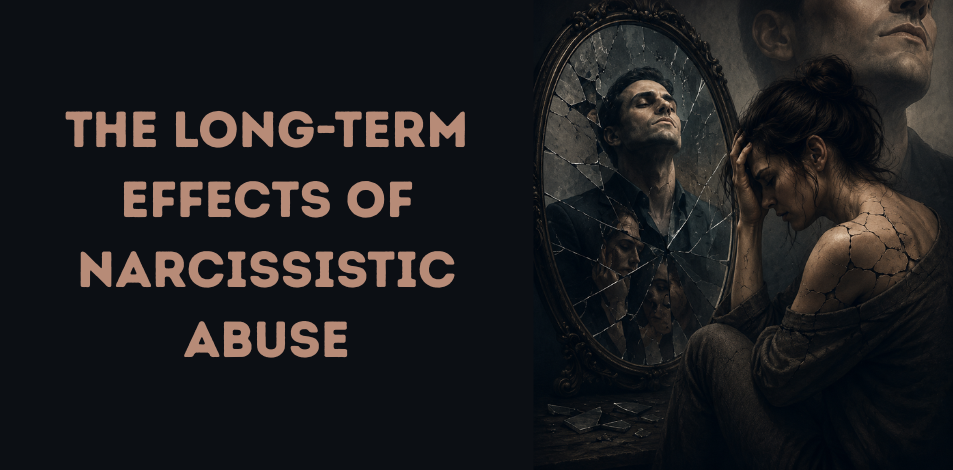
The long-term effects of narcissistic abuse are insidious and destructive, far more profound than you might imagine.
Narcissistic abuse affects your body, mind, perceptions, and beliefs, penetrating deep into your very being. It impacts your worldview, your self-perception, and pushes you to make decisions that are not in your best interest.
Over time, these effects intensify and consume you. You reach a point where, like a fish out of water, you no longer realize you’re swimming in a vortex of trauma. Learning to recognize and name the long-term effects of narcissistic abuse helps you separate your core self from your emotions. Instead of constantly criticizing and defeatizing yourself, you break this vicious cycle. From there, transformation and liberation are just one step away.
The long-term effects of narcissistic abuse include:
- Power-related amnesia
Once upon a time, five monkeys were in a cage. They watched a banana fall from a tree and land on the metal bars.
Out of curiosity, one of the monkeys tried to grab it. Suddenly, the ground shook violently beneath their feet, and all the monkeys trembled with fear.
A few moments later, the monkey tried again, and the ground shook once more. No one dared to take the banana again.
As time passed, one of the monkeys died and another took its place. This monkey, who had no memory of the previous earthquake, tried to grab the banana. Suddenly, the other four terrified monkeys pounced on it and beat it mercilessly. It didn’t try to take the banana again.
This cycle repeated itself. As one monkey died and another took its place, each monkey tried to grab the banana and was severely beaten.
Eventually, all the original monkeys disappeared, but the ritual of preventing anyone from reaching the banana remained. No one knew exactly why taking the banana was wrong. All they knew was that it was wrong.
The worst effect of narcissistic abuse is how it gradually distorts your perspective. The more the narcissist abuses you, the more inadequate you feel. The more you feel inadequate, the less confident you become, and the more opportunities a narcissist has to abuse you. Eventually, you forget why you feel hopeless and why you should never reveal your strength.
The banana symbolizes your inner joy, your curiosity, and your willingness to reach new heights. Instead of dwelling on why you haven’t tried, remember the divine spark within you that you can access.
- Toxic Shame
Shame is a restraining force that keeps us in check. It reminds us to cooperate with those around us to maintain our place in our group. Shame originated in tribes to ensure that members didn’t overstep boundaries, especially those of high standing.
When we act in a way that threatens people we value, their negative reactions trigger shame in us, weakening our power and putting us back in our place. This interaction ensures we aren’t ostracized from our group, something that, until two centuries ago, meant the difference between life and death.
Narcissists need to feel dominant in a relationship. As a result, they deliberately inflict shame on you to diminish your power and increase their own sense of superiority. In other words, they exploit a vulnerability in human nature by ridiculing, judging, questioning, and reacting negatively to any expression of authenticity and strength.
Over time, these shameful experiences accumulate into a festering swamp, causing a devastating sense of shame. The person suffering from this destructive shame feels, and even believes, that they are inherently worthless and incapable.
Related : Why Narcissists Withhold Love And Affection
Even the slightest hint of disapproval from others triggers a wave of self-pity. Your shoulders slump, your head hangs, your thinking slows, your face flushes, and negative thoughts begin to replay in your mind over and over again.
You compare yourself negatively to others, you judge yourself harshly, and in doing so, the cycle of destructive shame deepens further.
- Chronic Guilt
Guilt is a type of shame related to what you do, not who you are. It is a constant, debilitating feeling that eats you up day and night. It’s like a stab in the gut every time you do something, say something, or even think or want to do something. It is a byproduct of ongoing narcissistic abuse.
When you don’t act according to a narcissist’s expectations, they will constantly remind you of the “sacrifices” they’ve made for you, sacrifices you didn’t even ask for.
A narcissist’s rigid expectations and idealized standards create numerous points of conflict that generate guilt. You feel like you’re constantly letting them down. These repeated situations lead to guilt becoming an automatic feeling that accompanies many of your choices.
With chronic guilt, even the thought of doing anything that might upset the narcissist, even slightly, feels taboo.
- Psychological Imprisonment
Do you feel embarrassed to try new things? Does the opinion of others prevent you from making a change? Do you experience intense fear and anxiety when you are held responsible for something? Are you terrified of the unknown? This could be psychological imprisonment.
Psychological imprisonment is a long-term, often subtle, effect of narcissistic abuse. The bars of this prison are interwoven with countless experiences that trigger feelings of guilt and shame. You berate yourself for feeling “worthless.” You overthink everything before taking any action.
While others live powerful lives, you feel trapped. Shame, fear, and guilt overwhelm you whenever you try to step outside your comfort zone. These limitations are not accidental; they are the product of narcissistic abuse.
- Complex, Painful Past Memories
Trauma is an unhealed emotional echo from the past that haunts you in the present. It is the work you haven’t yet done, the pain you haven’t yet felt.
Trauma is often associated with fear and panic. In the case of complex trauma resulting from narcissistic abuse, it may also manifest as guilt, shame, feelings of abandonment, or depression.
The agonizing shame, chronic guilt, and a critical voice in your head are all components of trauma from narcissistic abuse. These components manifest as flashbacks.
When you experience flashbacks, you feel like you’re drowning in a particular emotion or state. You also notice patterns of automatic thoughts emerging. You might compare yourself to others, overthink the future, criticize and attack yourself for feeling worthless, and so on. It feels like a separate entity. You know you’re experiencing flashbacks when you “lose yourself.” You feel intense emotions that are out of place in the current situation. It’s as if you’re possessed.
While the triggers can be difficult to pinpoint, their impact is immense. A flashback can be so intense that it may take days to realize you were experiencing it. It draws you in, tosses you about, then hurls you away, leaving you bewildered and stunned by what has transpired.
- Loss of Self
The most tragic and lasting effect of narcissistic abuse is the loss of your wonderful, divine, and spontaneous self. Your inner world becomes so overwhelmed by negative emotions that it is virtually inaccessible. You remain adrift in your own thoughts, desperately trying to navigate life as a means of staying afloat amidst the raging waves of your pain.
You lose your autonomy; the narcissist becomes intertwined with your every thought and experience.
You forget what it means to be alone, to make decisions based on your intuition and the wisdom of your body. The narcissist occupies a permanent place in your mind and consciousness, able to access your inner beauty while leaving you unable to reach it.
The Long-Term Effects of Recovering from Narcissistic Abuse
When you recover from narcissistic abuse, life takes on new meaning. Like a blooming flower, your shame fades and your willpower grows stronger. You find space to think, feel, and act in your own best interests. You rediscover your hidden potential and remember what it was like to be curious, optimistic, and bold.
See the long-term effects of narcissistic abuse for what they are—something separate from you. Eventually, a new space will open up on its own, one you can use to heal and transform.