
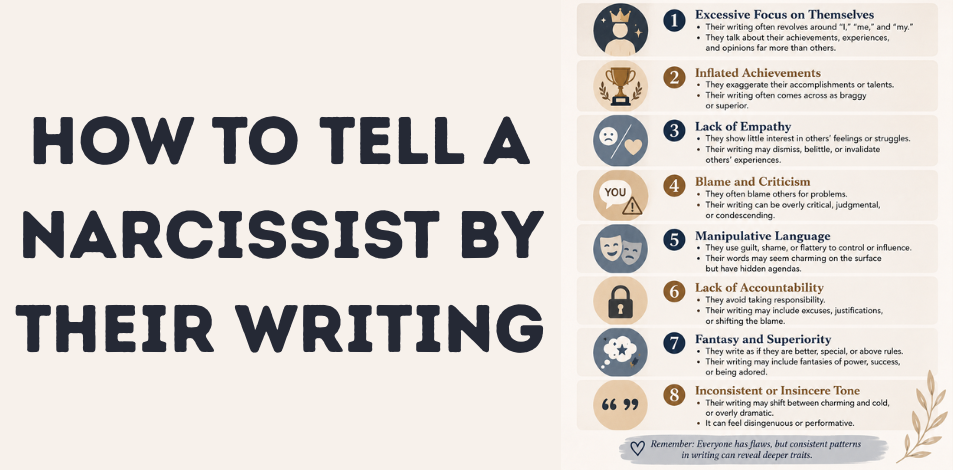
Narcissists are easily recognizable by their speech. Frequent self-referential, constant comparisons to others, a persistent sense of superiority, verbal attacks aimed at disarming and belittling others, and an insistence on deserving admiration for their accomplishments are all telltale signs. But when it comes to writing, it can be more difficult to identify.
For a fair assessment, the Diagnostic and Statistical Manual of Mental Disorders, Fifth Edition (DSM-5) criteria for narcissistic personality disorder will be used. Here are the brief characteristics identified in the DSM-5 and how they might appear in articles, books, blogs, emails, and even text messages:
Narcissists expect to be seen as superior. People with narcissistic personality disorder constantly seek attention. Therefore, their writing often has a condescending or self-aggrandizing tone. Sometimes, they even go so far as to openly declare that they are the best. They tend to write to incite or provoke others, but not necessarily to act. The victim feels defensive.
They exaggerate their achievements and talents. This often manifests as someone claiming expertise in a field where they lack credibility. Using the first-person pronoun in writing is common, as those with narcissistic personality disorder prefer to talk about themselves rather than the subject matter. Therefore, always verify the writer’s credentials with an independent source. Those with this disorder often lie about their accomplishments.
They have delusions of success, power, intelligence, beauty, or the ideal partner. Perhaps the best evidence of this is in a new romantic relationship, where the affected individual writes about how perfect their relationship with their partner is. Those with this disorder tend to rush into relationships and write only what seems appropriate. However, this delusion quickly fades once they are certain of the other person’s commitment and affection.
Related : Common Traits of Narcissists
They have a sense of superiority and a desire to be around exceptional people. Arrogance in their writing is often the first indicator, especially when the affected individual positions themselves as the standard. Some people with narcissistic personality disorder may quote famous people as if they have a personal connection to them, even though they don’t. For example, they might claim to be friends with someone they only follow on Twitter.
They crave constant admiration. In this case, attention is an attractive substitute for admiration. All attention, even negative attention, benefits the narcissist. They will deliberately exploit their power to gain more recognition. Or they may complain about others not liking them.
A sense of entitlement. Narcissists have a strong sense of entitlement. They wrote a book, therefore it deserves to be published. The quality of the writing or the subject matter doesn’t matter; what matters is that they did it, and it must be good or correct. Anyone who refuses to give them what they believe they deserve will be attacked.
Automatic compliance with their expectations. This often manifests in writing as demands to which the narcissist expects absolute compliance. Phrases like “You must do” are common, indicating no room for differing opinions or viewpoints.
They exploit others. This is usually done by blaming others for things that go wrong for the person with narcissistic personality disorder. Those with this disorder don’t take responsibility for their actions or reactions. By blaming others in their writing, they are passively and aggressively shirking responsibility.
They lack empathy. People with narcissistic personality disorder often expect empathy for themselves but refuse to give it to others. In their writing, this may be interpreted as playing the victim in an attempt to gain sympathy. However, those with the disorder see others’ attempts to gain sympathy as a sign of weakness.
They believe others are jealous of them. Phrases like “They’re jealous of my ability to…” are typical reactions, especially when a person with narcissistic personality disorder feels criticized. Sometimes the commentary is more subtle or passively aggressive, especially when the writing is directed at a higher authority.
This is prevalent in all their writing, without any apology for their arrogance. There may be some humility or slight remorse, but it is surrounded by a barrage of attacks directed at others. These attacks are intended to distract from their narcissism.
Once one recognizes the signs of narcissism, it becomes easier to identify. It manifests not only in their speech and body language, but also in their writing.