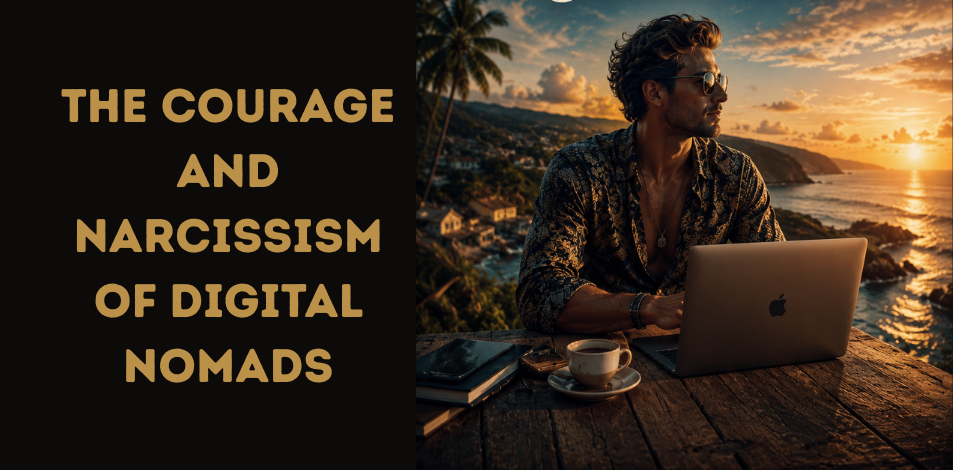
Every year, I spend my days traveling between the Northern and Southern Hemispheres, enjoying time with friends and family in relatively stable and familiar environments.
But recently, I’ve immersed myself in the nomadic lifestyle of Southeast Asia, spending extended periods in select cities, drawing on the “new mindset” that unfamiliar places offer to fuel my creativity. This has led me to the heart of the digital nomad scene, and I’m currently based in the stunning coastal city of Da Nang, Vietnam.
For Vietnamese people, Da Nang is a big, bustling city. For digital nomads, it feels like a small village. Most of them congregate in a small square in the My An district, which provides easy access to cafes, co-working spaces, and, of course, the beach. Just like in a village, if you stay here long enough, you’ll often encounter the same people. Friendly conversations frequently erupt, and friendships are easily formed.
Everyone has their own unique personality and story—why they came to Da Nang, how they spend their time, how they earn a living, their passions, hobbies, spiritual practices, and emotional experiences. Yet, over time, common patterns begin to emerge, and a captivating story of digital nomads unfolds.
A_Distinctive_Breed
I know many people who have lived in the same neighborhood or village for decades, seeing the same people every day, with routines that rarely change from year to year. For them, stability seems to be paramount.
Digital nomads are a different breed. While the stay-at-home person craves stability, the digital nomad craves experience and renewal. Where they live, who they know, and how they spend their time are constantly changing and evolving. Home isn’t where their heart beats; it’s where their laptop is. They have an insatiable desire that can only be satisfied by traveling to a new destination or, if they stay in one place for an extended period, attending a unique event. Meetings, bars, nightclubs, sports activities, or road trips—there’s always something to do. And when you start to get bored? Often, someone has already suggested another destination, sparking your curiosity.
Backgrounders are typically characterized by their openness, curiosity, energy, spirituality, dreaminess, thirst for knowledge, and embrace of chaos. They abhor restrictions and tend to get bored easily. They crave absolute freedom and adore open roads and the sea.
Backgrounders are also adventurous. They are quick to adapt and always have the courage to venture into the unknown. They are resourceful, flexible, and can tolerate chaos and uncertainty.
The question that has intrigued me since arriving in Da Nang is: What truly satisfies a backgrounder’s insatiable thirst?
Chasing Something, or Escaping?
I recently had dinner with a group of nomads I barely knew. The conversation ranged from the usual nomad topics: mental health, spirituality, favorite cities, people’s professions, the best bars in Da Nang, and who could recommend a good tattoo parlor. The conversation remained dry until one woman asked another about her family, to which the response was, “I don’t talk to my family.”
Related : Do Narcissists Recognize Other Narcissists?
After an awkward silence, the conversation shifted to “belonging,” something most of the other diners admitted they lacked. They saw “alternative communities” as the perfect solution. Only one nomad can truly understand another’s uniqueness, and only one nomad can keep up with their curiosity and passion. Home was rigid, predictable, and boring. The final destination was far into the future. Were these nomads chasing a mirage? Or were they seeking an authentic life that would allow them to live according to their true identities?
The Dark Side of Travel Life
Every community of travelers has a chat group where members can ask random questions to help them adjust to their unfamiliar environment or to organize meetups and events. One night, an anonymous user posted over a hundred bizarre and incomprehensible messages, which were seen by a thousand people. It seemed they were having a psychotic episode.
In the morning, the administrator deleted all the messages and removed the person from the group. Someone contacted them later, and it turned out they were suffering from mental health issues.
And from there, another trend emerged.
One person I met had post-traumatic stress disorder as a result of a military training exercise that went wrong. Another seemed to be under the influence of drugs every evening I passed him on the street, his pale, empty eyes searching for a fun party. Developmental delays seemed to be a prominent feature among travelers. Many of them looked much younger than their actual age. For every person who appeared calm and composed, there was another who seemed to be going through a difficult time.
In the community of truth seekers, there were many lost, wandering souls, roaming a strange paradise where the locals struggled for a living.
The Terrifying Allure of Invisibility
The backpacker’s life can be like an open playground. While locals struggle with the monotony of daily life, backpackers are on the hunt for their next adventure. The contrast is stark. And amidst this contrast, we discover the darker side of backpacking.
In backpacking, if you encounter someone you don’t like, you can always move on. If you arrive in a city that doesn’t excite you, you can pack up and leave. And if a place inspires you, you can enjoy its advantages without having to contribute to its continuation. There are virtually no accountability, responsibility, or boundaries. As happened with that guy who broke down on a WhatsApp group in front of all the digital backpackers in Da Nang, if you make a mistake, you can start over and try somewhere else.
Traveling to new places, immersing yourself in foreign cultures, and experiencing new lifestyles—it’s all a wonderful experience, and I recommend everyone try it for a while. It’s also a great way to support developing economies. However, viewing the world as a giant playground can quickly become unhealthy.
Our surroundings influence our behavior. If you live in a small village where everyone knows each other and no one ever leaves, you have to be careful what you say and do. Your reputation is always on the line. If you want to be accepted and supported, you have to be self-aware. In the nomadic world, this is no longer a concern. This is why the nomadic world attracts not only freedom lovers and curious travelers, but also narcissists with delusions of grandeur and psychopathic tendencies. Hiding behind the veil of anonymity can bring out the worst in a person, who gradually realizes that there are no consequences for bad behavior.
The nomadic world also attracts people with deep trauma, who find it extremely difficult to stay where their trauma originated. Constant progress can be a form of pain relief, allowing them to stay one step ahead of their repressed pain at all times.
The idea of absolute freedom and lack of accountability is capable of stirring our delusions of grandeur like no other. While the Bedouin dances above all else, reality remains constant, reminding him of his existence in the face of everyone struggling to make ends meet, and every message from home informing him of someone’s illness or some misfortune.
I would like to give this remarkable community a chance to clarify. Perhaps most Bedouins understand the truth and will diligently use their freedom to correct their views and heal their wounds before returning home. Perhaps some of the more astute Bedouins will manage to survive this turbulent life into old age. As for the rest, I suspect the reckoning will come soon, when their narcissistic illusions crumble.