
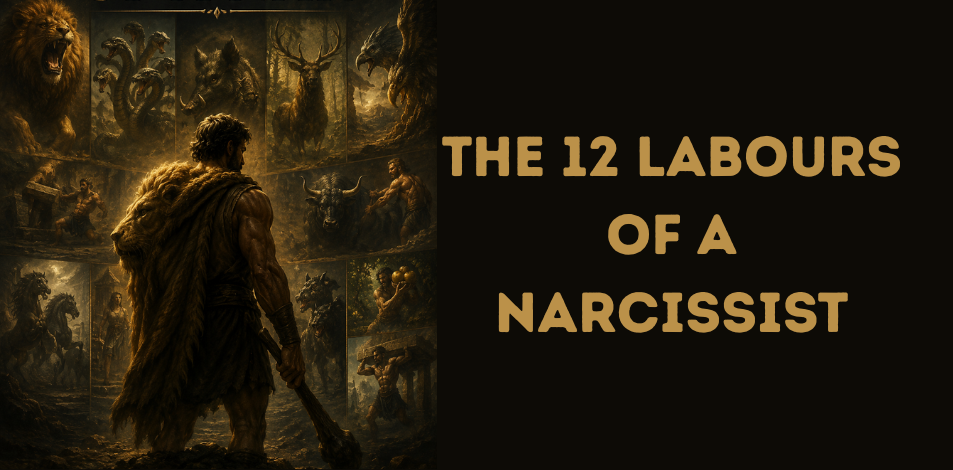
It’s widely believed that narcissism is an incurable disease, and that even if a narcissist wanted to change, they would fail. Since their psychological disorder developed during their formative years, there’s no hope for the narcissist. It seems that you can’t teach an old narcissist new tricks. Once a narcissist, always a narcissist.
Yet, my mind still wanders occasionally. As I observe the narcissists around me, I imagine what it might take. Sometimes my psychopathic tendencies smile at me, and I think about slipping a pill or an ecstasy into someone’s coffee. They wouldn’t stay the same after that, would they?
After a few laughs, I return to less sinister thoughts. My other mind becomes active again, connecting unfamiliar things. I find myself thinking about Hercules, or “Heracles,” as the Greeks called him.
Although he is hardly considered a narcissist, the story of Heracles contains enough to make me think his heroic journey could offer a model for narcissists to recover.
The Works Of Heracles
In Greek mythology, Heracles was the illegitimate son of Zeus. Hera, Zeus’s wife, hated her husband’s infidelity and often took revenge on his children.
After Heracles grew up, he was happily married with children. One day, he returned home to find his family gone. Instead, he found a pack of monsters. Enraged, he killed the animals before Hera’s cunning spell wore off. Heracles was horrified to discover that the monsters were none other than his wife and children in disguise.
Heracles was overwhelmed with grief and guilt. In ancient Greece, killing a relative was a grave sin. Thus, Hercules is forced, through a series of events, to perform “ten labors” to atone for his sins, each challenge demanding superhuman effort from our great hero.
Hercules’ labors included killing a lion, defeating a multi-headed Hydra that grew two new heads for every one cut off, and even, on one occasion, carrying the entire world on his shoulders. Is this what I would ask of a narcissist to “atone” for their sins?
In a sense, yes, I think so. Some of the labors I would suggest might seem as difficult as killing giant lions or carrying the entire world—at least to a narcissist.
So, what would these labors be like? And what would their effect be? Let’s take a closer look:
First_Action: Be Present
For a moment, the narcissist must relinquish their ego. No thinking, no fantasies of their own greatness, no seducing their victim, no escaping reality; only pure focus on the present moment.
To achieve this, the narcissist must sit upright in silence, alone, and concentrate their attention on a single point with their eyes open. Whenever their mind wanders or they become lost in thought, they must refocus on that same point.
This exercise results in a temporary escape from the narcissist’s false comfort zone, leaving their true self exposed to reality. In this vulnerable, present state, the narcissist’s repressed traumas, shame, and sadness surface, threatening to devour them completely like a predator.
Can the narcissist withstand this challenge? Even for twenty minutes?
Task Two: Complete Listening
While speaking with someone, the narcissist must avoid impulsively interrupting with unwanted analysis or a boastful anecdote. They are not allowed to think of a response until the other person has finished speaking. The narcissist must simply listen, utilizing the presence skill they acquired during Task One.
This second task is symbolic of Hercules slaying the flock of Stymphalians gathered at the lake. The birds represent the narcissist’s preoccupied thoughts, and the lake symbolizes the unconscious. By directing the “arrow” of presence toward their thoughts, the narcissist clears their subconscious mind, allowing them to listen completely.
Task Three: Providing Support
This task involves the narcissist offering assistance to someone in need—without expecting anything in return, just as was the condition imposed on Hercules during his tasks (no one could pay or help him).
Most narcissists resent providing service to others, as it directly contradicts their drive to feed their ego. No one who is “superior” offers help to those who are “inferior,” making this task extremely difficult for a narcissist.
Task_Four: Accepting Criticism
Would a person who is “perfect” in everything ask for constructive criticism? Of course not. Therefore, a narcissist must be open to suggestions for self-improvement—anything the other person deems worth mentioning.
Then, the narcissist must silently accept the criticism and evaluate themselves before taking any action to improve.
Task Five: Seeking Guidance
The narcissist believes they know everything. It’s obvious. However, for this task, they need to seek guidance from someone and then listen to them.
There’s an additional requirement for this task: this person cannot be a “teacher” or someone of high standing in the narcissist’s eyes. Rather, it must be someone the narcissist despises.
Task Six: Solitude
The narcissist must spend time in complete solitude, without anyone paying attention to them. They must put their phone on airplane mode and go somewhere undisclosed. They can even go into nature.
Whatever they decide to do, the narcissist must be alone, without any source to feed their ego. No flattery, no attention, no validation. Nothing. Just them and themselves, in complete isolation, contemplating their thoughts and feelings.
This task is very similar to Heracles’ pursuit of the bull of Crete, which was wreaking havoc on the island. The narcissist is often unable to control their impulsiveness, as their sense of grandeur pulls them in every direction.
This overwhelming drive for illusions of success, renewal, and pleasure is much like the bull of Crete, wreaking havoc in the narcissist’s life, leaving a trail of destruction in its wake. By relinquishing their grandeur and withdrawing, the narcissist has the opportunity to “control” the bull and bring it back into “balance.”
Action Seven: Atonement
In this action, the narcissist must reflect on how they have hurt someone and apologize. To avoid using this as a manipulative tactic, they must apologize to the person who saw through them and moved on.
Related : Can Psychedelics Heal A Narcissist?
True atonement requires repeating the mistake, apologizing, and thanking the person for everything they have done. The narcissist should offer this apology, either verbally or in writing, and then withdraw to spend some time alone and reflect.
After all, apologies aren’t a way to appease a narcissist, are they?
Action8: Be Honest
The next time a narcissist is idealizing someone and realizes they’re being pulled into a fantasy world, they need to stop and talk to them honestly. They need to explain their pattern of idealizing, abusing, and then abandoning former friends and lovers, and then warn the other person that this could happen to them too.
Work Nine: Grief
After the narcissist is honest with someone who rejects them for it, they must accept their fate. Work Nine invites them to live with the weight of grief and allow the pain to overwhelm them.
This surrender may unleash a lifelong, repressed sorrow that the narcissist has denied. This is reminiscent of Heracles, who was ordered to clean the stables of King Augeas in a single day—a daunting task for a hero. Yet, Heracles accepted his duty. He then proceeded to drill a hole in the stables and dig two wide ditches from nearby rivers to remove all the filth.
The rivers flowing through the stables symbolize the narcissist’s prolonged grief, which also needs to be “cleansed.” But before the narcissist can access their inner healing abilities, they must carve deep furrows within themselves by living with their grief.
Work Ten: Asking God for Forgiveness
In his final work, the narcissist is asked to open his hands and ask God to forgive him for all the harm he has caused. By acknowledging his shortcomings and asking God to lighten his burden, the narcissist admits, even if only for a moment, that he is not a god.
This often brings relief, which the narcissist may exploit as an opportunity to continue indulging in his vanity. This is the betrayal of any narcissist who tries to change course.
The Hidden Work
In the list of work mentioned above, I have included only ten, while Heracles actually performed twelve.
As mentioned earlier, the two essential conditions for Heracles to complete any work were that he accept no help or payment. Because Heracles sometimes violated these conditions, he was forced to redo the work twice, making a total of twelve times.
This symbolizes the greatest challenge facing the narcissist: in his attempt to atone for his sins, he may easily deceive himself and turn his work into another opportunity to feed his ego. The narcissist’s false image is absolute, his detachment from reality is profound, and his psychological manipulation is pervasive. He not only deceives you but often himself as well. This is because the narcissist barely distinguishes between fantasy and reality; to him, they appear as one and the same.
However, each of these actions, if executed perfectly, will undoubtedly create a flaw or crack in the narcissist’s false image. Will that be enough to atone for his sins?
The Ultimate Task
In his final and most difficult task, Heracles was tasked with descending to the underworld and abducting Cerberus, the ferocious monster guarding the entrance to the land of the dead.
Cerberus had three wild dog heads, a dragon’s tail, and snake heads covering his back. Hades, the ruler of the underworld who feared angering Hera, told Heracles he could proceed, but only on the condition that he not use any weapons to abduct Cerberus.
This final quest reveals what a narcissist faces when they abandon the world of fantasy. By dropping their defense mechanisms—their weapons—the narcissist instantly descends into the depths of their own soul.
How many narcissists will survive the confrontation with Cerberus?
The Death of Heracles
After completing his twelve labors, Heracles settled down and remarried. But he soon grew bored and returned to his adventures in search of excitement. These adventures led to his downfall, as he was accidentally killed by his wife as punishment for his infidelity.
The symbolism here is striking. Narcissists tend toward recklessness and self-destruction, experiencing periods of calm before succumbing to an intense hunger to satisfy their narcissism. A narcissist might use a period of calm to build something constructive in their life, but they end up destroying it due to their selfishness and shortsightedness.
Going back to the beginning, I believe that Heracles’s slaughter of his own family in a fit of rage and confusion provoked by Hera powerfully symbolizes how a narcissist treats their loved ones.
Firstly, Hera is a classic representation of the narcissist’s mother. It’s noteworthy that Heracles’ real mother and the woman after whom he was named were two different people. Heracles’ name means “His Glory is Hera’s.” Our hero was named in honor of Zeus’s wife, perhaps to appease her and spare him her wrath.
However, Hera persisted in driving Heracles to madness, ensuring he was severely punished for his father’s sins. This is the madness that manifests in the life of a narcissist, stemming from the traumas of both parents.
Due to their original traumas, narcissists often remain detached from reality, sometimes even suffering from psychosis, and rarely see the real person before them. For this reason, and driven by their insatiable hunger to satisfy their narcissism, they “devour” their entire families, sacrificing them on the altar of their inflated, false egos.
Whether a narcissist will ever feel guilt and seek atonement is another matter entirely.