Regarding Categorical B personality disorders, dialectical behavior therapy (DBT) is known to be effective in treating borderline personality disorder. Furthermore, as individuals with this disorder age, their symptoms and other symptoms tend to subside, often leading to relative stability in the second half of their lives.
Narcissists, on the other hand, tend to repeat the cycle of self-glorification, self-deprecation, and abandonment repeatedly, with their symptoms worsening as they age. Most narcissists end up in a state of dissociation. They either lose their ability to obtain narcissistic gratification or become pessimistic, isolating themselves from society and sinking into a life filled with doubt, loneliness, and emptiness, while dreaming of their glory days.
For narcissists facing this fate, or for their loved ones who simply wish to see the narcissist change for the better, the question of possible treatments remains. The prevailing belief is that there is no cure for narcissistic personality disorder beyond superficial behavioral changes. As a narcissist ages and loses their charisma and power, the best they can do may be reluctantly modify their behavior in an attempt to keep certain people in their life.
But is there hope for change beyond superficial alterations? Are there more effective treatments for narcissism than just talk therapy and wishful thinking?
World Of Psychotherapy
People with borderline personality disorder (BPD) tend to have the potential for positive growth because their trauma occurred later in life, allowing their true selves to develop. While they may be overwhelmed by intense emotions, their advantage over narcissists lies in their ability to manage those emotions.
If your pants are too short, you can’t make them longer. If they’re too long, you can shorten them. The same applies to people with BPD and narcissists. People with BPD can learn to regulate and control their emotions. Narcissists, on the other hand, don’t have the resources to do so, even if they want to change. They experienced trauma early in life, leading to a complete disconnection from their true selves and leaving them with little to no development. Therefore, narcissists lack the depth necessary to build authentic, fulfilling relationships. Their true selves are like a barren wasteland.
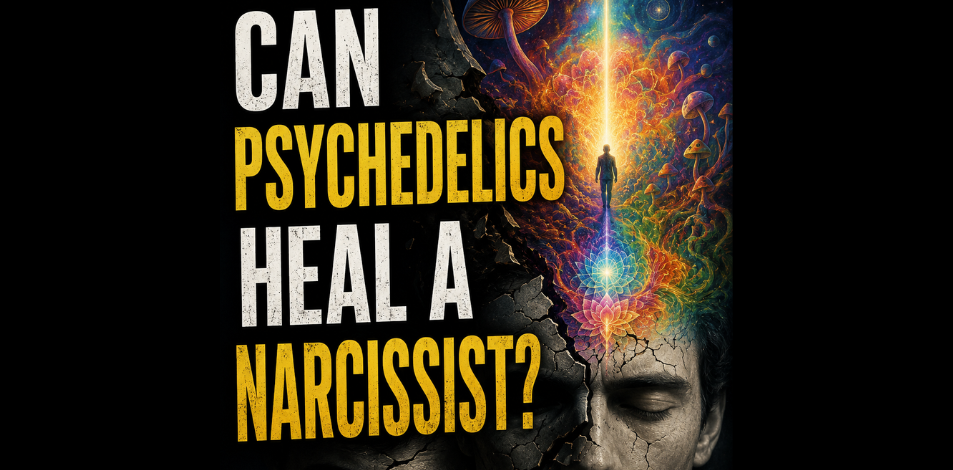
Neither regular therapy nor the passage of time can revive the neglected true self. However, despite the limitations of research on hallucinogens at this stage due to their legal status, the world is beginning to recognize their ability to awaken dormant elements of the soul through states of consciousness that transcend the ordinary.
With hallucinogens, anything seems possible. Dormant memories become accessible not only from the present life but also from past lives through ancestral DNA. Hallucinogens can bring to the surface pain and trauma inherited across generations for processing and release. States of peace, love, strength, and wonder can be evoked in ways the mind cannot comprehend. Hallucinogens offer not just another world of therapy, but an entire world.
Three types of hallucinogens, in particular, hold tremendous therapeutic potential:
- MDMA
MDMA works by increasing serotonin activity in the brain, stimulating feelings of love, joy, and peace, and elevating the senses to unprecedented levels.
When MDMA is taken, the outside world awakens and shines, transforming into a dazzling, luminous realm. This is why it is used as a recreational drug at parties. It allows for a deep connection with people and music, creating a sense of oneness with the world, the universe, and all of humanity.
Related : Why God Is Not Enough For A Narcissist
MDMA is also being explored as a potential treatment for trauma. Thanks to the increased serotonin levels, a person can experience deep relaxation and a feeling of complete security. With a sufficient dose, all feelings of anxiety, fear, doubt, and suspicion fade away. The resulting relaxation allows the traumatized person to emerge from their physical isolation and regain access to their true self. The influence of the ego diminishes, allowing the person to direct their consciousness toward their true self and experience it directly.
With MDMA, a person can access painful memories without experiencing fear or the associated negative emotions. It can evoke, accept, grieve, and release the associated trauma with minimal discomfort. This is the power of MDMA.
MDMA desensitizes and softens the trauma, facilitating the cleansing of the true self and creating lasting changes in one’s relationship with oneself. It can also dissolve tension and resistance in the body, allowing for more sustainable access to one’s emotions in the future.
MDMA’s effects are predictable, as the increased serotonin works in roughly the same way for everyone. However, when used in a therapeutic setting, its applications are multifaceted. Individuals with complex trauma have unique wounds, and therefore, the way these wounds are treated and healed must also be unique. MDMA can be used as a powerful tool for accessing and healing the true self in ways previously unimaginable. The effects of MDMA typically last between two and four hours, offering a golden opportunity for healing when taken under the supervision of a qualified professional.
- Magic Mushrooms
The rules of reality can be disregarded when taking magic mushrooms. In high doses, the mushroom alters color perception or causes vivid visual hallucinations when the eyes are closed. This is where things start to get strange.
Some may experience joy and a sense of oneness with the world, emerging with a deeper sense of self and a greater appreciation for life. Others may have horrific experiences, as if being thrust into the depths of a hell within their souls. Lifelong traumas may be triggered, or the power of the universe may flow through you. Profound and unexpected truths and insights about your family, relationships, life, or the universe itself may suddenly surface.
MDMA affects each person uniquely, to some extent, depending on their traumas, temperament, and personality. Magic mushrooms are unpredictable, and their effects vary from person to person. Every session is unique. The range of experiences is vast, as is the potential for transformation.
Generational traumas may suddenly become accessible, allowing someone to release centuries of accumulated pain in a single session. It’s natural for this confrontation to push a person to the brink of madness. Therefore, it’s essential to have a qualified therapist by their side to manage their condition, support them, and help them through their transformation.
- Ayhuasca
From Wikipedia: Ayhuasca is a hallucinogenic drink from South America, traditionally used by indigenous cultures and folk healers in the Amazon and Orinoco basins for spiritual rituals, divination, and the treatment of a variety of psychosomatic ailments. Ayhuasca is the plant that allows the spirit to soar, separate from the body, and enter the spiritual realm, forbidden to the living.
Ayahuasca is both a powerful and terrifying drug, not for the faint of heart. It can take you on a journey through thousands of years of your lineage, connecting you to archetypes and forms of energy in the subconscious, and transporting you through the universe to the depths of all its mysteries. It cannot be described; it must be experienced. Even after its effects wear off, what one has witnessed cannot be fully comprehended. One can only select certain fragments of the experience and integrate them into one’s life.
Profound, unexpected, and lasting transformations may occur without any apparent conscious intention. We have witnessed cases where people have overcome addiction, healed deep psychological traumas, and undergone radical personality and behavioral transformations after taking ayahuasca.
This drug, known as “Mother Ayahuasca,” is said to possess a wisdom and power that transcends human comprehension. When Mother Ayahuasca affects someone, it seems to know what they need and how they need it. It can be gentle and playful, or harsh and destabilizing, affecting every cell of the person’s soul. Much could be said about this drug, but leaving some mystery about it seems appropriate in this case.
The Deceptive Path To Enlightenment
As you may have noticed, hallucinogens, especially magic mushrooms and ayahuasca, can be dangerous. The unpredictability of their effects and their immense power can drastically alter a person’s life in any direction—for better or for worse.
As with any treatment, it is strongly advised to prepare yourself and your environment to ensure a successful and safe treatment experience. Prolonged fasting, mental preparation (preparation), and working with an experienced practitioner in a safe environment (the appropriate setting) are crucial. Most people experience hallucinogens without any side effects and feel deeply grateful for what they discover. It is now clear that radical change is possible with hallucinogens.
However, even with careful preparation and support, hallucinogens can have serious effects. There have been documented cases of prolonged psychosis following the experience. Others have needed months to recover from the trauma of what they saw and experienced. In rare cases, hallucinogens have been fatal.
Anyone considering trying hallucinogens should pause and think carefully before making that decision. First, they should consider whether they truly want to try them. If they have doubts, there is probably a valid reason.
Second, they should understand the risks. Although the effects of hallucinogens are unpredictable, and no one can be completely prepared for them, a period of reflection and experimentation is essential before using them. With the right attitude and proper respect, the chances of success increase, while the risks cannot be entirely eliminated.
A Powerful and Volatile Tool
Rather than being a magic cure, hallucinogens can be considered a powerful tool with high potential for spiritual transformation and healing, as well as for treating psychological trauma.
Some patterns formed in early childhood cannot be changed because they are developmental patterns. That is, they are acquired and internalized through direct experience within the context of relationships. For example, hallucinogens cannot heal the wounds of feeling ignored, unloved, and unprotected in early childhood. They cannot fill the voids left by poor upbringing. They cannot recreate an idealized life.
Above all, hallucinogens cannot magically cure narcissism or any other disorder. The true self is multifaceted and extremely complex. What hallucinogens can do is help release trauma and pain while altering consciousness in a way that leads to unprecedented insights.
When using hallucinogens, it is advisable to set an intention for the experience and to be purposeful and specific in your desire for transformation. This allows the most pressing problems in a person’s life to be subjected to the influence of hallucinogens, enabling a unique transformation.
After taking hallucinogens, a narcissist may overcome grief over childhood losses. They may gain a deeper understanding of the experiences of both their abusers and those they have abused. Their connection to the spirit may deepen. Their fear of death may lessen. Love may even take root in their heart. However, ultimately, these aspects must be integrated and utilized as part of a holistic whole. The narcissist will still need to evaluate themselves, find the courage to confront their flaws, wounds, and pain, and then integrate their awakening into their daily life.
Many of the changes brought about by hallucinogens fade in the months leading up to their withdrawal, especially if they are not fully absorbed. Some realizations are too overwhelming to confront, and, as is human nature, procrastination and denial may set in once the “magic” wears off. Furthermore, it may take several sessions with hallucinogens to achieve sufficient understanding to allow for genuine change. Dealing with these substances is a gradual process, not a one-time pill.
Most importantly, while hallucinogens can illuminate and revive aspects of one’s true self, they cannot force a person to change, especially a narcissist. That decision rests with them.