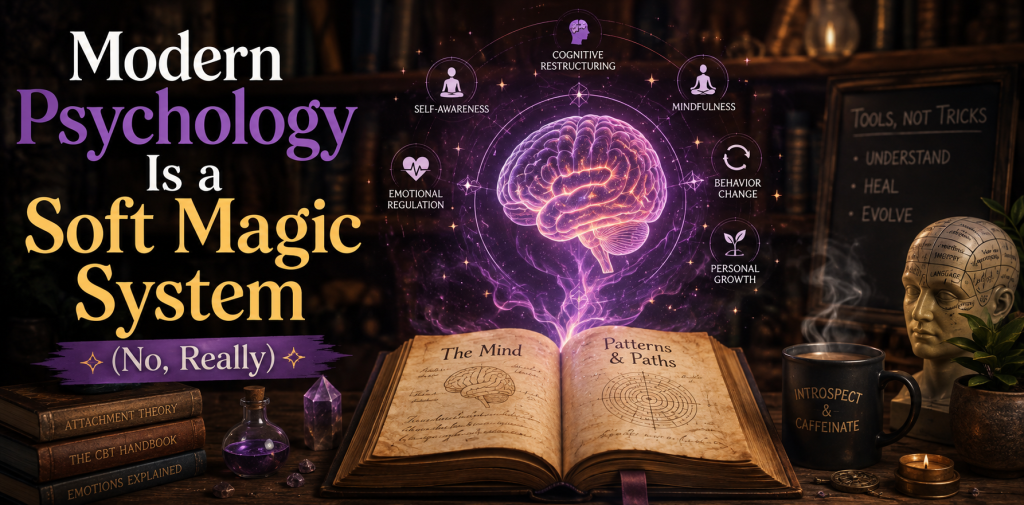
Fantasy nerds love arguing about magic systems. Not which one is coolest — which one is better designed. And somewhere along the way, a useful vocabulary emerged for talking about this: hard magic versus soft magic.
Here’s the short version. In a hard magic system, the rules are spelled out. You know exactly what the magic can and can’t do, so when a character solves a problem with it, it feels earned — like watching someone win a game by the rules you already understand. In a soft magic system, the rules stay foggy on purpose. Nobody, not even the characters, can fully explain how the magic works. That vagueness buys you wonder and mystery, but it costs you precision — you can’t build a satisfying puzzle out of a power nobody understands.
Now here’s the part that’s going to sound unhinged: modern psychology, especially the version most of us actually interact with, behaves a lot more like a soft magic system than a hard science. And once you see it, you can’t unsee it.
What a “Soft Magic System” Actually Means
Picture the difference between a magic system built around a clear resource — burn a specific metal, get a specific power, every single time — and one where an old, powerful figure occasionally does something impressive and everyone just sort of accepts that’s how it works. The first kind rewards a reader who pays close attention, because the rules are learnable and consistent. The second kind isn’t broken or lazy — it’s doing a different job. It’s optimized for awe, not for solvability.
Crucially, soft magic isn’t fake magic. Things still happen. Effects still occur. It’s just that the mechanism stays mostly out of view, and the people using it often can’t tell you precisely why it worked this time and not last time.
The Uncomfortable Parallel
Swap “magic” for “the mind” and the pattern starts looking eerily familiar.
The Rules Feel Like Vibes, Not Laws
Attachment styles. Love languages. Toxic this, gaslighting that, “he’s got main character energy.” These concepts spread because they feel true — they give people language for something real they’re experiencing. But they don’t behave like laws of physics. Two people with the same “anxious attachment style” can behave in opposite ways in the same relationship. The frameworks are more like weather folklore than orbital mechanics: often useful, rarely precise, almost never falsifiable.
Even inside clinical psychology, categories like the ones in diagnostic manuals aren’t discovered the way elements on the periodic table are discovered. They’re negotiated — committees reach consensus on where to draw lines between conditions that actually exist on messy, overlapping spectrums. That’s not a knock on the people doing the work. It’s just a very different kind of “rule” than F = ma.
It Explains Everything, Predicts Almost Nothing
Soft magic has a signature move: whatever happens, the magic can explain it after the fact. Nobody saw it coming, but nobody’s surprised either.
Pop psychology does the same trick disturbingly well. Person succeeds — must be their secure attachment. Person fails — must be unresolved childhood trauma. Person is generous — inner child healing. Person is stingy — scarcity mindset from their upbringing. Almost any outcome can be retrofitted with a plausible-sounding psychological story. That flexibility feels like insight. It’s often just narrative elasticity — a framework so accommodating it never has to risk being wrong. Researchers who study why the field has struggled to replicate many classic findings point at exactly this: theories loose enough to explain any result in hindsight rarely make sharp, falsifiable predictions in advance.
The Experts “Feel” It More Than They Can Explain It
Good therapists are the wizards of this metaphor, and that’s not an insult — it’s genuinely how the craft works. A skilled clinician can walk into a session and do something that visibly helps a person, without being able to hand you a step-by-step manual for why that exact intervention worked on that exact day. Researchers who study why therapy works keep bumping into the same humbling finding: the specific technique — CBT, psychodynamic, whatever’s on the brochure — matters far less than things like the strength of the relationship between therapist and client, and whether the client believes change is possible. The “spell” isn’t really the technique. It’s something closer to trust, delivered consistently, by someone who’s done this a thousand times.
Why That’s Not Automatically a Bad Thing
Here’s where the metaphor earns its keep instead of just being a fun jab. Soft magic in fiction isn’t a design flaw — it’s a deliberate trade. You give up the satisfaction of a cleanly solved puzzle in exchange for something a hard system can’t give you: genuine mystery, and room for meaning that isn’t fully mechanical.
Related : The Key to a Healthy Mind
Psychology’s “soft” layer does something similar for real people. Most of us don’t turn to a personality framework or a relationship concept because we need a peer-reviewed mechanism — we turn to it because we need a story that helps something painful or confusing make sense. “I have an anxious attachment style” might not be a rigorously validated diagnostic fact, but as a narrative, it can genuinely help someone recognize a pattern and start changing it. The story doing real work doesn’t require the story to be a hard law.
Where the Metaphor Breaks Down
To be fair to psychology as a field: not all of it is soft magic, and it would be sloppy to pretend otherwise. Cognitive neuroscience, psychophysics, reaction-time studies, and a good chunk of behavioral research operate much closer to hard magic — controlled variables, precise measurement, results that replicate under the same conditions. That’s the machinery running underneath the folklore.
The soft-magic problem lives mostly in the layer most people actually consume: self-help content, personality quizzes, therapy-speak borrowed secondhand from social media, and diagnostic labels people apply to themselves without a clinician in the room. That’s the pop-psychology surface, not the entire iceberg. It’s worth keeping the two separate instead of throwing out the field because the paperback version got mystical.
How to Actually Use This
None of this means you should stop using psychological concepts to understand yourself — it means using them the way a smart reader uses a soft magic system: with appreciation, and without mistaking atmosphere for a rulebook.
- Treat frameworks like attachment styles, love languages, or personality types as useful lenses, not verdicts. They’re for generating self-understanding, not settling arguments.
- Notice when a framework is being used to explain everything — that’s usually the tell that it’s explaining nothing in particular.
- For anything serious — real distress, a real diagnosis, a real crisis — go to a credentialed professional working from evidence-based practice, not a quiz result. Hard magic exists in this field too; that’s where you want it.
- Hold the mystery lightly. It’s okay for some of your own mind to stay a little unexplained. That’s not a failure of psychology — it might just be the genre it’s working in.
The Bottom Line
Soft magic systems get a bad reputation from readers who wanted a puzzle and got poetry instead. But poetry isn’t a lesser form — it’s a different one, doing a different job. Modern psychology, at least the version most of us live inside day to day, might be less a science handing down provable laws and more a very old, very human kind of magic: mysterious, occasionally spectacular, impossible to fully explain even by the people best at using it — and still, somehow, real enough to change a life.