Have you ever tried everything to keep the peace in a relationship, only to find yourself being blamed for the very reaction their behavior caused?
You explain how much their words hurt. You ask them to stop. You try to communicate calmly, choose your words carefully, and avoid arguments. Yet somehow, nothing changes. The same behavior continues until you reach a point where you simply cannot take it anymore.
Then something strange happens.
The moment you finally raise your voice, cry, become angry, or defend yourself, they suddenly act shocked. The conversation is no longer about what they did. Instead, it becomes about your reaction.
Suddenly, you’re the aggressive one. You’re the difficult one. You’re the person who supposedly needs help.
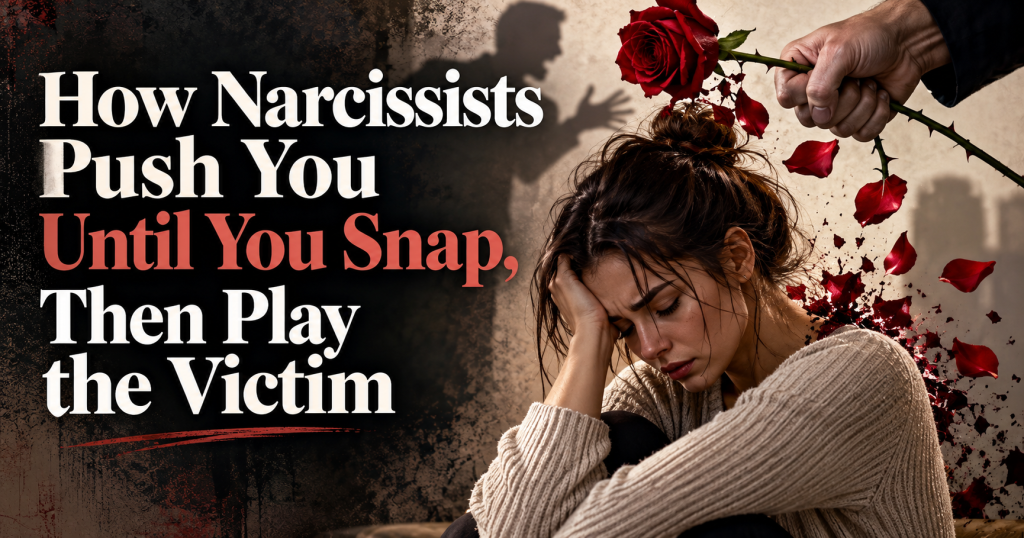
This is one of the most confusing experiences people describe when dealing with narcissistic behavior. It’s not just about being pushed to your emotional limits. It’s about having those limits crossed repeatedly and then being blamed for finally reaching them.
1. They Ignore Your Boundaries Until You Become Emotionally Exhausted
Healthy relationships require respect for boundaries. You should be able to say that something hurts you without having to repeat yourself a hundred times.
But in a toxic relationship, boundaries can become another opportunity for manipulation.
You might say:
- “Please stop making jokes about my insecurities.”
- “I don’t want to argue anymore.”
- “I need some space.”
- “You can’t keep speaking to me like that.”
Instead of respecting your requests, the other person may dismiss your feelings, mock your boundaries, or deliberately repeat the behavior.
Over time, you start feeling as though your words have no value.
You become exhausted from explaining the same things, and eventually, your emotional tolerance begins to disappear.
The painful part is that you may start questioning whether you’re asking for too much when all you’ve wanted is basic respect.
Related: Why Narcissists Target Strong People
2. They Keep Provoking You, Then Focus on Your Reaction
One of the most damaging dynamics in emotionally abusive relationships is when someone repeatedly engages in hurtful behavior but refuses to acknowledge its impact.
They might make cruel comments, bring up your past mistakes, dismiss your feelings, or deliberately turn simple conversations into arguments.
When you finally react, they suddenly become focused on your tone.
They don’t discuss the insults. They don’t acknowledge the repeated disrespect. They don’t remember the conversations where you calmly asked them to stop.
All they want to talk about is how you reacted.
This can leave you feeling guilty, confused, and desperate to explain yourself.
You might even apologize for shouting while completely forgetting that the original problem was never resolved.
Your reaction becomes the distraction, and their behavior disappears from the conversation.
3. They Use DARVO to Reverse the Roles
There is a psychological manipulation pattern known as DARVO, which stands for Deny, Attack, and Reverse Victim and Offender.
This concept describes how someone confronted about harmful behavior may respond by denying what happened, attacking the credibility of the person confronting them, and presenting themselves as the real victim.
For example:
You: “You constantly disrespect me, and I’ve asked you to stop.”
Them: “I never do that. You’re always exaggerating.”
You: “I’ve tried talking to you about this so many times.”
Them: “Look at how you’re speaking to me. You’re the one who treats me terribly.”
Suddenly, you’re defending your character instead of discussing their behavior.
Research published in the Journal of Aggression, Maltreatment & Trauma examined how DARVO can influence perceptions of victims and perpetrators. The researchers found that exposure to this tactic could make victims seem less believable and more responsible for the situation in the eyes of observers.
This helps explain why role reversal can be so emotionally damaging. It doesn’t just create conflict between two people. It can also influence how others understand what happened.
4. They Act Shocked When You Finally Lose Your Patience
Perhaps the most frustrating part is watching someone act surprised by a reaction that didn’t happen overnight.
They may have witnessed your tears, heard your explanations, and watched you struggle emotionally for months or even years.
Yet when you finally reach your breaking point, they behave as though your reaction came out of nowhere.
They might say:
- “I can’t believe you’re treating me this way.”
- “You’ve completely changed.”
- “I don’t recognize you anymore.”
- “You’re becoming a horrible person.”
- “I never thought you could behave like this.”
Notice what’s missing from these statements: accountability.
There is no acknowledgment of the repeated arguments, the ignored boundaries, or the emotional pain that came before that moment.
Instead, the entire story gets reduced to one incident: your reaction.
And because you may not be proud of how you reacted, you start questioning yourself.
But one emotional reaction does not erase the history that led up to it.
Related : A Man Who Doesn’t Want to Lose You: 5 Clear Signs
5. They Use Your Emotional Reaction Against You
In some toxic relationships, personal information becomes ammunition.
The things you shared during vulnerable moments may later be used to discredit you.
If you’ve ever cried during an argument, they might describe you as unstable.
If you’ve ever raised your voice, they might tell others you’re aggressive.
If you’ve ever struggled emotionally, they might use that experience to suggest that your feelings cannot be trusted.
This creates a painful situation where you begin monitoring every word, every facial expression, and every emotional response.
You become afraid of showing frustration because you know it might be used against you later.
Eventually, you may stop expressing your feelings altogether.
You don’t do this because everything is suddenly fine. You do it because explaining yourself has become exhausting.
6. They Tell a Different Story to Other People
When someone consistently presents themselves as the victim, they may also try to influence how friends, relatives, or mutual acquaintances perceive the relationship.
They might share selected details about an argument while leaving out everything that happened beforehand.
They may describe your reaction without mentioning what triggered the conflict.
Sometimes, they might even portray themselves as the patient person who tried everything to make the relationship work.
This can be particularly painful because you suddenly feel misunderstood by people who never witnessed what happened behind closed doors.
You may feel tempted to explain every detail and prove that you’re not the person they’ve described.
But constantly defending yourself to everyone can become another exhausting cycle.
You don’t need every person to understand your experience for that experience to be real.
7. You Start Believing That You’re the Problem
Perhaps the deepest consequence of this dynamic is what happens inside your own mind.
After enough arguments, blame-shifting, and emotional confusion, you may begin questioning your personality.
You ask yourself:
“Am I really too sensitive?”
“Why can’t I stay calm?”
“Maybe I’m the toxic one.”
“Why do I become someone I don’t recognize around this person?”
These questions can become overwhelming.
You might even miss the person you were before the relationship became emotionally exhausting.
But it’s important to understand something: recognizing that you sometimes react poorly is not the same as accepting responsibility for someone else’s repeated harmful behavior.
You can take accountability for your reactions without taking responsibility for another person’s choices.
Both things can be true.
Related : Narcissists and God: 7 Signs of Spiritual Manipulation
8. How to Stop Getting Pulled Into the Same Cycle
Breaking this pattern doesn’t necessarily mean finding the perfect words to make the other person understand.
Sometimes, you’ve already explained yourself enough.
The next step is to focus on protecting your emotional well-being.
Stop overexplaining your boundaries.
A boundary doesn’t need to become a long debate. State what you are comfortable with and decide what action you will take if that boundary is ignored.
Recognize when a conversation is going nowhere.
If every discussion turns into an argument about your personality, consider stepping away rather than continuing to defend yourself.
Keep track of repeated patterns.
Writing down incidents can help you maintain perspective, especially when conversations repeatedly leave you confused about what happened.
Stop measuring your worth through their approval.
You don’t need someone who repeatedly dismisses your feelings to confirm that your feelings matter.
Seek support outside the relationship.
Talk to someone you trust or consider working with a qualified mental health professional. If you feel unsafe, prioritize your safety and seek appropriate local support.
Most importantly, remember that leaving a harmful dynamic or creating distance doesn’t require winning an argument first.
Final Thoughts: Your Breaking Point Doesn’t Erase What Happened Before It
One of the hardest things about experiencing narcissistic or emotionally abusive behavior is realizing that the person who repeatedly hurt you may never acknowledge the damage.
You may never receive the apology you deserve.
You may never get an honest conversation about what happened.
And you may never convince them to see the situation from your perspective.
But you don’t have to spend the rest of your life trying to prove that your pain was real.
You can acknowledge your mistakes without accepting blame for everything. You can work on managing your emotions without allowing someone to repeatedly disrespect your boundaries.
And you can choose peace without waiting for someone else to agree that you deserve it.
Remember: The fact that you finally reacted doesn’t mean the pain that came before your reaction never existed.
Sometimes, the most important step in healing is no longer allowing someone else’s version of the story to become your truth.