Recovering from complex trauma is a daunting and challenging endeavor, as the damage is rooted in thousands of experiences and deeply embedded in a person’s being from a young age. It can feel like trying to untangle a long thread that has been tangled in a washing machine for decades.
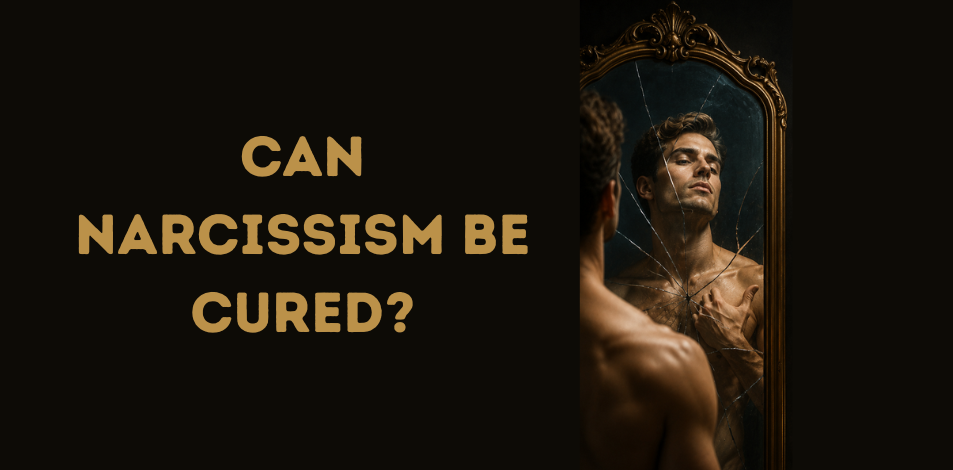
Since narcissism is a post-traumatic condition, we can ask the same question: Can it be treated? The short answer, as most people know, is no. But the longer answer reveals more details and possibilities.
The first thing to consider is: Is your narcissism subtle or overt? This is important because the path to recovery differs depending on the type of narcissism.
Overt Narcissism
An overt narcissist will find it extremely difficult to recover from their narcissism because they are addicted to feeling euphoric. They have a firm belief in their uniqueness and a constant supply of narcissistic gratification throughout their lives, both of which are difficult to relinquish. Why be ordinary when you can be powerful?
Overt narcissists typically operate within a social hierarchy that reinforces their narcissism. Consider the spiritual leader, or the spoiled child in the family. External forces reinforce their sense of uniqueness. Narcissistic parents can always hone their skills against their children, feeling superior simply for having given birth. Children, in turn, are conditioned to see their parents as special and more powerful than themselves. This dynamic can be intoxicating for the parent.
Spoiled children, in turn, receive reinforcement from their parents. Together, the narcissistic parent and spoiled child reinforce each other’s narcissism. Even lone wolves tend to have a constant source of unexpected targets to exploit. As long as the flow of narcissistic gratification continues, why stop?
Suppose the apparent narcissist runs out of gratification, or loses their position in the hierarchy of dominance. What then? The consequences of a life spent denying their true self await them. Toxic shame, anger, panic, and emptiness await them. Will they brave the dark night of the soul, endure the agonizing suffering and radical transformation, and emerge unscathed?
Yes, recovering from narcissism doesn’t lead to anything special. That’s the basic idea. You’re not special just because you decided you were. You’re a living, breathing human being, tasked with self-realization and contributing your talents to the world. Being true to yourself brings real rewards, but it also brings challenges and responsibility. There’s no magic bullet. Therefore, you need cooperation, humility, empathy, patience, shared power, and accountability. Being a healthy human being is difficult and uncomfortable.
But what about the other side of the coin?
Hidden_Narcissism/Vulnerable_Narcissism
The hidden narcissist faces a different challenge. While the overt narcissist enjoys constant external validation, the hidden narcissist has nothing. The hidden narcissist appears completely normal, with nothing remarkable at first glance. But their “distinction” lies hidden, deep in their inner shadow, lurking, waiting for the opportune moment to emerge.
The hidden narcissist might be the spouse of an overt narcissist. Hidden narcissism can even be passed down to the lost children and scapegoats of a narcissistic family. The hidden narcissist is the forgotten one, hiding in broad daylight. They are the one repeatedly wounded by narcissism, without ever experiencing the benefits of distinction. They have suffered shame and profound psychological trauma, leading them to isolate themselves. To preserve their sanity, they have created a “distinctive” version of themselves. This is very similar to the overt narcissist, except the covert narcissist doesn’t receive external validation for their false self-image. Often, they feel ashamed but soothe themselves by imagining themselves as special.
Related : The 12 Labours Of A Narcissist
In the past two years, while writing several books on narcissism and narcissistic abuse, I discovered my own covert narcissism. It’s so insidious and difficult to recognize that even someone who has spent years thinking about the subject might have missed it for a while. The covert narcissist believes they are just, loving, and even a victim.
Where Is The Narcissism In That?
Covered narcissism is a topic in itself, but its main characteristic is its opaque way of operating. Even if someone doesn’t have narcissistic personality disorder, they may exhibit narcissistic behaviors without realizing that they stem from a narcissistic wound. They hide their pathological shadow, which is then exploited by overt narcissists for their own purposes. It may seem harmless, but beneath the surface lies a massive narcissistic iceberg. This is the most terrifying aspect of covert narcissism.
Therefore, a covert narcissist is unlikely to seek treatment because, firstly, they cannot see the problem. Furthermore, they are in so much pain, dealing with so much shame and trauma, that they cannot even contemplate confronting themselves. Looking inward is so painful that most people probably never dare to do it. There is nothing to reinforce their narcissism, but there is an inner pain that holds them back.
No Way Out
Narcissism manifests itself in ways we cannot imagine. We may all resort to narcissistic coping mechanisms when our sense of self is threatened. Narcissists, whether overt or covert, often end up in cohabiting relationships that reinforce each other’s narcissism and distract them from seeing their true selves. Pain keeps us stuck. Denial keeps us stuck. Upbringing keeps us stuck. Anger keeps us stuck. Shame keeps us stuck. Trauma keeps us stuck. External reinforcement keeps us stuck. Recognizing, accepting, and healing narcissism is no easy feat.
We humans are prone to failing. That’s why we need external help: a community of people, moral values, and a God who loves and guides us in times of pain and despair.
Crossing The Maze
Dealing with narcissism is difficult. In every relationship, in every social group, power struggles and hierarchies are inevitable.
Relationships, by their very nature, are based on establishing and managing power, and the best outcome is a balance of power. Mutual needs are met with love, and mistakes are discussed and addressed. No one is perfect, but love heals and guides the relationship enough for it to succeed.
Related : The 12 Labours Of A Narcissist
In other cases, the imbalance can become so severe that it’s sometimes difficult to determine who is being more narcissistic. The abuse is obvious to everyone except the victim. There’s even a hint of narcissism in codependency behavior, where the dependent person uses their sense of grandeur by believing they can save someone else. It’s a murky situation.
Fulfilling your needs in this life means that a healthy degree of narcissism is necessary. You have to consider yourself special enough for people to take you seriously and support your growth. Narcissism isn’t bad in itself; it only becomes so when it becomes corrupted.
But why does it become corrupted?
The Power Of Community
I believe that greatness is tempered by the ethics of our society. Every individual possesses the potential for boundless power, but realizing this power depends on the society in which we live. It is essential to have someone who supports us and guides our behavior simultaneously. We must know what is permissible and what is forbidden, what is right and what is wrong, what is ethical.
Even with a set of ethics and principles, adhering to them is not easy. We need to feel that there is a valid reason for doing so. Deviation is all too easy when there is no accountability. Why not resort to manipulation and control to achieve the goal? Often, this is the easiest path. This is especially true in urban culture, where people live in cities filled with unknown faces. However, families isolated from their surroundings can be corrupted in the same way.
Human beings need something meaningful and valuable to strive for, and this striving is nourished by their love for their tribe or community. A person flourishes when they have a purpose and when they are connected to God as they understand Him. A man may be filled with a sense of purpose and courage when he falls in love with a virtuous woman and looks into the eyes of their first child. A woman may feel connected and empowered by her siblings, by having members of her community who care for her and encourage her to uphold high moral values. Her strength comes not from unbridled pride, but from shared humanity and a common purpose. She prays to God as she understands Him, and her needs are met. Why would she seek more? She has everything she needs.
The Original Break
Trauma can disrupt this harmonious process. War. Famine. Poverty. Exile. Many families lose their way when they lose their heritage. Often, the head of the family is separated from or torn from their original family. This leaves them isolated in a world that does not welcome them. Their wounds make them arrogant and bitter, and they develop a narcissistic personality as compensation. They find a partner who encourages their narcissism, and they have children. Thus, the narcissistic family is born, and narcissism spreads. Absolute power corrupts absolutely. In the absence of a higher power to restrain the dominant narcissist, narcissism runs rampant.
Without a higher power, narcissism becomes a god. So, if anyone wants to recover from their narcissism, they must recognize this and ask themselves: Who is my god? Will I need spiritual practice in my search for God? Will I join a community with humility and openness, ready to serve instead of imagining myself a divine leader?
I believe that love, acceptance, and a shared sense of shame can begin the healing process. This has helped me immensely, even though I am a very passionate person. I still have a lot to do, but my self-confidence and moral compass have been radically transformed. I know how to fiercely defend my principles while also making some compromises. I prioritize myself and then strive to empower and love the others in my life as much as I can. I often fail, having hurt many with my unconscious narcissism and flawed moral principles. My deep wounds still affect my relationships, but I constantly strive to rise again, learn from them, and grow as a complete human being.
However, none of this would have been possible without my spiritual awakening.
A Gap in Consciousness
When I was 26, I had a fight with my partner and was on the verge of exploding with rage, even resorting to violence. Terrified, I ran out of the house and into the street, driven not only by the overwhelming energy of anger but also by a desperate desire to escape the chaos I had helped create over seven years of our relationship. I reached the end of the street. My fists were clenched, my breath came in short, shallow gasps, my jaw and shoulders were tense, and I was about to lose my mind. What more could I do? I was about to explode…
And I did. It was the most peaceful, wonderful, and meaningful experience of my life. My hands relaxed, my breathing calmed, and the muscles in my jaw and shoulders loosened. I felt like I was standing on a beach on a calm summer day. I knew.
What did I know? Simply that God’s hand had touched me. And like a flash of lightning, the spirit of consciousness shone through me. I was conscious for the first time in my life. The spell of the unconscious was broken.
But it wasn’t completely shattered; it was just a crack. But it was enough. A dividing line was drawn in my history, and I embarked on a completely different path. I’ve made many mistakes since then, and I’ve struggled to understand everything, but little by little, things slowly fell into place. I had to shed many layers, shed many tears, reach countless realizations, and experience so much to become the person I am today. But none of this would have been possible without that gap in my consciousness. Without that tiny crack that appeared in the hard shell of my ego, like a thunderbolt that struck me that day.
Can a narcissist heal unconsciously? I have some doubts. When the true self finds a crack, I believe the truth will visit you whether you like it or not. I think that’s what victims of narcissistic abuse hope for: that one day the narcissist will be shocked and see the error of their ways.
Not everyone wakes up. Some people pass through life unaware, and depart from it the same way. Perhaps they will see the truth for the first time when they pass through those golden gates. Who knows? It is not your responsibility to awaken them. Your task is to strive for your own awakening, and through the radiance of your own light, we hope to inspire and awaken others with your presence. Nothing more, nothing less.
If, during your journey, you are confronting your own narcissism, I hope this article helps you gain a broader perspective and inspires you to become a more complete, mature, stronger, and more loving person.