In my practice, I see many couples where one partner lacks empathy, is selfish and arrogant, and believes they bear no responsibility in any situation (I’ll use the third person here because, although narcissists exist in both sexes, narcissism is more commonly observed in men). This partner may meet the criteria for narcissistic personality disorder, even though they haven’t been formally diagnosed, because narcissists typically see no reason to seek individual psychotherapy.
Treating narcissists in couples counseling is extremely difficult because they avoid any suggestion that they might be contributing to the current marital problems. They blame either their partner or circumstances beyond their control (such as their job or other family members) for every conflict within the relationship.
The non-narcissistic spouse usually suffers from low self-esteem. Then, in a vicious cycle, being with a narcissist leads to even lower self-esteem. (Another common pattern is a narcissist marrying another narcissist, but this couple is unlikely to acknowledge any problems in their marriage or seek psychological help.)
Conflict arises in a marriage when the non-narcissistic spouse desires closeness and emotional fulfillment from their narcissistic partner, but feels repelled, as if the narcissist doesn’t truly know or care about them. The narcissist often resorts to psychological manipulation, denying reality to their partner, either directly through lies or indirectly by refusing to acknowledge any wrongdoing. For example, conversations might occur like this:
So, we have a dynamic where one partner acts as if they are infallible, refusing to acknowledge any role in marital problems and believing they don’t need to make any effort to fix the marriage, while the other is desperate to improve the situation and feel known, understood, and appreciated. The non-narcissistic spouse may sometimes act irrationally because they desperately crave being heard and understood by the narcissist, perhaps by screaming, crying, or throwing things. This backfires, because the narcissist will think, or say outright, “Of course I don’t want to be near you; you’re crazy.” This, in turn, makes the wife feel even more insecure and unstable, and consequently, she strives to repair the marriage.
Related : 6 Signs of a Friend with Narcissistic Traits
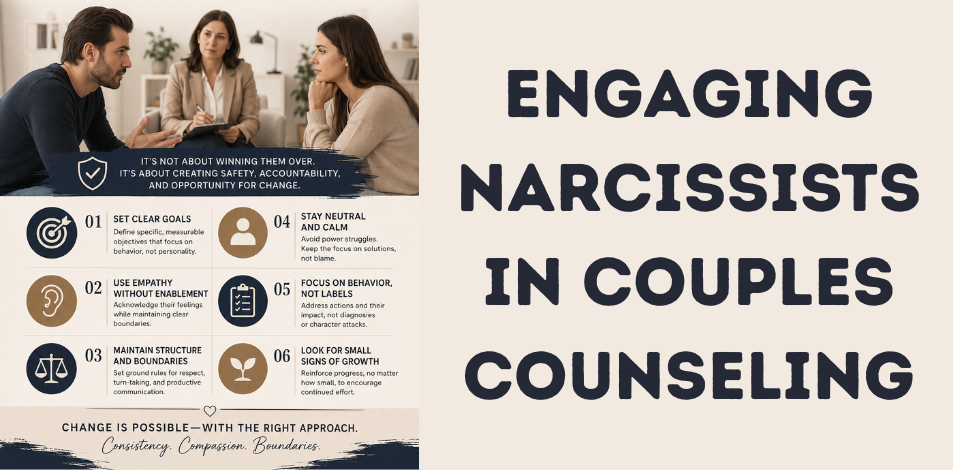
This couple is difficult to deal with, but the success of therapy depends on developing empathy in the narcissist toward their spouse’s perspective and feelings. Even a small step toward understanding their point of view can improve the marriage. On the other hand, it’s essential to boost the wife’s self-esteem and confidence. If she can value herself and find support from others, in her work, or in any other area, she won’t be dependent on the narcissist for validation.
One approach to helping a narcissist explore their more empathetic side is to start with what they already excel at and build upon it. Many narcissists are adept at interacting with their children (especially when they are too young to reject the parent or their values) and their pets because they enjoy relationships where others look up to them. Children are often seen as extensions of the narcissist’s personality. If the narcissist possesses any capacity for empathy, it will manifest here.
Therefore, a narcissist can be encouraged to develop empathy for their spouse by acknowledging their empathetic behavior toward children or pets and relating these situations to their own marriage. For example: Just as you were wonderful at comforting Josh when he lost the game, I hope you will show empathy for your wife when she is feeling down or lonely.
Furthermore, narcissists often crave the admiration of others, and their desire to demonstrate their quick learning to the therapist can actually benefit the couple. As long as the therapist praises the narcissist’s efforts, they will strive to excel in therapy, which may include acquiring empathy skills. In fact, this is a skill the narcissist likely didn’t develop at home, so they are often very curious about it and how to use it to improve their communication with others. Narcissists often respond positively to the idea of learning from experts, such as therapists, and pride themselves on being the best learner of therapy the therapist has ever seen.
This change may seem superficial at first, as it is driven by external rather than internal motivations. But in reality, if the narcissist sees that empathy is effective and changes their spouse’s behavior and feelings toward them, it will strengthen their desire to continue therapy, as it offers the opportunity for deeper and more fundamental personality change. The marriage will also stabilize if the wife finally feels heard and understood for the first time in the relationship, giving her a safer base from which to explore ways to boost her self-esteem and identity outside of marriage. In general, teaching basic empathy and validation skills can be an effective way to gain initial agreement from the narcissist in couples counseling sessions, allowing for deeper change to occur later.