Individuality, spontaneity, and agency are meaningless in a narcissistic family. Each member is reduced to a mere role serving the inflated, false self of the narcissistic parent.
The spouse is a crucial pillar for legitimizing the narcissist’s ego. They also serve as an emotional shield, protecting the narcissist from having to reveal their vulnerability to the children. The spouse typically assumes the responsibility of resolving conflicts and maintaining peace within the home.
The favored child becomes the embodiment of the narcissist’s “bright” side. They are the narcissist’s devoted disciple, the one on whom the narcissist pins their hopes and dreams.
As for the “dark” side of the narcissist’s ego, frustrations and negative emotions are absorbed to preserve the integrity of the false self. Ultimately, the “superior” and “special” individual cannot have flaws. Therefore, the scapegoat within the family serves as an outlet. The narcissist shames, humiliates, and lashes out at the scapegoat, blaming them for every mistake. While the spoiled child is infallible, the scapegoat is infallible.
Finally, the perfect child serves as the narcissist’s talisman, playing a symbolic role in projecting a positive image of the family to the public.
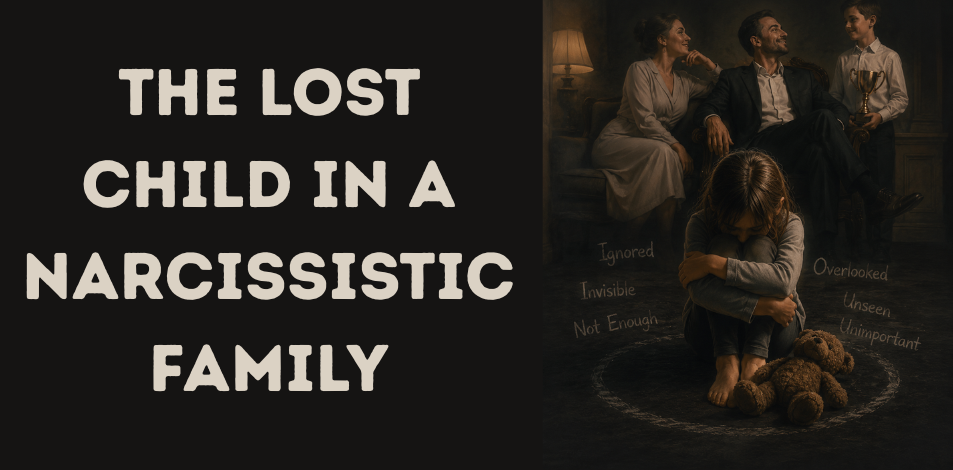
The only one without a defined role is the lost child. Their sole purpose is to remain silent and avoid causing trouble.
No Entry
The lost child is usually the middle child, or in some cases, the youngest. Once the narcissist categorizes two of their children as “perfect” and “disgusting”—that is, “good” and “bad”—they cease to care about the rest.
This is the simplest way to understand it. Of course, there are exceptions.
Like the spoiled child, the perfect child is infallible. But what distinguishes them is that, unlike the spoiled child, nothing is expected of the perfect child. The spoiled child is expected to fulfill the demands of the narcissistic parent—to become competent, exceptional, and powerful according to the parent’s vision. The ideal child is the “spoiled child,” adored simply for being a child. The spoiled child can be seen as the idealized version the narcissist imagines of themselves, and the ideal child as the child the parent could have been before their narcissistic wound was exposed. Both are projections.
Related : Engaging Narcissists in Couples Counseling
In some narcissistic families, one child is designated as a surrogate parent and tasked with caring for their younger siblings. In this case, the surrogate parent is granted a position of importance unrelated to the narcissist’s grandeur. They simply fulfill a functional role that relieves the narcissist of the pressures of their parental role.
Any child who doesn’t find their place in this frantic competition for roles is neglected. While they are unlikely to be thrown out onto the street, they subconsciously realize that there is a VIP section in their family, and they are not among them.
The narcissistic parent then continues to maintain their “kingdom” of grandeur, shining the spotlight (and the shadows) of their attention on the children in their “club.” Meanwhile, the lost child gradually feels invisible. They may resist this reality for a while, using aggression to attract attention, but the narcissistic parent quickly brings them back into line. Over time, a thick, heavy fog of shame settles over the lost child, and they sink deeper and deeper into oblivion.
The_Identity_Dizziness
In the home of the narcissistic family, no one asks about the lost child. No one asks them questions or stops to share a genuine moment with them. Family discussions revolve around the lost child, who sits silently.
If the lost child dares to speak, they might be met with a blank stare before the conversation continues without them, or they might be interrupted mid-sentence. Nothing the lost child shares is taken seriously. If the lost child is depressed, upset, or struggling, no one notices or cares.
Meanwhile, the lost child lives with a persistent sense of worthlessness. They feel as though no one sees them, hears them, or cares about them. Without a mirror to reflect their reality, to offer appreciation, praise, and guidance, the lost child loses their sense of self. Their only companion in this desolate world is shame, that burning feeling of inferiority and worthlessness. Overwhelmed by a bleak weight, he finds himself drifting deeper and deeper into an inner abyss, feeling as though he is floating in an infinite void.
The lost child eventually develops a schizophrenic personality, detached from the world, observing it through a psychological lens. Nothing seems real in this state, not even the lost child himself.
The lost child suffers from despair, tormented by the pain of not belonging or even existing, and continues to drift down the dark abyss before glimpsing a glimmer of hope on the horizon. A utopia awaits him.
A New World of Possibilities
The sense of alienation a lost child feels from their family often extends into the real world. Lacking basic social skills, the lost child struggles to find their place in social circles at school and in the community. They spend most of their time alone, feeling isolated even when surrounded by people. They may develop special relationships with other lost children, and these relationships may eventually evolve into a group of “outcasts.” However, their psychological state remains unchanged: they feel like strangers in outer space.
Without a world to connect with, and with a growing sense of shame, the lost child withdraws from their pain into their inner world. They often have a vivid imagination, envisioning countless scenarios where people love them or where they are the hero. This helps alleviate their feelings of unloved and powerless in the real world.
The lost child also goes through a prolonged period of admiration, choosing special people who might “choose” them and rescue them from oblivion. These feelings often remain trapped in the imagination of the lost child, who gazes longingly from afar.
In their free time, the lost child may spend hours reading, watching TV series, or playing video games. This detachment from reality eases their pain and gives them a sense of peace and control.
The lost child often engages in creative activities, doing so instinctively as a way to make sense of their indescribable reality. How can one express something that doesn’t exist?
As an outsider for most of their life, the lost child develops a unique and comprehensive view of the world. While others are preoccupied with the trivial details of daily life, the lost child sees only the big picture. Unaffected by noise and drama, and distracted by social demands, the lost child has only time and space. They spend their time observing the world, and patterns and ideas accumulate in their fertile imaginations, connecting threads that no one else can see.
An_Indispensable_Perspective
The world is a chaotic and confusing place. The constant stream of events in our lives and society creates waves of overwhelming emotions and problems. Someone leaves dental floss on the sink every day, and you feel like you’re about to explode. Two of your closest friends have stopped talking, and you find yourself playing the diplomat while suffering from insomnia because of it. Your partner has been acting strangely and coldly lately. Long working hours make it difficult to keep up with your commitments to your basketball teammates. These are the demands of living in an interconnected world. You don’t have time to think, let alone understand the meaning of your life.
Enter, Lost Child.
The lost child barely notices the mess on the sink, lost in their own thoughts. They quietly observe the events of their school or work from their secluded vantage point, wondering if they resemble that psychology book they spent the entire weekend reading. An acquaintance, exhausted and burdened with stress, notices the motionless lost child and confides their emotional troubles to them. The lost child consults his fertile imagination and deep knowledge, suggesting something that had never occurred to the acquaintances before. Between admiration and skepticism, the acquaintances thank the lost child and go about their day, wondering how they will apply this valuable advice.
Related : 6 Signs of a Friend with Narcissistic Traits
Herein lies the paradox of the lost child. From their marginalized and forgotten position, they become uniquely valuable and indispensable. Thanks to their creative thinking, broad knowledge, and comprehensive perspective, the lost child can offer immense value.
Often, however, this value is wasted, as the lost child, burdened by insecurity and a sense of helplessness, remains trapped in oblivion.
But for the fortunate lost child, the world calls out to them. In this case, someone recognizes their exceptional worth and encourages them to share it. Lost children are often renowned painters, prolific writers, and brilliant philosophers. They go from being outcasts to transcending the world, effecting change in society in ways that are often unimaginable.
If you are one of these lost children, know that you are worthy of appreciation. But only when you learn to see yourself. Rise to your highest potential, and guide your lost inner child to follow your light back into the world.
God knows she needs you.