
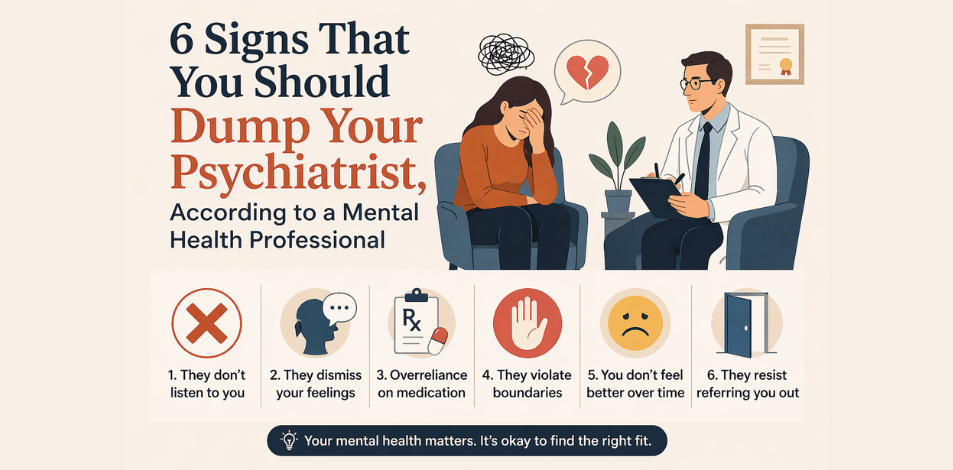
These 6 red flags might mean it’s time to switch providers
Finding a psychiatrist can be difficult. Most don’t accept insurance, and there are often long waiting lists, meaning you might not get an appointment for weeks or even months. So, once you find a psychiatrist, it’s natural not to want to let them go.
But even more important than simply having a psychiatrist is choosing the right one. As a licensed therapist and former patient, I’ve identified some indicators you should discuss with your psychiatrist when they appear.
If your psychiatrist isn’t willing or able to work with you to resolve any of these issues, it could mean there’s a better doctor for you.
Indicator #1: Nothing Changes
When you see a psychiatrist, your symptoms or medication should change. So, if you’re still experiencing symptoms, and your psychiatrist isn’t working with you to find the right medication to alleviate them, it might be time to look for another doctor.
Related : 7 Habits Of Women Stuck In Toxic Relationships
This is especially important if your psychiatrist tells you that your current situation is the best you can hope for. I’ve been through this myself—I saw a psychiatrist for years who treated my symptoms as inevitable and tried to convince me of it. And I believed him.
This led to years of suffering with symptoms that disappeared in just a few months once I switched to a psychiatrist who truly believed I could recover.
So, if you’re still experiencing symptoms and your psychiatrist isn’t working with you to change, find another doctor.
Warning Sign Two: Your Psychiatrist Is Focusing on the Wrong Thing
I once had a psychiatrist who was more concerned with my weight gain than with the effect of the medication he prescribed on my symptoms. He would begin every session by saying, “Oh my God, you’ve gained weight!”
Not only did it make me feel bad about myself, but it wasn’t psychologically helpful either—we were focusing on one of the drug’s side effects, not its primary function. Strangely, even though he noticed this side effect, he didn’t change his mind about whether I should take the medication.
And this leads us to another warning sign…
Warning Sign Three: Your Psychiatrist Isn’t Taking Your Side Effects Seriously
Psychiatric medications can come with a long list of potential side effects, ranging from mildly bothersome to unbearable. If you’re experiencing side effects that are bothering you, you should definitely ask for a change of medication, and your psychiatrist should respect that decision.
But if he doesn’t, or tries to convince you that what you’re experiencing isn’t so bad, or that you won’t feel better with any other medication without actually trying any alternative, this is a sign that you might need to consult another doctor.
In my personal experience with medication, I’ve always been in the 1%—the 1% of people who experience more serious side effects from any psychiatric drug. If there’s a chance of that happening, it’s a sure thing.
I quickly learned to stand up for myself and fought hard for years until I finally found a psychiatrist who didn’t question my experience and was immediately attentive to what was happening to me. You deserve a doctor who does the same.
Warning Sign #4: Constant Talk About Medication
To gain a comprehensive understanding of your mental health, your sessions with your psychiatrist shouldn’t be limited to your medication alone. There are many factors that affect your mental health, such as your social life, living conditions, relationships, family, work, and even the weather or season. If your psychiatrist doesn’t ask about what’s going on in your life, they won’t be able to get a complete picture of you and your symptoms.
While a psychiatric session doesn’t have to be a traditional therapy session (though that’s ideal), it’s essential that your psychiatrist asks about other aspects of your life that might be affecting you. This helps them make more informed decisions about your care.
If your psychiatrist doesn’t seem interested in this, it might be time to look for another therapist.
Warning Sign #5: Your therapist asks (or orders) you to do something that makes you uncomfortable.
There’s a fine line between coercion and unethical behavior, but if your therapist makes a suggestion or asks you to do something that feels wrong, listen to that feeling. Here are a few examples from my own experience:
Your therapist insists you try a medication they were paid to promote or some other reward for. (This might be in the form of “free samples”—be wary of these.)
Your therapist asks you to write a positive review for them online. This is clearly unethical. (To make matters worse, my therapist told me the positive review was in response to some negative reviews written by previous patients “to get back at them.” What a clear warning sign!)
Related : 19 Things Highly Intelligent People Quietly Avoid That Average Minds Chase
Your therapist should never make you uncomfortable, and you don’t owe them anything—they’re working for you. Don’t feel guilty if you seek another therapist if something like this happens to you.
This brings us to…
Warning Sign #6: Your therapist makes you feel bad about yourself
Regardless of who you are or your mental state, your therapist should treat you with respect. This may seem obvious, but no therapist has the right to belittle, insult, or make you feel inferior in any way. You are a human being seeking help, just like anyone who goes to the doctor for a physical illness, and you should be treated as such.
One of my personal experiences illustrates this point. My longtime therapist suddenly said to me, without warning, “Imagine what you could do if you weren’t so sick.”
These words devastated me. They made me feel like a hopeless case with no future.
I regret to say, however, that didn’t end my relationship with him. Learn from my mistake and never accept abuse, insults, or disrespect from your therapist.
In short
Your therapist should always be open to feedback and strive to improve your relationship and collaboration. Discussing these issues can be beneficial, especially if it leads to positive change. However, if you raise your concerns and they are ignored, that’s a bad sign.
You don’t need to experience all six of these warning signs to change therapists; any one is enough. Remember, you’re paying your therapist for a service they provide, and if that service isn’t helping you, you can and should seek another therapist.