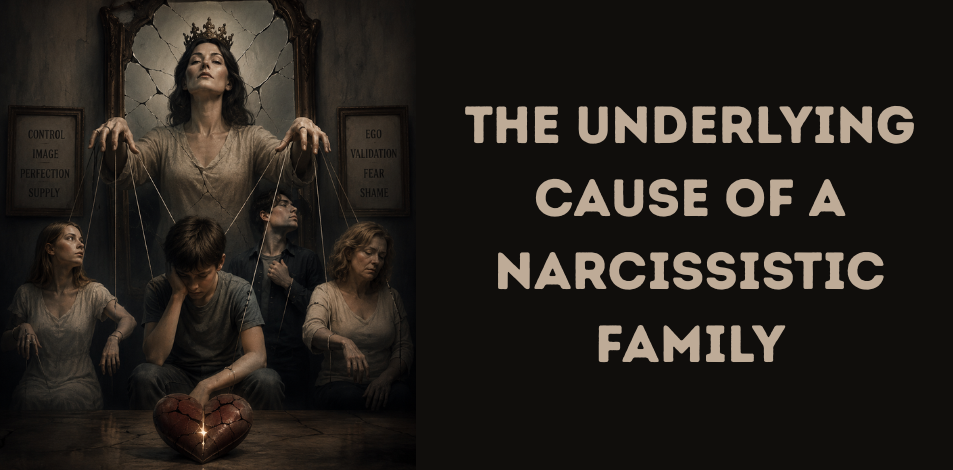
The narcissistic family is like an isolated group, belonging to no one. They do not worship God, have no connection to the state, and are completely detached from the culture of their people and homeland. Their sole object of worship and submission is the narcissistic parent.
All roads lead to the narcissist. The narcissistic family lacks any sense of belonging. They may live in a village, a city, or even a country, but they feel no affiliation or loyalty to any of them. It is self-evident that the key to understanding this phenomenon lies within the narcissist themselves.
The narcissist carries within them the trauma of neglect, humiliation, control, cruel treatment, and being looked down upon, and most importantly, of not being seen for who they truly are. As a result of their dysfunctional environment, the narcissist experiences chronic insecurity and a sense of unworthiness. Faced with indescribable fear and shame, their true self is shattered into countless fragments. On the brink of death and collapse, they made a final, desperate attempt to salvage what remained of themselves: they severed ties with their true selves and created a grandiose, domineering false self.
Although it may be merely a construct in their minds, this false self plays a pivotal role in stabilizing the narcissist’s identity and psyche. It acts as a gargoyle on the edge of their soul, protecting them from the devastating force of shock.
Yet, at their core, the narcissist remains paranoid and detached from reality. They do not see people as they truly are. They cannot empathize with them, feel their suffering, or connect with them. What the narcissist sees are mere abstractions about people. With their childish, one-sided thinking, they label these abstractions based on a binary system of good and evil. There is no gray area. The narcissist idolizes people based on what they deem good or vilifies them based on their own paranoia.
Ultimately, the narcissist uses a single criterion to judge others: Do they believe their distorted self-image, and do they feed it by indulging their narcissism? This paints a picture of someone detached from reality, living in a bubble of distrust and delusion.
Inside this bubble, the spouse and children find themselves. The narcissist is suspicious of strangers, sensitive to losing control, and expects nothing less than perfection. Therefore, the spouse and children are expected to live up to impossible standards, never disappoint the narcissist, and never escape their control.
While members of the narcissistic family often withdraw into the outside world, the narcissist plants the seeds of narcissism in their minds, psychologically controlling them from within the home. Family members feel guilty for wanting independence, fear the narcissist’s wrath, and remain trapped in the shame and fear instilled in them by the narcissistic parent.
People want to believe they are loved, and that their home and family are filled with warmth and affection. These things are fundamental to our identity, psychological well-being, and overall health. Without this image, we will suffer greatly.
A narcissistic family is far from warm and loving. No one is seen as they truly are. The suppression of one’s authentic self is incredibly painful. The agony of confronting this truth is overwhelming, forcing members of the narcissistic family to distort reality with fantasy to alleviate their suffering and anxiety.
Related : How Narcissists Secretly Get Even With You
A kind of Stockholm syndrome develops, where the spouse and children convince themselves that their family is perfect. They are taught to worship the narcissist, to be absolutely loyal to their family, and, most importantly, to belittle the outside world. Everyone else is seen as dangerous, inferior, or both. This concept is reinforced repeatedly, tightening the narcissist’s grip and further isolating the family members.
In this strange, fantastical world, members of the narcissistic family are unaware that they are under the control of the deep psychological trauma inflicted upon them by their narcissistic parent. Because the narcissist is often detached from reality and has denied their true self, they are effectively ostracized from their spirituality and community. There is no way to connect genuinely with people or with God. The support of community and spirituality is lost. Addiction and vanity become religious practices for the narcissistic family. Mental illnesses become widespread, and physical ailments accumulate. The suppression of the true self exhausts the members of the narcissistic family, who struggle to live up to the narcissist’s idealized and paranoid standards.
Healthy families do not develop in isolation from the outside world. Spirituality and religion nourish the soul. A genuine sense of belonging to a community helps the family feel connected to the wider world. Pride in one’s homeland can foster optimism and strength, paving the way for a better future.
Feeling in harmony with your culture, land, history, and faith opens up vast horizons of strength and peace. The narcissistic family, however, is detached from all of this, and any glimmer of hope is instantly extinguished. Independence, spontaneity, and personal strength all pose a threat to the rigid, megalomaniacal, and false ego of the narcissist. The present moment is bleak, and the future is even bleaker. Members of the narcissistic family remain trapped in an endless cycle, desperately trying to escape their shame, guilt, and pain, while their bodies wither and their spirits fade until they are almost dead.