Have you ever wondered what makes Cinderella’s stepmother, Snow White’s stepmother, and Rapunzel’s adoptive mother so wicked? They are among the most hated characters precisely because their maternal instincts clash with those of a loving mother. Cinderella’s stepmother is a narcissistic and abusive mother who neglected and ignored her daughter after the trauma of losing her father. Snow White’s stepmother is a cruel and narcissistic mother obsessed with comparing her beauty to her daughter’s, and she tries to kill her for this reason. Rapunzel’s adoptive mother is an overprotective narcissist who isolated her daughter from the world, lied about her birth, demanded unwavering loyalty, and insisted she was always right.
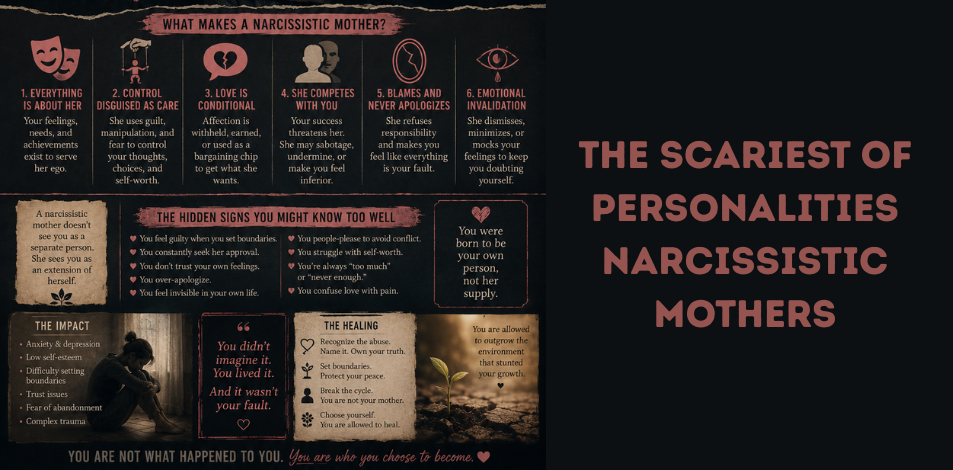
Mother-daughter relationship: While these stories may be entertaining in movies, they are not so much the same in real life. Reality can encompass all three types. The impact of a narcissistic mother on her child is significant and painful for both genders, but it is particularly devastating for the daughter. Narcissistic mothers view their daughters as rivals, possessing younger skin, better opportunities, and slimmer figures. In contrast, loving mothers are excited about their daughters’ futures and want to encourage them to build a healthy relationship with them.
The pregnant narcissistic mother: A pregnant woman receives a great deal of attention from friends, family, and even strangers. For most people, simply seeing a pregnant woman evokes feelings of hope, anticipation, and positivity. This feeds her narcissistic ego, which may be fluctuating due to the physical changes. But once the baby is born and attention shifts to it, the narcissistic mother feels jealous of her newborn. The result is one of two reactions: either distancing herself from the baby or clinging to it tightly to attract attention through physical contact.
Related : Spotting Narcissistic Love Bombing: What It Is — and Isn’t
The first stage of development. According to Erik Erickson’s theory of eight stages of psycho social development, the first stage is when a child learns to trust or distrust their caregiver. Trust fosters hope and faith in the infant, while distrust cultivates doubt and fear. Under a narcissistic mother, this stage is exacerbated to more extreme forms. Trust transforms into excessive attachment to the mother alone, while distrust becomes paranoia and panic. Both encourage the development of anxiety in the child, who unconsciously tries to maintain or gain their mother’s love.
The authoritarian mother. A mother who gives her child absolute trust is an authoritarian mother. To others, she appears as the ideal, loving mother who intervenes in every detail of her child’s life. But in reality, this mother does not allow her child to make even the simplest decisions and completely controls the development of their independence and initiative. The child becomes a physical extension of their mother’s identity, inseparable from her. In return for her commitment and loyalty, the mother expects her child to worship her, thus satisfying her narcissistic need for admiration. Others see the ideal child, then glorify the mother for her excellent parenting skills, completely ignoring any role the child may have in this process.
Ultimately, a narcissistic mother typically raises two types of children: one who matures remarkably well for their age, and another who is constantly dependent on others and feels entitled. Unfortunately, both types will require psychological counseling to overcome this personality trait, which is one of the most dangerous that can afflict a mother.