Family creates the strongest bonds. As we grow, our family shapes us physically, spiritually, and psychologically. We acquire its customs, traditions, and beliefs about the world. It is not merely a group we belong to; it is a mindset we inherit.
When we examine a family tree, we see how one person’s belief system can be passed down and influence dozens, even hundreds, of people across generations. Typically, a child absorbs much from their family, but as they separate and mature, they develop in unpredictable ways, and the family’s influence diminishes due to their experiences outside the home.
In a narcissistic family, a child’s development is more controlled, making the family’s influence even stronger and more dominant. What is most terrifying about a narcissistic family is that through this tendency toward isolation and psychological manipulation, one person’s delusional agenda can cast a dark shadow over generations, often without anyone realizing it.
Look at the following family tree:
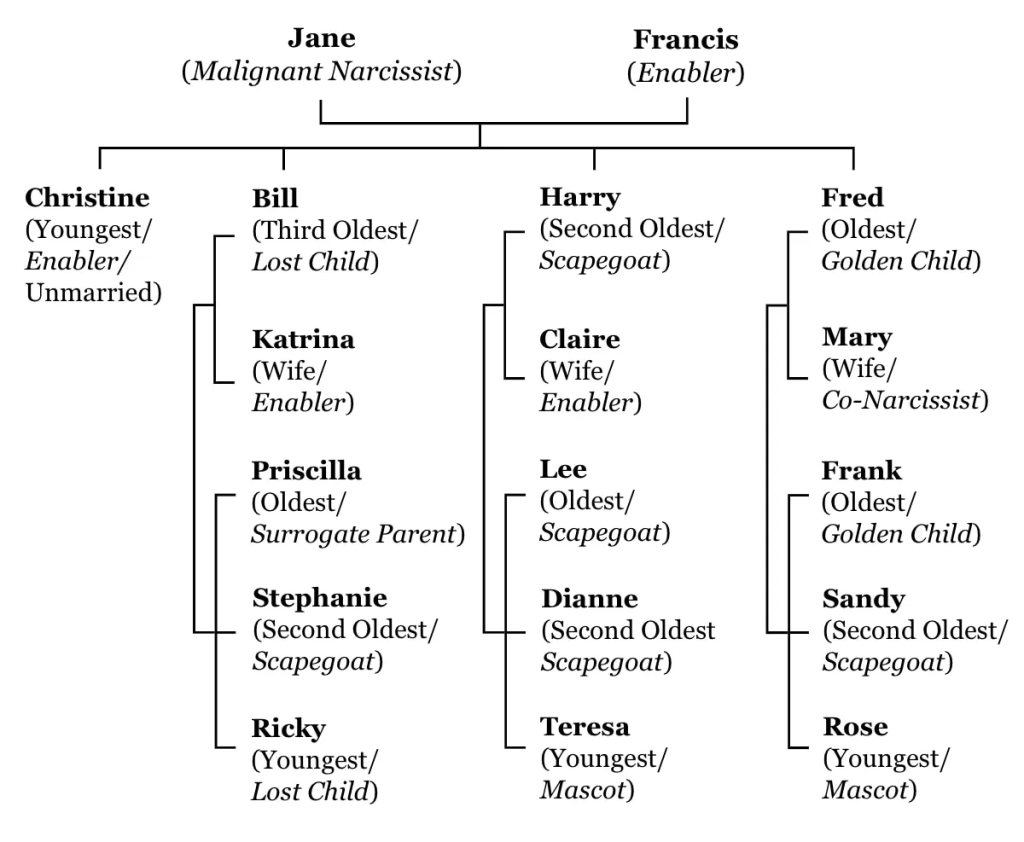
A Narcissistic Family Tree for Three Generations
First, to understand what follows, it is recommended that you read the article on narcissistic families if you haven’t already. Second, the following key to symbols will help you understand the many names mentioned in the family tree:
Bold: Parents (the primary narcissist and spouse)
Italic: First generation (the narcissist’s children)
Regular: Second generation (the narcissist’s grandchildren)
Jane is a malignant narcissist with a strong and domineering personality. Frances is a gentle man with a dry sense of humor. They have four children: Fred, Harry, Bill, and Christine. Because it is run by a narcissist, their family follows the typical narcissistic family structure, which is organized as follows:
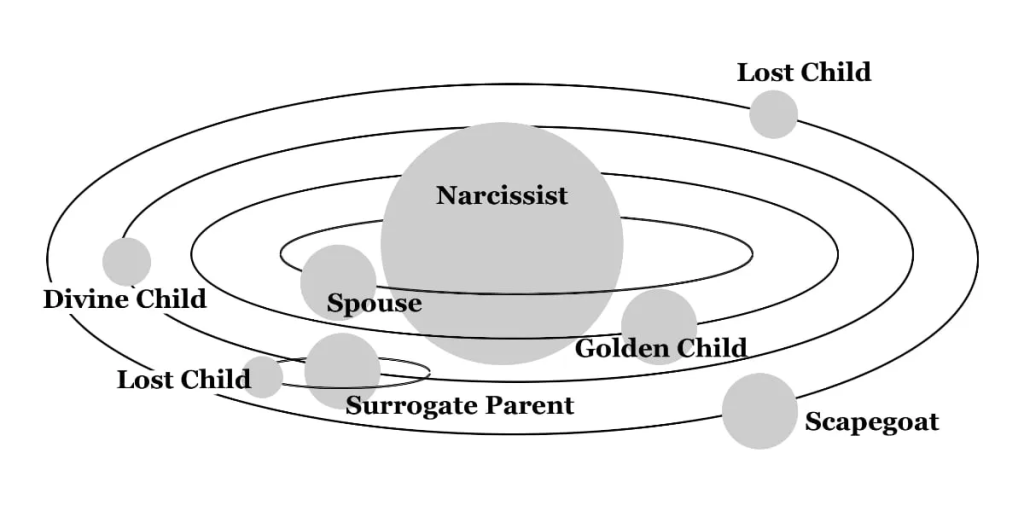
Fred (the spoiled child), the eldest, suffers from a superiority complex, as his mother elevates him to the position of head of the family. Fred respects his father, but believes he is the strongest and wisest in the family.
Harry (the scapegoat), the “angry one,” bears the brunt of his mother’s criticism and the family’s ridicule. Harry resents Fred’s domineering personality and tyrannical behavior, and the two often argue.
Bill (the lost child), the third oldest, obeys his mother’s commands and tries to avoid trouble.
Related : The Lurking Danger Of The Aware Narcissist
Christine (the perfect child), the youngest, goes out of her way to please her mother, helping with housework and caring for her siblings, but she still receives a lot of criticism from her mother, who sees her as a threat.
Jane is always strict with her children and doesn’t believe in affection. She herself grew up in a tense, loveless, and often violent family, and her children became the target of her pent-up anger. The three boys tend to express their pent-up anger through misbehavior, both at home and in public, but Jane ultimately manages to control them and bring them back to their senses with her shouting.
Despite sometimes being difficult to manage, all the children revere their parents and believe their family is happy. For Fred, Harry, Bill, and Kristen, family is their sole priority, and their mother, Jane, is the ultimate decision-maker in their lives.
Family Politics
As Jane and Frances’ children grow up, each starts their own family. Having been raised in a hostile and authoritarian environment, and with their needs unmet, each develops compensatory narcissistic traits. They maintain the belief that their family is superior and happy. At the same time, they project their inflated egos and repressed anger onto their families, affecting their spouses and children and keeping them locked in a fierce struggle for love and acceptance.
As Fred, Harry, and Bill have more children with their wives, the narcissistic structure expands into a family of narcissism passed down through generations, creating internal conflict. Each branch of the family tree begins to compete with the others. Each family inherits a collective identity, based on the identity of the leading parent.
Fred’s family is considered superior due to Fred’s overwhelming personality and his self-appointed position as the “leader” of the entire family.
Harry’s family becomes a collective scapegoat, ridiculed and attacked by all members, which breeds resentment towards Fred’s family.
Bell’s family remains isolated, like a lost family, unable to assert itself because of Bill’s fear of his older brother, Fred. When Fred is around, Bill tends to withdraw, and his family subconsciously knows the need to avoid trouble.
As the family tree continues to grow, the drama intensifies and becomes more complex. Fred’s son, Frank, assumes the role of the pampered son of his immediate and extended family, having absorbed his father’s domineering personality and being the eldest of his generation.
Harry’s son, Lee, becomes a scapegoat for his extended family, playing a secondary role to Frank while absorbing his father’s anger and inheriting his identity as “The Angry One.”
Bell’s eldest daughter, Priscilla, acts as a surrogate mother to her siblings. She is diligent in her studies and avoids the spotlight. She prefers not to provoke her father, who represses his emotions because he is unable to express them, and who then unleashes his anger on her suddenly.
Sandy, Diane, and Stephanie, daughters of Fred, Harry, and Bill, respectively, grew up in difficult circumstances. As the second eldest children and a girl, they are often made scapegoats. Sandy ran away from home several times and became addicted to drugs. She suffers from borderline personality disorder and schizophrenic episodes. Diane tends to fantasize and disconnect from reality frequently, and she was diagnosed with bipolar disorder in her twenties. Stephanie is constantly ridiculed by her brothers and has also tried to run away from home twice. The family avoids discussing the behaviors and disorders of their second daughters, and they are immediately blamed when they act this way. No one questions the reasons behind these behaviors.
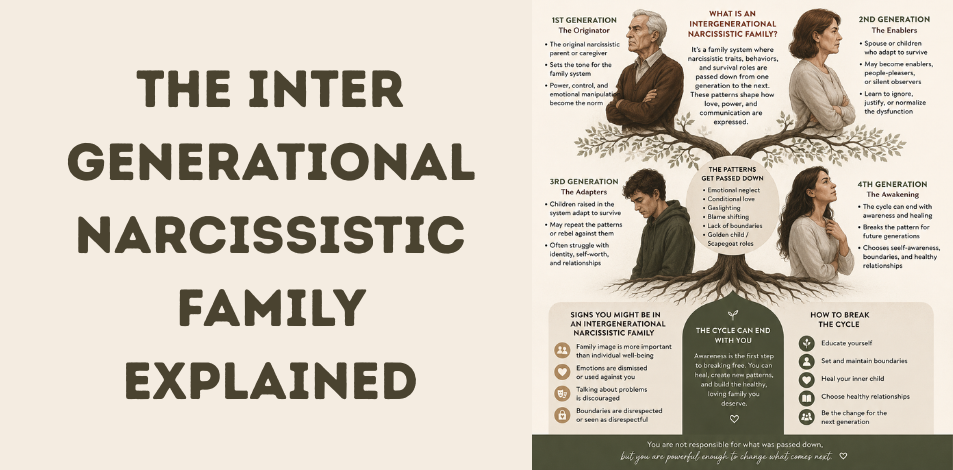
The devastating consequences of narcissism are evident in this family tree. Jane’s domineering and arrogant personality creates rivalry among her children, pushing the shame down the family tree toward Harry and Bill. Narcissism develops among the siblings, each desperate to avoid the burden of shame. They carry their inflated egos with them into their own families, perpetuating the same dynamics and passing the burden of shame on to their spouses and children. The narcissistic supply then flows up the family tree, passing through Fred, the favored son, to Jane. The shame is then pushed down and distributed unevenly among the rest of the family, accumulating mostly with the scapegoat and the marginalized children.
Each family speaks of the others in secret. The oldest and most outspoken members assume positions of power, while the rest try to avoid trouble. Individuality is discouraged and ridiculed, except for Fred’s children. Homophobia and racism are widespread, and the older members of the family reject any behavior that deviates from their family model.
Family “cohesion” is celebrated, and a fierce competition to show off erupts at every opportunity. Behind this narcissism, passed down through generations, lies Jane’s inflated and false personality. As the matriarch, she commands respect and obedience from all her children and grandchildren. Jane doesn’t hesitate to issue orders, and because of her elevated position, the family rarely dares to contradict her.
Jane’s narcissistic power lies in having a large family that revolves around her, submits to her will, and provides her with a constant supply of narcissism. Her principles of obedience and familial sacrifice are enforced with an iron fist, leaving no room for individual expression or the pursuit of an independent lifestyle.
Narcissistic Mindset
The development of strong narcissistic tendencies, the transformation of an individual into a malignant narcissist, and remaining within the healthy range all depend on several factors, including birth order, attachment style, and personality type. Regardless of role, every member of a narcissistic family is complicit in this dysfunction. Living in a narcissistic family means possessing a narcissistic mindset.
The narcissistic mindset, ingrained subconsciously, is the belief that relationships are defined by a hierarchy of power, and that you are either the controller, treated like a child, or, at worst, a scapegoat or forgotten. These are the only choices: either you are valuable or worthless, strong or weak, a hero or a villain. There is no middle ground; you are committed to the narcissistic family principle through a rigid role, or you are outside of it. As long as you remain within a narcissistic family structure passed down through generations, you must constantly struggle against the overwhelming sense of shame that hangs over you.