At the heart of every narcissist, behind the elaborately crafted false image that fools almost anyone, lies a timeless methodology. Aristotle formulated the “Three Pillars of Persuasion” more than two thousand years ago, and they remain a universal blueprint for influence:
- Credibility (Appeal to Credibility)
Possessing credibility means projecting competence, dignity, and authority. A person’s clothing, body language, expressions, and ability to project success and status all combine to create credibility.
Take Adolf Hitler, for example. He meticulously crafted his appearance and body language to create an impression of authority, displaying extraordinary discipline in polishing his image. He rarely made mistakes in public, maintaining perfect posture and controlled body language. He had to project an absolute and flawless image of greatness. Hitler also touted his military record as proof of his courage and patriotism.
Kim Kardashian is another example. She has dedicated herself entirely to her image, surgically sculpting her body and perfecting her movements, posture, and behavior to create an illusion of perfection and sanctity.
Credibility is a powerful force; it persuades without imposing conditions. In the uninformed mind, the presence of someone with apparent power, beauty, or competence inspires submission.
Related : The Narcissist’s Lifelong Villain Arc
While the average narcissist may not be as devoted as Hitler or Kim Kardashian, they will develop a strategy. They alter their body language, facial expressions, and clothing to project an image of superiority. Narcissists also exaggerate their accomplishments, hoping to convince others of their high value.
- Appealing to Emotions
Narcissists use appearance and reputation to attract their victims and make them more susceptible to influence. But to effect real change, they must appeal to others’ emotions. Sometimes they resort to subtle accusations, and other times to outright slander, aiming to confuse their victims. They also use overly emotional generalizations to manipulate them.
A narcissist’s words may instill fear in their victims or shame them through ridicule. They may also exploit a person’s pride by questioning their worth and forcing them to reclaim their status. A narcissist may win a victim’s affection through charm or provoke them into anger. In all cases, the goal is to confuse the victim and force them to comply with the narcissist’s agenda. Our tendency to act on emotion makes us all vulnerable to the narcissist’s influence.
- Logic (Logical Reasoning)
The ultimate goal of a narcissist is to control their victim’s mind. While disarming and emotionally destabilizing a person are effective tools, a narcissist must also target a person’s core beliefs to maintain effective control.
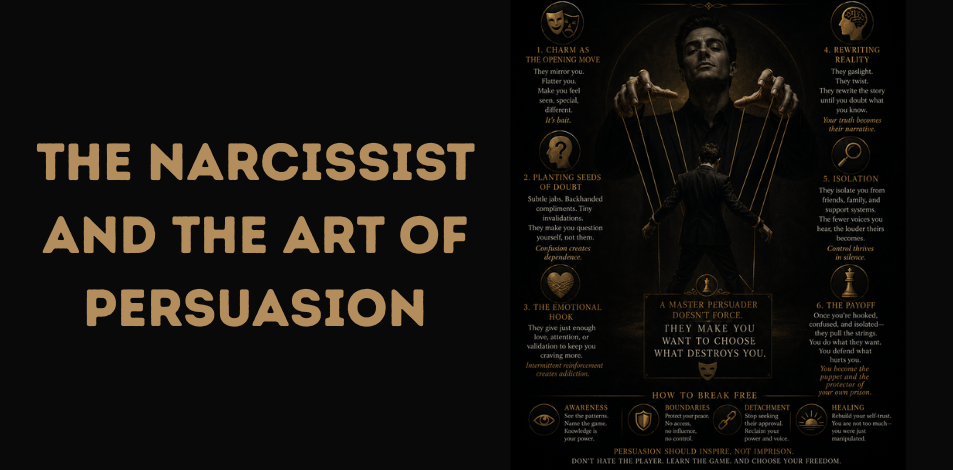
By constantly questioning and challenging a person’s reality, a narcissist can alter how others see the world and themselves. For example, a narcissist might say, “Your friends don’t care about you,” or “That’s not what a real friend does.” Depending on the situation, this will at least make you question your friendships, potentially leading to you distancing yourself from them. In this way, the narcissist goes a long way in isolating you from those you care about.
The narcissist is relentless in their assault on their victim’s mind, using a barrage of self-questions and statements designed to reprogram their victim’s core beliefs.
To maximize their impact, the narcissist utilizes all three pillars simultaneously. He cultivates his own image while discrediting and ridiculing those who threaten him (credibility), and he questions his victim’s reality and attacks them using emotionally charged language (emotion) and persuasive but subjective arguments and statements (logic).
Using credibility, emotion, and logic, the narcissist can neutralize those who threaten his power, disarm his victim, draw them into his world, and then manipulate them to subdue them. When used on the untrained, this psychological attack is extremely effective.