A healthy relationship isn’t supposed to mean agreeing on everything or never having difficult conversations. Every couple has disagreements, bad days, and moments when emotions run high.
The bigger question is how your partner treats you when you’re hurt, upset, or trying to communicate a need.
If you repeatedly feel dismissed, punished, controlled, or emotionally alone, it’s worth paying attention to the pattern rather than focusing only on individual arguments.
Some behaviors that look like ordinary relationship problems can become serious when they happen repeatedly and are used to control, intimidate, or isolate a partner. The National Domestic Violence Hotline describes emotional abuse as non-physical behavior intended to control, isolate, or frighten someone, including manipulation, humiliation, monitoring, jealousy, and dismissiveness.
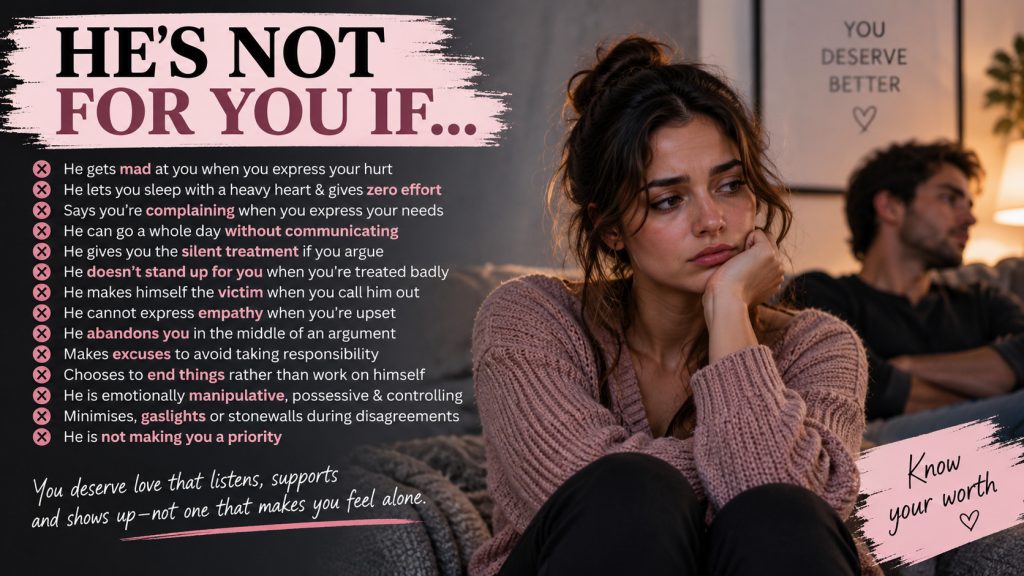
1. He Gets Angry When You Express That You’re Hurt
Being able to say “That hurt me” should not automatically turn into another argument about why you’re wrong for feeling that way.
Related : Sharing Your Trauma With a Narcissist: How Your Vulnerabilities Can Be Used Against You
A partner doesn’t have to agree with your interpretation of every situation, but they should be able to hear you without turning your vulnerability against you.
If expressing pain consistently results in anger, insults, intimidation, or punishment, that’s an important relationship pattern to notice.
2. He Treats Your Needs Like Complaining
There is a difference between having unrealistic expectations and simply asking for basic consideration.
When every request for communication, affection, reassurance, or respect is dismissed as “complaining,” you may eventually stop asking for anything at all.
That’s not healthy communication.
3. He Gives You the Silent Treatment to Punish You
Taking some time to cool down during an argument can be healthy when both people communicate that they need space and return to the conversation later.
But deliberately withholding affection or communication as punishment is different. The Hotline lists withholding attention or affection among potential signs of emotional abuse.
The difference often comes down to purpose and pattern.
“I need an hour to calm down, and we’ll talk tonight” is very different from deliberately ignoring someone to make them anxious or force them to give in.
4. He Makes Himself the Victim Whenever You Raise an Issue
You bring up something that hurt you.
Suddenly, you’re apologizing to him.
The conversation shifts from:
“Why did you treat me this way?”
to:
“Look what you made me do.”
Repeatedly shifting responsibility onto the other partner can make it extremely difficult to resolve problems. Blaming a partner for abusive behavior is also identified by The Hotline as a warning sign.
5. He Minimizes Your Feelings or Questions Your Reality
Statements such as:
- “You’re too sensitive.”
- “That never happened.”
- “You’re imagining things.”
- “You’re making a big deal out of nothing.”
can become particularly damaging when they’re part of a repeated pattern.
Gaslighting involves behaviors that cause someone to question their own perception, memories, or feelings.
Over time, constantly second-guessing yourself can make it harder to trust your own judgment.
6. He Is Possessive or Controlling
Love shouldn’t require you to give up your independence.
Constantly monitoring where you are, demanding access to your communications, controlling who you spend time with, or becoming excessively jealous can be signs of controlling behavior.
Related : Narcissists Aren’t the Only Ones Who Hurt You: The Pain of People Who Take Their Side
A relationship can have boundaries without one person controlling the other’s entire life.
7. He Doesn’t Support You When You’re Being Treated Badly
A partner doesn’t have to agree with you about everything.
But if someone repeatedly watches you being disrespected and refuses to support you, or even joins in, the emotional impact can be significant.
Feeling alone while you’re supposed to have a partner can be one of the most painful parts of an unhealthy relationship.
8. He Abandons the Conversation Instead of Resolving It
Walking away from an argument isn’t automatically unhealthy.
Sometimes people genuinely need time to calm down.
The problem is when leaving becomes a recurring way to avoid accountability, create anxiety, or make sure difficult conversations never happen.
Healthy conflict resolution allows both people space to express themselves without fear of retaliation.
9. He Keeps Making Excuses Instead of Taking Responsibility
Everyone makes mistakes.
The important part is what happens afterward.
A healthy response sounds more like:
“I understand why that hurt you. I shouldn’t have done that. I’ll work on it.”
Repeated excuses, denial, blame, and promises without meaningful change create a very different pattern.
10. He Makes You Feel Like You Have to Earn Basic Respect
You shouldn’t have to become quieter, easier to control, less emotional, or constantly available just to receive basic kindness.
A relationship should leave room for both people to have feelings, boundaries, friendships, opinions, and needs.
When one person’s needs consistently dominate the relationship, the relationship can become unequal.
Related : The Hidden Cost Of Loving A Narcissist Will Make You Sick When You See It
11. He Uses Manipulation to Keep Control
Emotional manipulation can take many forms.
It might involve guilt, threats, jealousy, isolation, intimidation, gaslighting, or deliberately withholding affection.
The Hotline describes relationship abuse as a pattern of behaviors used to gain or maintain power and control over a partner.
One difficult conversation doesn’t automatically mean someone is abusive. Patterns matter.
12. You’re Constantly Walking on Eggshells
Perhaps the biggest question isn’t simply:
“Does he love me?”
It may be:
“How do I feel when I’m around him?”
Do you feel safe expressing yourself?
Can you disagree without being punished?
Can you say no?
Can you talk about something that hurt you without fearing what will happen next?
If you constantly monitor your words and behavior because you’re afraid of your partner’s reaction, that deserves attention.
Final Thought
Not every relationship problem means a relationship is abusive, and not every emotionally difficult partner is a narcissist. In fact, The Hotline specifically notes that not everyone who behaves abusively has narcissistic personality disorder, and not everyone with NPD abuses their partners.
What matters is the actual behavior and the repeated pattern.
You deserve a relationship where communication doesn’t require fear, where your feelings aren’t automatically dismissed, and where disagreements don’t become opportunities for control.
If you’re repeatedly feeling smaller, more confused, isolated, or afraid to speak honestly, don’t ignore that feeling. Look at the pattern, not just the occasional good day.