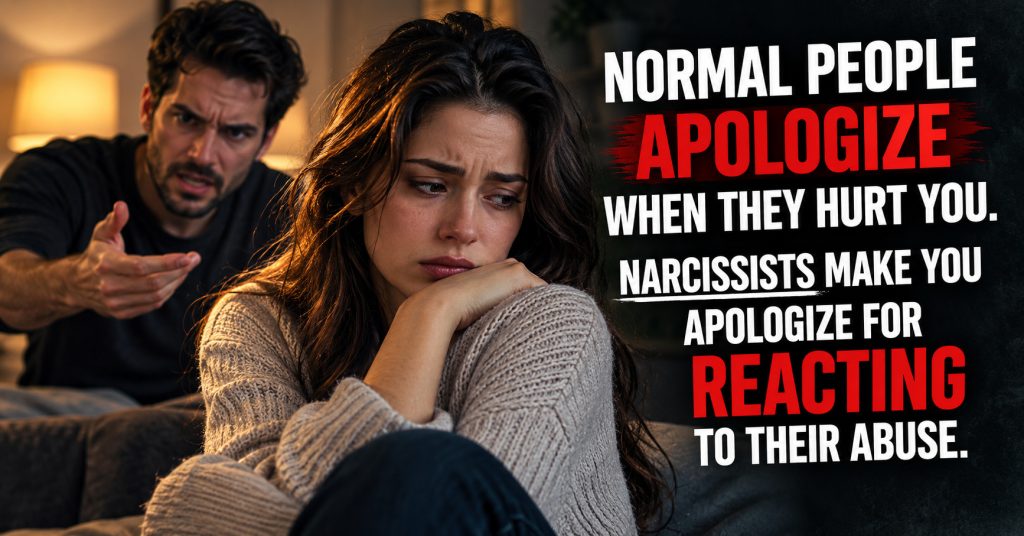
There is a strange kind of confusion that can happen in an unhealthy relationship: you get hurt, you react, and somehow you end up being the one apologizing.
You try to explain why something hurt you. They become angry. You raise your voice after being pushed too far. Suddenly, the conversation is no longer about what they did. It becomes about your reaction.
This pattern can leave you questioning yourself: Was I too sensitive? Did I overreact? Should I have stayed quiet?
Understanding this dynamic can help you separate your reaction from the behavior that triggered it.
Healthy People Usually Take Responsibility When They Hurt Someone
Nobody handles relationships perfectly. Even caring, emotionally healthy people can lose their temper, say something hurtful, or make a mistake.
The difference often comes afterward.
A person who recognizes that they hurt you may say:
“I understand why that hurt you. I’m sorry. Let’s talk about what happened.”
They might not agree with everything you say, but they can acknowledge your feelings and take responsibility for their part.
In a healthier relationship, an apology isn’t treated as a weakness. It’s part of repairing trust.
Related : Men Don’t Always Say What They Feel: 5 Emotions They May Keep Hidden
Narcissistic Abuse Can Turn the Conversation Around
In relationships involving narcissistic traits or emotionally abusive behavior, accountability can become much more complicated.
Instead of addressing the original behavior, the focus may shift toward how you reacted.
You might hear things like:
- “Look how crazy you’re acting.”
- “You’re always overreacting.”
- “I wouldn’t have treated you that way if you weren’t like this.”
- “You made me do it.”
- “You’re the one causing problems.”
- “You need to apologize for your attitude.”
Notice what happens here.
The original issue disappears.
Instead of discussing what happened to you, the conversation becomes about what is wrong with you.
That shift can be incredibly confusing.
Why Do You End Up Apologizing?
One reason is emotional exhaustion.
After repeated arguments, accusations, silent treatment, blame, or manipulation, you may eventually apologize simply because you want the conflict to stop.
You may think:
“Fine. I’m sorry. Can we just move on?”
But the apology doesn’t necessarily resolve anything.
It can create a cycle:
They hurt you → you react → your reaction becomes the problem → you apologize → the original behavior is never addressed.
Over time, you may become increasingly careful about what you say, how you say it, and even how you express normal emotions.
Related : Girl’s Love Language: 5 Ways She May Feel Most Loved and Appreciated
Your Reaction Doesn’t Automatically Erase What Happened
This is an important distinction.
You can be responsible for your reaction without being responsible for someone else’s abusive behavior.
Maybe you shouted.
Maybe you became angry.
Maybe you walked away.
Maybe you cried.
Maybe you finally said something you had been holding inside for months.
Those reactions can be examined honestly. If you behaved in a way you regret, you can take responsibility for it.
But taking responsibility for your behavior does not require pretending that the original behavior never happened.
Both things can be true:
“I shouldn’t have shouted.”
And:
“I was also hurt by what happened.”
Accountability should work in both directions.
Related : Male vs. Female Intimacy: What Really Creates Emotional Connection?
The Danger of Constantly Explaining Yourself
When someone repeatedly challenges your perception of events, you may start defending yourself constantly.
You explain why you’re hurt.
Then you explain why you’re angry.
Then you explain why you reacted.
Then you explain why your reaction wasn’t the real issue.
Eventually, you spend so much energy defending yourself that you forget the original question:
Why did this situation become so painful in the first place?
Healthy communication doesn’t require you to build a courtroom case every time you have a feeling.
You deserve to be able to say, “That hurt me,” without immediately being forced into a debate about whether you’re allowed to feel hurt.
How to Break the Cycle
Breaking this pattern doesn’t necessarily mean winning an argument.
Sometimes it means refusing to participate in the endless blame cycle.
Try asking yourself:
What actually happened?
What did I do in response?
What part am I willing to take responsibility for?
What part belongs to the other person?
This can help you separate accountability from misplaced guilt.
You don’t have to deny your own mistakes in order to recognize someone else’s harmful behavior.
And you don’t have to apologize simply because someone is demanding an apology.
Final Thought
One of the most damaging effects of emotional manipulation is that you can eventually become more focused on defending your reaction than recognizing what caused it.
You start apologizing for being angry instead of asking why you were pushed to that point.
You apologize for crying instead of asking why you felt so hurt.
You apologize for speaking up instead of asking why you felt you had to remain silent.
Your reaction deserves accountability, but your pain deserves to be understood too.
If a relationship repeatedly leaves you confused, guilty, and responsible for everything that goes wrong, it may be worth stepping back and looking at the entire pattern, not just the latest argument.