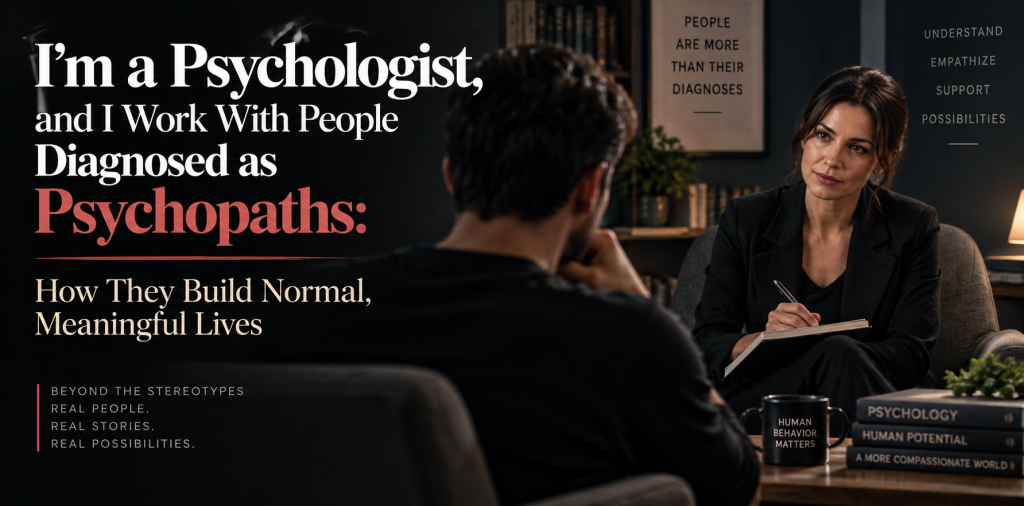
When people find out what I do for a living, I get the same reaction almost every time: a slight pause, a raised eyebrow, and some version of the question, “Aren’t you scared?”
I understand why. Popular culture has spent decades turning psychopathy into shorthand for serial killers, con artists, and remorseless villains. But the truth I’ve learned over years of clinical work is far less cinematic , and far more human. Most of the people I see diagnosed with psychopathy aren’t hiding bodies in a basement. They’re holding down jobs, raising children, running businesses, and quietly working, session by session, to understand a mind that doesn’t process emotion, empathy, or consequence the way most people’s do.
This article is about what that work actually looks like, and how people diagnosed with psychopathy build normal, meaningful lives , not despite the diagnosis, but by learning to work with it.
What Does It Actually Mean to Be Diagnosed With Psychopathy?
The first thing I tell every new client, student, or curious dinner-party guest is this: psychopathy is not a diagnosis you’ll find in the DSM-5. There’s no billing code for “psychopath.” What clinicians actually diagnose is Antisocial Personality Disorder (ASPD), and psychopathy is best understood as a more specific, research-driven construct that overlaps with it , typically assessed using tools like the Hare Psychopathy Checklist-Revised (PCL-R).
Related : If He Cheated, Stop Asking What You Did Wrong
Psychopathy is generally characterized by a cluster of traits, including:
- Reduced fear response and low anxiety
- Shallow or blunted emotional experience, especially around guilt and remorse
- Difficulty with cognitive empathy translating into emotional empathy
- Impulsivity and sensation-seeking
- A tendency toward manipulation or superficial charm
- Difficulty forming deep emotional attachments
Here’s the part that surprises people most: traits alone don’t equal danger. Psychopathy exists on a spectrum, and a meaningful percentage of people who score high on psychopathic traits never commit a violent crime in their life. Researchers sometimes call this group “successful psychopaths” , people whose traits are channeled into competitive careers, high-stakes professions, or simply a life lived with a different internal compass than most.
Myth vs. Reality: What Psychopathy Actually Looks Like in a Therapy Room
Television has convinced most of us that a psychopathic diagnosis comes with a checklist of chilling, dramatic behavior. In reality, the traits I see most often in session are quieter , and often more painful for the client than for anyone around them.
Myth: They feel nothing. Reality: Many clients describe a kind of emotional colorblindness. They may recognize that something should upset them without actually feeling upset , and that disconnect can be genuinely distressing once they understand how differently they’re wired compared to people they love.
Myth: They can’t have relationships. Reality: Many of my clients are married, are parents, and maintain long friendships. What differs is how they build and sustain those bonds , often through logic, loyalty, and habit rather than a felt sense of emotional closeness.
Myth: Treatment doesn’t work. Reality: This is one of the most persistent , and most damaging , myths in the field. It isn’t that people with psychopathic traits can’t change. It’s that the goal of treatment isn’t to make someone feel guilt the way a neurotypical person does. It’s to build a life where their actual wiring doesn’t lead to harm, for themselves or others.
How I Actually Work With These Clients
Traditional talk therapy, built around processing emotion and cultivating empathy, often falls flat with clients high in psychopathic traits , not because they’re unwilling, but because the tools weren’t built for their neurology. Over time, I’ve leaned into a few approaches that tend to work better.
1. Framing Change as Self-Interest, Not Morality
Appealing to guilt or a client’s conscience rarely lands. What does land is framing consequences in terms the client already understands: If you do this, you lose your job, your marriage, your freedom, your reputation. Many clients diagnosed with psychopathy are highly rational and strategic , so treatment often works best when it speaks that language instead of fighting it.
2. Building External Structure
Where a neurotypical client might rely on internal cues (guilt, anxiety, empathy) to regulate behavior, clients with psychopathic traits often benefit more from external scaffolding , routines, accountability systems, clear rules, and predictable consequences. Structure does the emotional regulation that their internal wiring doesn’t automatically provide.
3. Teaching “Borrowed” Empathy
Some clients can’t feel empathy the way others do, but many can learn to simulate it effectively through observation and practice , almost like learning a second language. Over time, this “borrowed” empathy can become functional enough to sustain real relationships, even if the internal experience never matches a neurotypical one.
4. Redirecting, Not Suppressing, Traits
Traits like fearlessness, charm, decisiveness under pressure, and comfort with risk aren’t inherently bad , they’re simply raw material. Part of my job is helping clients find contexts where those traits are assets rather than liabilities: leadership roles, entrepreneurship, surgery, law, the military, elite sports, high-stakes negotiation.
A Composite Case: “Marcus”
To protect confidentiality, I want to share a composite case , a blend of patterns I’ve seen across multiple clients, not any single real person.
“Marcus” came to therapy in his early thirties after his second marriage nearly ended. He wasn’t cruel or violent. He was, in his own words, “checked out” , going through the motions of caring without feeling much of anything, and quietly resentful that everyone around him seemed to need so much emotional reassurance.
Related : Why Adult Children Stop Visiting Their Parents: 5 Reasons That Hurt More Than You Think
We didn’t spend our sessions trying to manufacture guilt he didn’t feel. Instead, we built a framework: what behaviors mattered to his wife, why maintaining the relationship served his own long-term goals, and how to perform the emotional labor of partnership even when it didn’t come naturally. Three years later, Marcus is still married. He describes his marriage not as something he feels his way through, but something he chooses, deliberately, every day. For him, that’s a meaningful life.
The Building Blocks of a Meaningful Life With Psychopathy
Across dozens of clients, a few consistent ingredients show up in the ones who go on to build stable, satisfying lives:
- Early, accurate diagnosis , understanding their own wiring removes years of confusion and self-blame
- A strengths-based identity rather than a shame-based one
- Structured routines that reduce impulsive decision-making
- Relationships built on mutual benefit and clear expectations, not assumed emotional intuition
- Career paths that reward their natural traits instead of punishing them
- Ongoing, judgment-free clinical support, since psychopathy isn’t something that gets “cured” so much as managed and understood
Frequently Asked Questions
Is everyone diagnosed with psychopathy dangerous? No. Most people with elevated psychopathic traits are never violent. Danger correlates more strongly with the combination of psychopathy and other risk factors , such as a history of violence, substance use, or extreme impulsivity , than with the traits alone.
Can someone with psychopathy really love their family? Many do, though the internal experience of that love may differ from the norm. Commitment, loyalty, and consistent caretaking behavior are possible even without the same felt emotional depth.
Related ; Body Language Signs She’s Actually Flirting With You
Is psychopathy the same as sociopathy? Not officially. “Sociopathy” isn’t a clinical term either, but it’s often used informally to describe antisocial traits shaped more by environment and upbringing, while “psychopathy” is more often associated with innate, temperamental differences. In clinical practice, both usually fall under the ASPD diagnosis.
Does therapy actually help? Yes , though success looks different than it does with other conditions. The goal isn’t to install empathy that isn’t there; it’s to build a life structured around a person’s actual psychology so it doesn’t cause harm to them or the people around them.
The Takeaway
Working with clients diagnosed with psychopathy has taught me that “normal” was never really the goal , and it doesn’t need to be. What I’ve watched, over and over, is people building lives that work: stable marriages, steady careers, real friendships, and a version of meaning that doesn’t require feeling exactly like everyone else feels. Understanding your own mind, however differently wired, is still the first step toward living well in it.
If you’re concerned about your own mental health or that of someone you know, consider speaking with a licensed mental health professional for a proper evaluation.