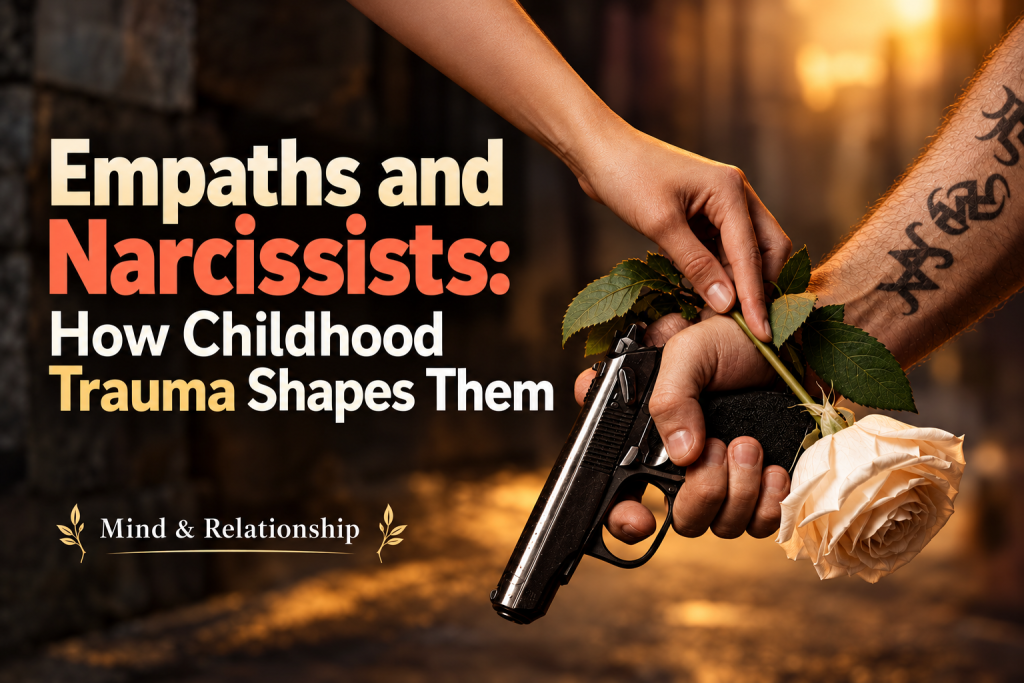
Sometimes, two people can grow up in painful environments and come out of those experiences behaving in completely different ways. One becomes deeply sensitive to other people’s emotions, always trying to understand their pain. The other may build emotional walls, struggle with vulnerability, or seek control and admiration to protect a fragile sense of self.
This is one reason the relationship between empaths and narcissists attracts so much attention. People often wonder how two individuals who may have experienced difficult childhoods can develop such different ways of relating to others.
The answer is more complicated than simply saying that one becomes good and the other becomes bad. Childhood experiences can influence how people see themselves, how they trust others, and how they respond to emotional pain. However, trauma does not affect everyone in the same way, and it does not automatically determine someone’s personality or future behavior.
Understanding these differences can help us recognize unhealthy relationship patterns, develop emotional awareness, and begin healing from the experiences that shaped us.
Related : How to Stop People-Pleasing and Find Yourself Again
How Childhood Trauma Can Shape an Empath

Some people who grow up in emotionally unpredictable households learn to pay close attention to the feelings of everyone around them.
Perhaps they had a parent whose mood changed without warning. Maybe affection was conditional, arguments were frequent, or they felt responsible for keeping the family peaceful. In these environments, noticing small changes in someone’s voice, facial expression, or behavior can become a way to anticipate conflict.
As adults, these individuals may be highly sensitive to other people’s emotions. They might notice when a friend is upset before anyone else does, offer comfort without being asked, or feel uncomfortable when someone around them is angry.
People often describe this as being an empath.
However, there is an important distinction: empathy is the ability to understand or share another person’s feelings, while hypervigilance is a heightened state of alertness that can develop after stressful experiences. Sometimes, the two can overlap.
A person who constantly monitors other people’s moods may genuinely care about others while also trying to prevent the emotional chaos they experienced during childhood.
This can lead to several difficulties:
- Feeling responsible for everyone’s happiness.
- Saying yes when they desperately want to say no.
- Attracting relationships in which their needs are consistently ignored.
- Confusing love with sacrifice and emotional exhaustion.
- Feeling guilty whenever they prioritize themselves.
Over time, they may become so focused on understanding others that they forget to understand themselves.
Healing begins when empathy is no longer something they use to earn love or avoid rejection. It becomes a choice rather than a survival strategy.
How Childhood Trauma Can Influence Narcissistic Traits

Childhood adversity can also influence the development of narcissistic traits, although there is no single childhood experience that explains narcissism.
Some people grow up receiving excessive praise without learning to tolerate criticism or respect other people’s boundaries. Others experience rejection, humiliation, emotional neglect, or inconsistent affection. Different experiences can contribute to different coping patterns, and many people with difficult childhoods never develop narcissistic traits.
For some individuals, maintaining a powerful image becomes a way to protect themselves from feelings of shame, inadequacy, or vulnerability.
They may become highly focused on how others perceive them. Criticism may feel like a personal attack rather than an opportunity to learn. They might struggle to acknowledge mistakes, dismiss another person’s feelings, or react with anger when they feel challenged.
When these patterns become persistent and affect relationships, they can cause considerable emotional harm.
Related : Why Narcissists Ruin Special Occasions and Holidays
Narcissistic traits exist on a spectrum, and having some of these traits does not automatically mean someone has narcissistic personality disorder (NPD). Only a qualified mental health professional can diagnose the condition.
It is also important to remember that understanding the possible origins of harmful behavior does not mean excusing that behavior.
Someone may have experienced genuine pain and still be responsible for how they treat other people today.
Empaths and Narcissists: The Key Differences
Although people often discuss empaths and narcissists as opposites, real human behavior is more nuanced. Empathy, self-esteem, emotional regulation, and personality traits vary from person to person.
Still, certain patterns can help explain why two people may respond differently to emotional pain.
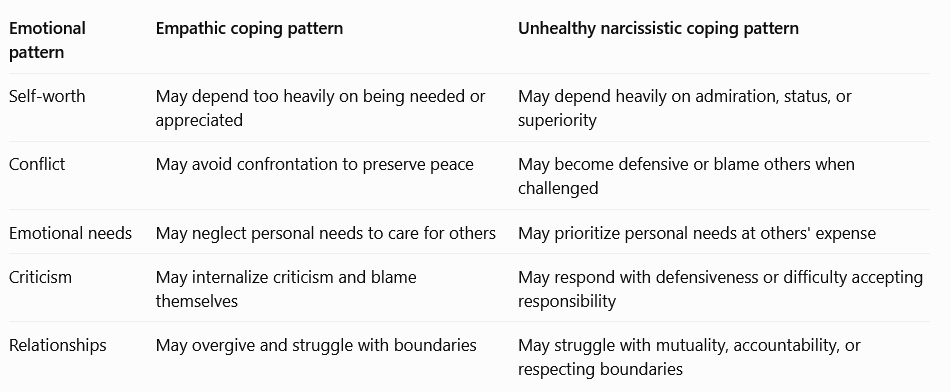
These are possible patterns, not universal rules. Empathic people can behave selfishly, and people with narcissistic traits can show empathy in some situations.
The more useful question is not which label fits someone perfectly. It is whether their behavior supports mutual respect, accountability, and emotional safety.
Why Empathic People Sometimes Become Trapped in Unhealthy Relationships
One of the most painful relationship patterns occurs when a person who deeply values connection becomes involved with someone who repeatedly disregards their emotional needs.
At first, the relationship may feel extraordinary. There may be intense attention, affection, promises, and a sense of finally being understood. Later, the dynamic may shift toward criticism, emotional distance, manipulation, or repeated cycles of conflict and reconciliation.
For someone who learned during childhood to work hard for affection, this instability can feel strangely familiar.
They may believe that if they become more patient, more understanding, or more loving, the relationship will return to the way it was at the beginning.
They might tell themselves:
- “Maybe they act this way because they were hurt before.”
- “If I understand them better, things will improve.”
- “I know the good person they can be, so I cannot give up on them.”
- “Maybe I am asking for too much.”
Compassion can be a beautiful quality, but it becomes painful when it requires someone to abandon their own well-being.
You can understand someone’s wounds without accepting repeated harm from them.
A healthy relationship does not require one person to become the permanent emotional caretaker while the other avoids responsibility. Both people deserve to have their feelings heard, their boundaries respected, and their mistakes addressed honestly.
Can Empaths and People With Narcissistic Traits Both Heal?
Yes. People can learn healthier ways of relating to themselves and others, although change requires willingness, sustained effort, and appropriate support.
For highly empathic people who struggle with overgiving, healing often involves learning that love does not require self-abandonment.
This may mean practicing boundaries, tolerating the discomfort of saying no, and recognizing that another person’s disappointment does not automatically mean they have done something wrong.
For people who struggle with narcissistic traits, meaningful change may involve developing greater self-awareness, learning to tolerate criticism, taking responsibility for harmful actions, and practicing genuine consideration for other people’s experiences.
Psychotherapy can help people explore the origins of their coping strategies and develop healthier responses. Childhood trauma is not the only explanation for these patterns, and treatment should be tailored to the individual rather than based on a label.
The goal is not to decide who suffered more or who is morally superior. It is to understand how learned behaviors affect relationships and what can be changed.
Five Steps Toward Emotional Healing

1. Recognize your emotional patterns
Notice whether you automatically apologize, seek approval, avoid conflict, or feel responsible for other people’s reactions.

2. Separate compassion from responsibility
You can support someone without fixing their problems, managing their emotions, or protecting them from the consequences of their choices.

3. Establish healthy boundaries
Decide what behavior you will accept and what you will do if those boundaries are repeatedly crossed.

4. Choose relationships based on actions
Look for consistency, honesty, accountability, and respect rather than relying solely on promises or intense emotional chemistry.

5. Seek support when you need it
A trauma-informed therapist can help you understand recurring relationship patterns and build healthier ways of responding to emotional stress.
The Most Important Lesson About Empaths and Narcissists
Perhaps the biggest lesson is that childhood pain can help explain our behavior, but it does not have to define our entire lives.
Some people respond to emotional pain by becoming extremely attentive to others. Some protect themselves through control, defensiveness, or a constant need for validation. Others develop entirely different coping strategies.
There is no guarantee that suffering will make someone kinder, wiser, or more compassionate. Nor does having a difficult childhood mean someone is destined to hurt others.
What matters is what a person does with their experiences.
Related : Healing After a Toxic Relationship: 7 Tips
Do they become willing to examine their behavior? Can they acknowledge when they have hurt someone? Are they prepared to respect boundaries, learn from mistakes, and make meaningful changes?
These questions reveal far more about a relationship’s potential than childhood history alone.
If you recognize yourself in the person who always gives, always forgives, and always tries to understand, remember that your emotional needs matter, too. You do not have to prove your goodness by enduring pain.
And if you recognize unhealthy patterns in yourself, you are not powerless to change them. Accountability is not a punishment. It is an opportunity to build relationships that are healthier for everyone involved.
Final Thoughts
Empathy is valuable, but it should not come at the cost of your identity, peace, or self-respect. Understanding the connection between childhood trauma, empathic behavior, and narcissistic traits can help us see why people develop different emotional defenses.
The real goal is not to label everyone as an empath or a narcissist. It is to recognize harmful patterns, take responsibility for our own behavior, and create relationships where love does not depend on fear, control, or self-sacrifice.
Your past may explain some of your wounds, but healing gives you the chance to choose what happens next.