There is something that changes after you have experienced narcissistic abuse.
You start seeing things differently.
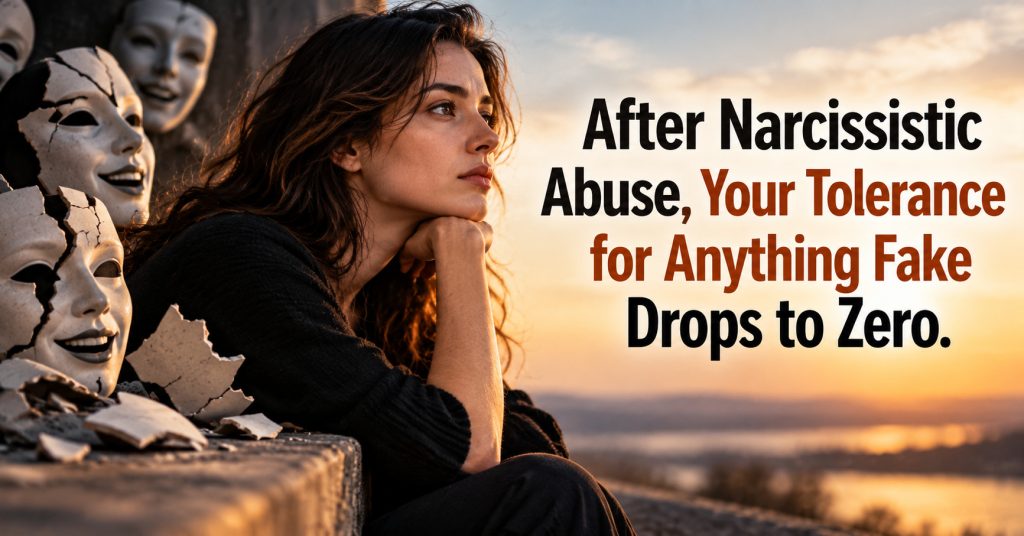
The fake smile. The forced apology. The empty promises. The sudden kindness that comes with an expectation attached to it. The person who says all the right words but consistently does the opposite.
Before the abuse, you might have tolerated these things because you wanted to believe the best in people.
Afterward, something inside you says: “I can’t do this anymore.”
Why Your Tolerance for Fake Behavior Drops
Narcissistic abuse can teach you a painful lesson about the difference between words and actions.
You may have spent months or years trying to understand someone’s behavior. You gave explanations. You accepted excuses. You waited for promises to become reality.
Eventually, you learned that someone’s words mean very little when their actions continually contradict them.
That’s why, after narcissistic abuse, you may become much more sensitive to inconsistency.
You don’t necessarily become cold.
You become more aware.
Related : Staying in an Unhealthy Marriage: When Is It Too Much?
You Start Paying Attention to Actions
One of the biggest changes after narcissistic abuse is that you stop being impressed by words alone.
Someone can tell you:
“I care about you.”
But you naturally look at how they treat you.
Someone can say:
“I’ve changed.”
But you look for consistent behavior.
Someone can apologize.
But you ask yourself whether their behavior actually changes afterward.
This isn’t about expecting perfection from people. Everyone makes mistakes.
It’s about recognizing the difference between a genuine mistake and a repeated pattern.
Fake Connections Become Exhausting
After experiencing manipulation or emotional abuse, superficial relationships can become incredibly draining.
Small talk isn’t necessarily the problem.
The problem is pretending.
Pretending everything is fine when it isn’t.
Pretending someone is trustworthy when their behavior says otherwise.
Pretending you don’t notice manipulation because confronting it feels uncomfortable.
Once you’ve experienced the emotional exhaustion that comes with narcissistic abuse, you may no longer have the energy to participate in relationships that require you to constantly ignore your own intuition.
Your Boundaries Become Stronger
Healing often means learning that saying no doesn’t make you selfish.
You don’t have to explain every boundary.
You don’t have to convince someone to respect you.
And you don’t have to keep giving access to people who repeatedly make you feel unsafe, confused, or emotionally exhausted.
Your peace becomes more important.
You may realize that being alone for a while is healthier than being surrounded by people who constantly make you question yourself.
Related : 7 Signs of an Emotional Affair You Are Too in Love to Notice
You’re Not Becoming “Too Sensitive”
Sometimes people who have never experienced narcissistic abuse don’t understand this change.
They might say:
“You’re overthinking.”
“You’re too suspicious.”
“Not everyone is trying to hurt you.”
And they’re right about one thing: not everyone is trying to hurt you.
But healing doesn’t mean becoming suspicious of everyone.
It means learning to trust yourself again.
There’s a difference.
The goal isn’t to assume everyone is fake. The goal is to stop ignoring obvious signs just because you desperately want someone to be genuine.
The Real Goal Is Authenticity
Eventually, the healing journey becomes less about avoiding narcissists and more about choosing healthier relationships.
You start looking for people whose words and actions match.
People who can communicate without manipulation.
People who can apologize without turning themselves into the victim.
People who respect boundaries without punishing you for having them.
People who don’t require you to abandon yourself just to keep the relationship alive.
And perhaps most importantly, you become someone who no longer feels obligated to accept less than you deserve.
Final Thought
After narcissistic abuse, your tolerance for fake behavior may drop dramatically.
That’s not necessarily a bad thing.
Sometimes losing your tolerance for fake relationships is actually part of finding your way back to yourself.
You don’t have to become harder. You just have to become more honest about what you will and will not accept.