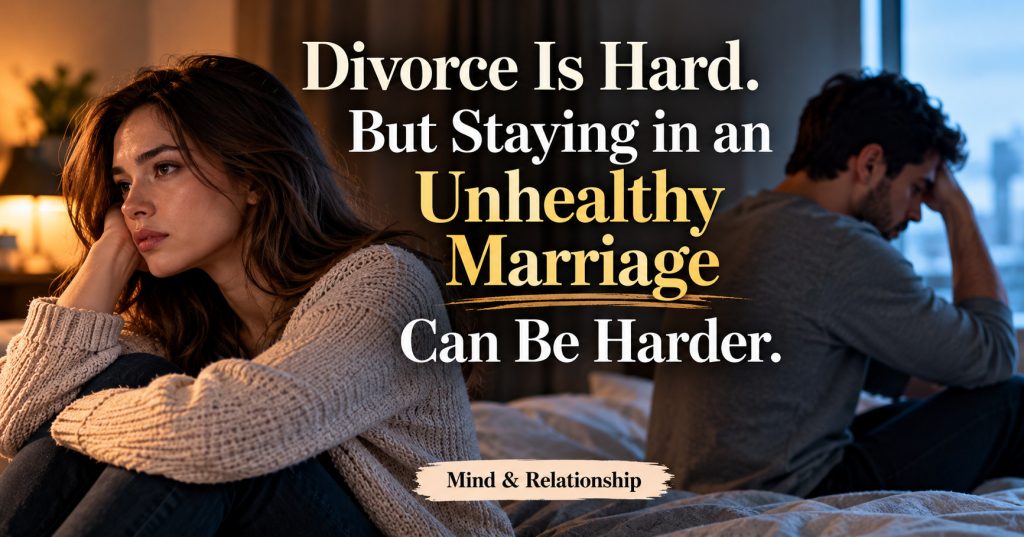
Divorce is painful. There is no need to pretend otherwise.
Even when you know a relationship is no longer healthy, ending a marriage can bring fear, grief, loneliness, financial concerns, and uncertainty about the future. You may find yourself wondering whether leaving is really the right choice, especially after years of building a life together.
But sometimes the harder choice is staying.
Staying in a marriage where you constantly question your worth, silence your needs, or feel like you are never enough can slowly change the way you see yourself.
When Love Starts Making You Doubt Yourself
A healthy relationship should not require you to constantly prove that you deserve love.
Everyone has disagreements. Every marriage goes through difficult seasons. But there is a difference between normal relationship problems and a pattern that consistently damages your confidence.
If your partner repeatedly criticizes you, dismisses your feelings, controls your decisions, humiliates you, or makes you feel responsible for everything that goes wrong, you may eventually start believing the negative things you hear.
You begin asking:
- “Maybe I am too sensitive.”
- “Maybe I am the problem.”
- “Maybe I should just tolerate it.”
- “Maybe this is what marriage is supposed to feel like.”
That is where staying can become especially damaging.
Related : 7 Signs of an Emotional Affair You Are Too in Love to Notice
You Can Lose Yourself While Trying to Save a Marriage
Sometimes people spend years trying to make a broken relationship work.
They communicate more carefully.
They give more chances.
They apologize even when they are hurt.
They become smaller to avoid conflict.
They stop asking for what they need.
Eventually, the goal is no longer to build a healthy marriage.
The goal becomes simply surviving the relationship.
And that can come at a tremendous emotional cost.
You may still have a house, a family, and a marriage certificate, but inside, you may feel disconnected from the person you used to be.
Leaving Doesn’t Mean You Failed
One of the biggest fears surrounding divorce is the feeling of failure.
But ending an unhealthy marriage does not automatically mean you failed at marriage.
Sometimes leaving means you finally accepted that love alone cannot fix a relationship that consistently harms you.
It can mean choosing your dignity over appearances.
It can mean deciding that your children deserve to see healthy boundaries rather than watching one parent constantly lose themselves.
And sometimes it simply means admitting:
“This life is no longer healthy for me.”
That realization can hurt deeply, but it can also be the beginning of something better.
Your Worth Doesn’t Depend on Someone Else’s Treatment of You
If someone constantly makes you feel worthless, that does not make you worthless.
If someone doesn’t appreciate you, that doesn’t mean you aren’t valuable.
If someone chooses not to respect your boundaries, that doesn’t mean your boundaries are unreasonable.
Your worth existed before the relationship, and it will continue to exist after it.
Healing often begins when you stop measuring yourself through someone else’s behavior toward you.
Related : Trust and Accountability in Relationships
Choosing Yourself Can Be Scary
Walking away from an unhealthy marriage isn’t always simple.
There may be children involved. There may be financial complications, shared property, family pressure, or years of memories that make leaving incredibly difficult.
That’s why there isn’t one answer that fits every marriage.
But if you are constantly questioning your worth because of the way your partner treats you, don’t ignore what that experience is doing to you.
Take your feelings seriously.
Talk to someone you trust. Consider professional support if you need it. And if there is abuse or you feel unsafe, prioritize your safety and seek appropriate local support.
Sometimes the hardest decision isn’t leaving.
Sometimes it’s finally believing that you deserve a life where you don’t have to earn basic respect.