Have you ever experienced someone treating you badly behind closed doors, only to discover that they have been telling everyone else a completely different story about you?
Perhaps they have described you as difficult, unstable, selfish, or even abusive. People who once trusted you may suddenly begin questioning your character. And when you try to explain what really happened, you find yourself defending things you never did.
This experience can be deeply confusing, especially when the person responsible appears calm, innocent, and genuinely hurt in front of others.
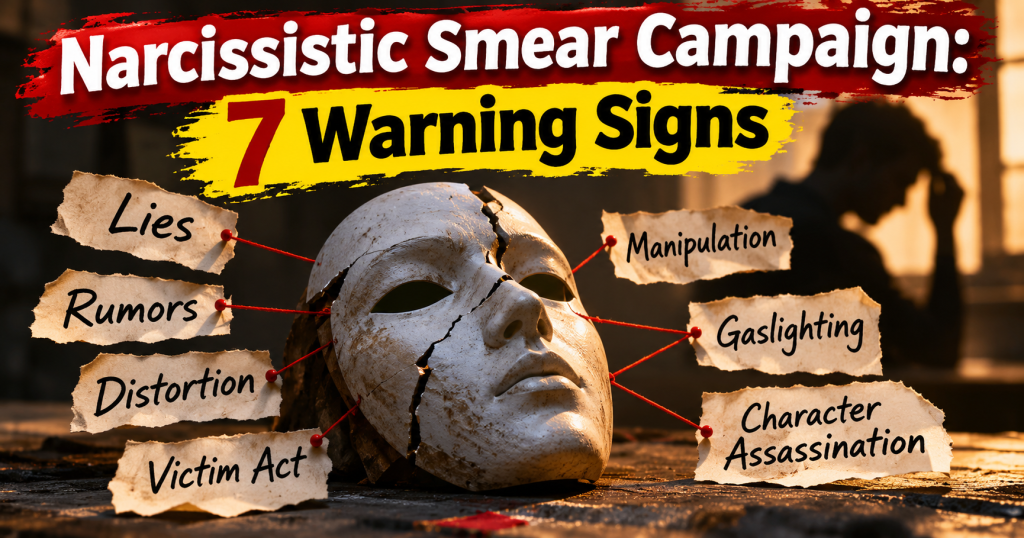
In relationships involving narcissistic traits, this behavior is often described as a narcissistic smear campaign. It involves spreading misleading information, exaggerating events, or presenting a distorted version of someone else’s behavior to damage their credibility.
Understanding why this happens can help you recognize manipulation, protect your emotional well-being, and stop feeling responsible for correcting every false story.
What Is a Narcissistic Smear Campaign?
A narcissistic smear campaign is a pattern of behavior in which someone attempts to damage another person’s reputation through gossip, false accusations, selective storytelling, or deliberate misrepresentation.
Rather than addressing relationship problems honestly, the person may try to influence how friends, relatives, colleagues, or mutual acquaintances perceive you.
They might tell people that you are emotionally unstable, claim that you mistreated them, or leave out important details that would change the entire story.
The goal may be to gain sympathy, avoid accountability, isolate you socially, or make others less likely to believe you if you eventually speak about your experience.
One particularly painful aspect is that the people hearing these stories may have no idea what happened behind closed doors.
Related : How Narcissists Use Projection to Reveal Their True Selves
7 Signs Someone Is Running a Narcissistic Smear Campaign Against You
Not every disagreement or negative comment is a smear campaign. However, certain repeated patterns may indicate that someone is deliberately trying to undermine your reputation.
1. They Tell Everyone Their Version Before You Can Speak
One common tactic is controlling the narrative early.
Before you have an opportunity to explain what happened, the other person may already have contacted friends, family members, or mutual acquaintances.
They might present themselves as the person who was hurt, misunderstood, or abandoned.
By the time you realize what is happening, people may already have formed opinions about you based on incomplete information.
2. They Make You Look Emotionally Unstable
Someone who has repeatedly provoked you may later use your emotional reactions as evidence against you.
For example, they may ignore your boundaries, repeatedly criticize you, or push you into exhausting arguments.
When you finally become upset, they focus entirely on your reaction while ignoring everything that happened beforehand.
Suddenly, the conversation is no longer about their behavior. It becomes about how you reacted to it.
This can be especially damaging because people who witness only your emotional response may misunderstand the situation.
3. They Play the Victim in Front of Others
One of the most confusing parts of a smear campaign is watching someone portray themselves as the victim while privately behaving very differently.
They may talk about how much they sacrificed, how unfairly they were treated, or how difficult you supposedly made their life.
Meanwhile, the experiences that led to the conflict remain hidden.
This reversal can make you question your own understanding of the relationship, particularly when other people immediately sympathize with them.
Related : How Narcissists Push You Until You Snap, Then Play the Victim
4. They Twist Your Words and Misrepresent Your Actions
A simple conversation can become something completely different when repeated by someone who wants to damage your credibility.
You might say that you need space, but they tell others that you abandoned them.
You might establish a boundary, but they describe you as cruel or controlling.
You might explain that their behavior hurt you, but they claim you attacked them.
Over time, these distorted stories can create a version of events that bears little resemblance to what actually happened.
5. Mutual Friends Suddenly Treat You Differently
Sometimes, the first indication that something is happening is a noticeable change in people’s behavior.
Friends become distant. Family members ask strange questions. People who once communicated normally begin avoiding you.
Not everyone who becomes distant has been manipulated, of course. However, when several people suddenly repeat similar accusations or assumptions, it may be worth considering whether they have heard a one-sided account.
You do not need to chase everyone down and explain yourself immediately.
6. They Use Your Silence Against You
When you refuse to participate in gossip or public arguments, the other person may interpret your silence however they want.
They might claim that you have nothing to say because their accusations are true.
Alternatively, if you defend yourself, they may describe your response as proof that you are obsessed, aggressive, or unable to move on.
This creates an exhausting situation in which almost every response can be turned into another accusation.
The important thing to remember is that you do not have to answer every allegation to prove your character.
7. They Try to Make You Look Untrustworthy Before You Expose Their Behavior
This is perhaps one of the most damaging aspects of a smear campaign.
If someone fears being held accountable, they may try to undermine the credibility of the person who could reveal what happened.
They might describe you as dishonest, jealous, vindictive, or mentally unstable.
As a result, if you eventually share your experience, some people may dismiss it before even considering the evidence.
This is why protecting your credibility and keeping accurate records can be important.
Related : Why Narcissists Target Strong People
Why Do Narcissists Misrepresent You?
People who display strong narcissistic traits may struggle with criticism, rejection, shame, or situations that threaten their preferred self-image.
When confronted with behavior they do not want to acknowledge, they may respond with defensiveness, blame-shifting, or attempts to control how others see the situation.
Several motivations may contribute to a smear campaign:
Protecting their image: They may want others to continue seeing them as kind, innocent, successful, or misunderstood.