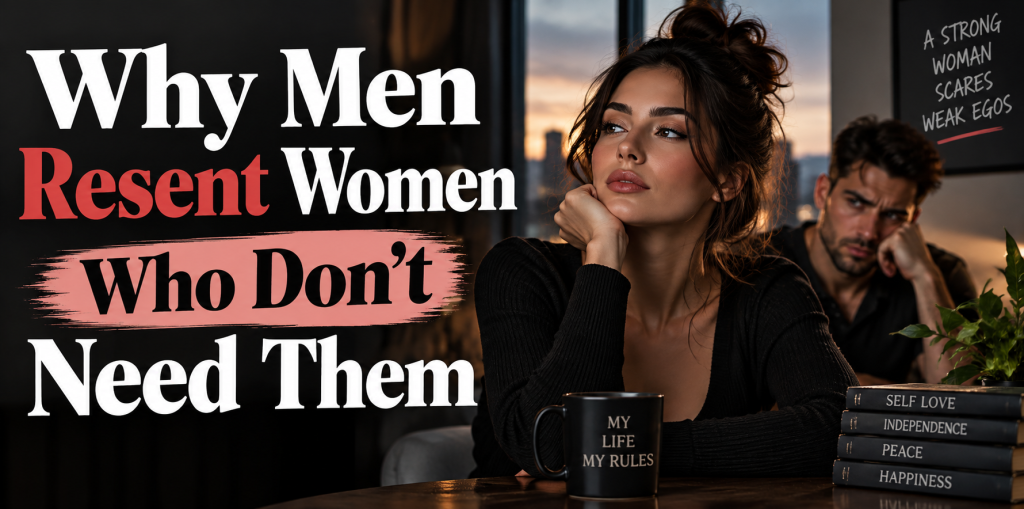
There is a strange paradox at the heart of modern dating culture: independence is considered an attractive trait, so much so that the phrase “she doesn’t need a man” is often viewed as a compliment on social media. Yet, in real-world relationships, many women who are financially stable, emotionally self-sufficient, and fully capable of managing their lives on their own report a common experience: some men pull away, act emotionally distant, or seem to harbor a silent resentment, not because they were mistreated, but simply because their partners did not need them.
This phenomenon does not apply to all men, nor is it a character flaw unique to one gender; rather, it is a psychological pattern rooted in identity, socialization, and attachment styles. Understanding the underlying causes is far more constructive than simply labeling the behavior, whether for women trying to make sense of a recurring dynamic in their lives, or for men wishing to recognize this pattern in themselves before it costs them a good relationship.
What Does “Not Needing a Man” Really Mean?
Before delving into the reasons behind this resentment, it is worth defining what is actually meant by the phrase. When a woman is described as “not needing a man,” it usually implies a combination of the following:
Related : 5 Things Gen X Women Wish We’d Learned Decades Ago
Financial independence: She does not rely on his income to maintain a comfortable lifestyle.
Emotional self-sufficiency: She is capable of regulating her own mood and does not anchor her sense of stability to him.
Practical competence: She is able to make repairs, make decisions, and solve problems without consulting him. Social independence: She has her own friends, identity, and private life that do not revolve entirely around the relationship.
None of the above implies that she does not desire a partner; wanting something is different from needing it. Yet, for some men, the source of their discomfort lies precisely in this distinction.
The Psychological Roots of Resentment
- A Threat to Identity, Not Just the Ego
Throughout generations, the roles of “provider” and “protector” were not merely functions men performed; they were fundamental pillars defining and validating masculinity. When a woman does not require financial or practical support, some men lose more than just a task or a role—they lose a source of their identity and sense of self-worth. It is less about feeling “useless” and more about not knowing “who they are” in this context.
Psychologists sometimes describe this as an identity threat rather than mere insecurity; it affects the self-concept far more deeply than jealousy does.
- Attachment Style Plays a Bigger Role Than Gender
Attachment theory offers a more precise and clear explanation than the notion that “men feel threatened by strong women.” Men with an anxious attachment style often equate “being needed” with “being loved”; if a partner is independent and self-reliant, they may (mistakenly) interpret this as emotional coldness or a lack of interest. Conversely, men with an avoidant attachment style may be unsettled by independence for a different reason: an independent partner is difficult to ignore or emotionally withdraw from without consequences.
Related : The Most Powerful Morning Routine I’ve Found After 3+ Years of Experimenting
In other words, these feelings of resentment often reflect how an individual learned to feel secure in relationships, rather than the nature of gender itself.
3. Fear of Being Dispensable
Feeling needed by one’s partner provides a sense of security: “If I am essential, I won’t be left behind.” However, having a self-sufficient partner removes this safety net. For men who tie their sense of relational security to being indispensable, an independent partner can, unconsciously, trigger fears of abandonment, even if she shows no sign of wanting to leave.
- Adjusting to the Concept of Control
In relationships governed by traditional or unequal dynamics, “need” can function as a subtle form of control. A partner who relies on you is, whether acknowledged or not, easier to influence and direct. Independence disrupts this dynamic; not because the woman is acting with hostility, but because she removes a tool of leverage that some men have grown accustomed to possessing (often unconsciously).
Cultural Background
These individual psychological patterns do not emerge in a vacuum; broader forces shape these concepts:
Socialization based on traditional gender roles has instilled in many men the idea that their value in a relationship hinges on a “give-and-take” (or transactional) principle: providing protection and necessities, and being needed. Consequently, altering or abandoning these expectations can cause confusion, even for men who consciously reject such roles. Media narratives have long portrayed the “independent woman” either as a challenge to be won over or a threat to be avoided; rarely has she been depicted as a natural and equal partner in a relationship.
Evolutionary psychologists have proposed the hypothesis that the instinct to “provide resources for a partner” is deeply rooted in the history of human pair-bonding. Yet, while this theory remains a subject of debate rather than an established fact, it does not justify feelings of resentment in the present day.
It is crucial to clarify an important point: none of the above justifies or validates such feelings of resentment; this perspective merely explains the context in which this behavioral pattern emerged, it does not serve as a defense of it.
A Crucial Distinction: It Doesn’t Apply to “All Men”
Many men are attracted to independent women, precisely because they do not desire a relationship based on dependency. As for the men who resent this, they typically share certain traits, traits not inherent to being male:
A lack of emotional security or unresolved emotional wounds (attachment issues)
Self-worth closely tied to feeling “useful” or “needed”
Discomfort with partnerships based on equality (as opposed to those based on predefined roles)
Difficulty accepting a partner’s full independence, including her ability to leave
Related : 5 Red Flags I Ignored When First Dating My Abusive, Narcissistic Ex
Framing this as an inevitable conflict between “men and independent women” overlooks the more nuanced reality: it is about a specific pattern of insecurity found in some men, not a universal male trait.
#How This Pattern Manifests in Real-Life Relationships
Common signs indicating this dynamic:
Indirectly downplaying her: Ignoring or minimizing the importance of her achievements or decisions instead of celebrating them.
Withdrawing after her successes: Pulling away immediately after she achieves something significant.
Overcompensating to prove usefulness: Inserting oneself into tasks where no help was requested.
Resentment regarding comparisons: Visible tension when she outperforms him in income or professional success.
Mistaking independence for emotional coldness: Labeling her “too independent” rather than acknowledging one’s own personal discomfort.
Building a relationship that balances independence and intimacy
The goal is not to have your partner “need” you in order for you to feel secure, but rather to build “interdependence”: two complete individuals choosing one another, rather than two people completing each other to fill an internal void.
For the man facing this within himself:
Separate your self-worth from being someone who is “needed”; instead, build that worth on personal growth, a sense of purpose, and strength of character.
Try to understand the source of your discomfort with curiosity and reflection, rather than projecting that feeling onto her and viewing it as a flaw on her part.
Accustom yourself to the idea that you are “chosen,” not “imposed” or “required out of necessity.” This provides a more secure and stable foundation than being indispensable.
For women facing a partner’s resentment:
Name the pattern clearly and directly, rather than curtailing your independence merely to preserve his emotional comfort.
Distinguish between a partner who is working on his own personal growth and one who expects you to do that work for him.
Remember that desiring support is different from desperately needing it; a healthy partner welcomes being wanted.