Manipulative relationships rarely become unhealthy overnight.
In many cases, the dynamic develops gradually. A person may initially make you feel deeply understood, valued, and appreciated. Over time, however, the relationship can shift toward guilt, confusion, criticism, control, and emotional dependency.
When these patterns involve someone with strong narcissistic traits, it can become particularly difficult to recognize what is happening because the relationship may alternate between intense affection and painful treatment.
The important thing is not to focus only on whether someone has a particular diagnosis. Instead, pay attention to repeated behaviors and how the relationship affects you.
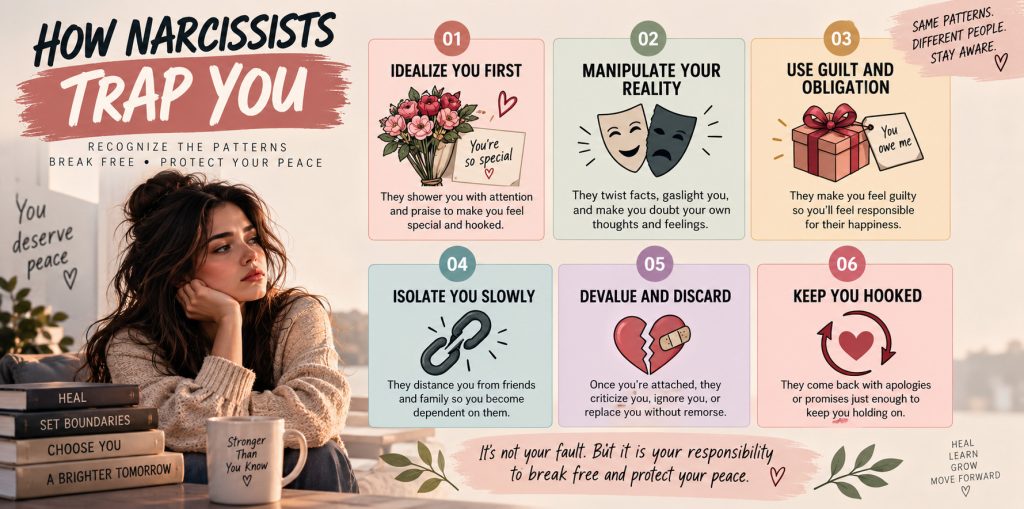
Here are six patterns that can create an unhealthy emotional trap.
- They Idealize You First
One of the most confusing parts of a manipulative relationship can be how wonderful the beginning feels.
You may receive:
Constant attention
Excessive compliments
Frequent messages
Intense affection
Promises about the future
A strong feeling of being uniquely understood
This can create a powerful emotional connection very quickly.
The problem begins when the affection becomes inconsistent. The same person who once made you feel incredibly important may suddenly become distant, critical, or dismissive.
You may then find yourself trying to get back the version of the relationship you experienced in the beginning.
Related : Why Men Resent Women Who Don’t Need Them
That can keep you emotionally invested even when the relationship is hurting you.
- They Make You Question Your Reality
Another damaging pattern is repeatedly challenging your perception of events.
You might hear things like:
“That never happened.”
“You’re too sensitive.”
“You’re imagining things.”
“You’re remembering it wrong.”
When this happens repeatedly, you may begin questioning your own memory and judgment.
This type of behavior is often associated with gaslighting, although disagreements or differences in memory alone don’t necessarily constitute gaslighting.
The important question is whether there is a repeated pattern of denying or distorting reality in a way that leaves you increasingly unsure of yourself.
- They Use Guilt and Obligation
Guilt can become a powerful form of emotional pressure.
Instead of openly discussing what they want, a manipulative partner may make you feel responsible for their emotions.
You might start thinking:
“Maybe I’m being selfish.”
“I should apologize.”
“Maybe I need to try harder.”
“If they’re unhappy, it’s my fault.”
“I shouldn’t have said no.”
Over time, you may stop making decisions based on what you genuinely want and start making them based on avoiding someone’s negative reaction.
Related : 5 Things Gen X Women Wish We’d Learned Decades Ago
A healthy relationship allows both people to have needs, boundaries, and responsibilities without one person constantly carrying the emotional burden of the other.
- They Slowly Isolate You
Isolation doesn’t always begin with an obvious demand to stop seeing your friends or family.
Sometimes it happens gradually.
A partner may repeatedly criticize your friends, create arguments before social events, complain whenever you spend time away from them, or make you feel guilty for having a life outside the relationship.
Eventually, you may start avoiding people simply because it’s easier than dealing with the conflict afterward.
The result can be dangerous: your support network becomes smaller while your emotional dependence on the relationship becomes stronger.
Maintaining healthy connections with trusted friends and family can be an important part of protecting your perspective and emotional wellbeing.
- They Devalue You After You Become Attached
Once emotional attachment has developed, the dynamic may change.
The compliments can become criticism.
The attention can become indifference.
The person who once seemed fascinated by you may begin finding fault with almost everything you do.
You may start working harder to prove your worth or regain their approval.
This creates a painful cycle:
Affection → attachment → criticism → insecurity → increased effort → temporary affection.
The more you focus on earning back their approval, the easier it can become to lose sight of what you actually need from the relationship.
- They Keep You Hooked With Intermittent Reinforcement
One of the strongest reasons people remain emotionally attached to unhealthy relationships is that the relationship isn’t necessarily painful all the time.
There may be periods of affection, apologies, promises, or moments when everything suddenly feels good again.
Those positive moments can create hope.
You may think:
“Maybe they’ve finally changed.”
Then the unhealthy behavior returns.
This unpredictable pattern of reward and withdrawal can make emotional attachment particularly difficult to break. You aren’t only remembering the painful moments—you are also waiting for the good moments to return.
That’s why judging a relationship by its overall pattern, rather than its best moments, can be important.
Why These Patterns Can Be So Difficult to Escape
Manipulation becomes particularly powerful when several behaviors occur together.
For example:
Idealization creates attachment.
Gaslighting creates self-doubt.
Guilt creates responsibility.
Isolation removes outside perspective.
Devaluation damages self-esteem.
Intermittent reinforcement creates hope that things will improve.
Together, these patterns can leave someone feeling emotionally trapped.
Related : 8 Everyday Things That Make a Narcissist Miserable
And this is why telling someone to simply “walk away” can sometimes underestimate how complicated these situations become.
How to Start Breaking the Cycle
Recognizing the pattern is often the first step.
Start paying attention to behavior rather than promises.
Ask yourself:
Do I feel safe expressing disagreement?
Can I say no without being punished emotionally?
Am I constantly apologizing?
Do I feel guilty for having normal needs?
Have I become isolated from people I trust?
Do I frequently question my own memory or judgment?
Am I constantly trying to regain someone’s approval?
Is the relationship consistently respectful, or only occasionally?
Your answers can reveal more than a label ever could.
If you’re experiencing emotional abuse or feel unsafe, consider reaching out to someone you trust or a qualified mental-health professional who can help you assess your situation and identify appropriate support.
You Don’t Have to Keep Proving Your Worth
A healthy relationship shouldn’t require you to constantly earn someone’s affection.
You shouldn’t have to abandon your friends, silence your feelings, question your memories, or shrink yourself to keep another person happy.
Breaking free from manipulation isn’t about becoming cold or bitter.
It’s about rebuilding your ability to trust yourself.
You are allowed to have boundaries. You are allowed to say no. You are allowed to have a life outside a relationship. And you are allowed to choose peace over a cycle that repeatedly hurts you.
Sometimes the first step toward freedom isn’t changing the other person.
It’s recognizing the pattern and deciding that you no longer want to participate in it.