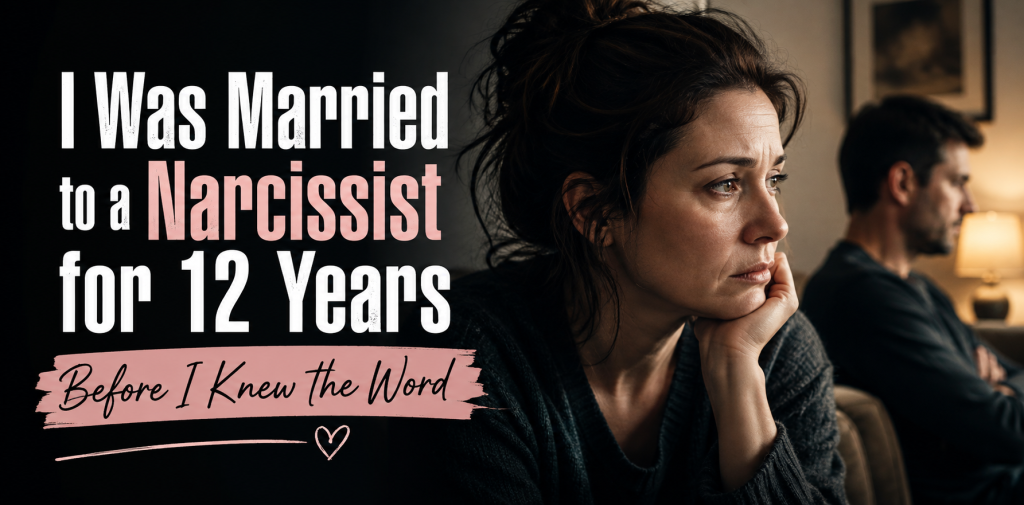
For twelve years, I didn’t have a word for what was happening to me. I had “he’s just stressed.” I had “marriage is hard for everyone.” I had “maybe I’m too sensitive.” What I didn’t have, until a stranger said it to me in a support group basement with bad coffee and folding chairs, was the word narcissist.
She wasn’t even talking about my husband. She was describing her ex. And I sat there, frozen, thinking: that’s my marriage. She just described my marriage, word for word.
This is the story of the twelve years before that moment — and the slow, strange process of learning a word that explained everything and nothing at all.
The marriage that looked perfect from the outside
If you’d asked our friends, they would have told you we had the marriage everyone envied. He was charming at dinner parties. He remembered people’s names, their kids’ birthdays, the small details that make a person seem attentive. He was successful, articulate, the guy who gave the toast at every wedding because he was good at it.
At home, the man in the toast and the man across the breakfast table were not quite the same person, but the gap was so gradual I never saw it open.
That’s the part people don’t understand about narcissistic relationships: they rarely start with cruelty. They start with intensity. He noticed me instantly, wanted me constantly, made me feel like the only interesting person in any room. Psychologists call this idealization, and it works precisely because it doesn’t feel like a tactic. It feels like love, only louder.
It didn’t start with a fight
The shift wasn’t a single argument. It was a thousand small recalibrations, each one small enough to explain away.
He’d correct my version of a story in front of guests, and I’d laugh it off. He’d go quiet for two days after I disagreed with him about something trivial, and I’d learn to apologize first, just to end the silence. He’d tell me I was remembering things wrong, and eventually I stopped trusting my own memory enough to argue.
None of it seemed like abuse. Abuse, I thought, looked like yelling, like bruises, like something a stranger could point to and say that’s wrong. What I was living in didn’t look like anything. It looked like marriage. It looked like compromise. It looked, most days, like it was probably my fault.
The signs I couldn’t name for 12 years
Looking back now, with the word finally in hand, the pattern is almost embarrassingly clear. If you’re reading this and any of it sounds familiar, it might be worth paying attention to:
- Every conflict somehow became about your flaws. No matter what started the disagreement, it ended with a list of what was wrong with me — not what happened between us.
- Apologies from him were rare, and never simple. If they came at all, they arrived wrapped in a reason it was partly my doing.
- Your reality got quietly edited. Conversations I remembered clearly would later be described back to me so differently I started keeping a private log, just to trust myself.
- Affection had a transactional feel. Warmth showed up right after I’d done something for him, or right before he needed something from me.
- Your friends and family slowly became “the problem.” People who challenged him, even gently, stopped getting invited. I didn’t notice how small my circle had gotten until it was very small.
- In public, he was a different person. Generous, funny, easy to like — which made it harder to describe what happened at home to anyone who’d only ever met the public version.
- You started narrating your own life defensively. I caught myself, more than once, mentally preparing an explanation for something I hadn’t even done yet.
None of these are exclusive to narcissism — everyone is defensive sometimes, everyone has an off week. What made it a pattern, rather than a rough patch, was that it never let up long enough to become anything else.
The day the word finally fit
I didn’t leave the night I learned the word. I want to be honest about that, because most of what I’ve read made it sound like a lightning bolt — you learn the term, you see the truth, you walk out the door. It wasn’t like that for me.
Related : Narcissism vs. Self-Confidence: 7 Key Differences (With Examples)
What the word gave me wasn’t an exit. It was a mirror. For the first time, I could describe what was happening without describing myself as the problem. Narcissistic abuse wasn’t a diagnosis I was handing my husband from a folding chair in a church basement — I’m not a clinician, and I’ll never know for certain what was happening in his mind. What the word gave me was language for a pattern, and language for a pattern is the first thing you need before you can address it at all.
It took another year to leave. Not because the pattern wasn’t clear anymore, but because twelve years of doubting my own perception doesn’t reverse itself in one support group meeting.
What healing actually looked like
Nobody tells you that leaving is the beginning of the work, not the end of it. The hardest part wasn’t the divorce. It was relearning how to trust a version of events that only I had witnessed. It was sitting in a therapist’s office, hearing myself describe something as “not a big deal,” and having her ask, gently, “would you say that if it happened to a friend?”
It was slow. It still is, some days. But somewhere in the last few years, I stopped rehearsing my own life like testimony, and started just living it.
If you see yourself in this
I want to be careful here, because “narcissist” has become one of those words the internet reaches for a little too quickly — for an ex who was simply selfish, a boss who was simply difficult, a parent who was simply flawed the way all parents are. Not every hard relationship is this. Not every difficult person meets the criteria a clinician would use for narcissistic personality disorder, and I’m not qualified to hand out that label, including to the man I was married to for over a decade.
What I can tell you is this: if you’ve spent years quietly editing your own memory to keep the peace, if you find yourself constantly explaining, constantly managing someone else’s reactions, constantly wondering if you’re the unreasonable one — that feeling is worth taking seriously, whatever word ends up fitting it. You don’t need a diagnosis to justify believing yourself.
If any of this resonates and you think you might be in a pattern of emotional or psychological abuse, it can help to talk it through with a therapist who has experience with these dynamics, or a domestic violence advocate — even if nothing about your situation looks “bad enough” yet in your own head. In the US, the National Domestic Violence Hotline (1-800-799-7233) supports emotional and psychological abuse, not only physical, and they’re used to callers who start the conversation with “I don’t even know if this counts.”
It counted for me. I just needed twelve years and one word to believe it.