Key Points
A narcissistic family system assigns specific roles, with the narcissist as the dominant figure.
Siblings in a narcissistic family are not encouraged to bond, communicate, or develop emotional closeness.
It is helpful to understand the complexities and challenges of each role played by siblings.
Part 1 of 2
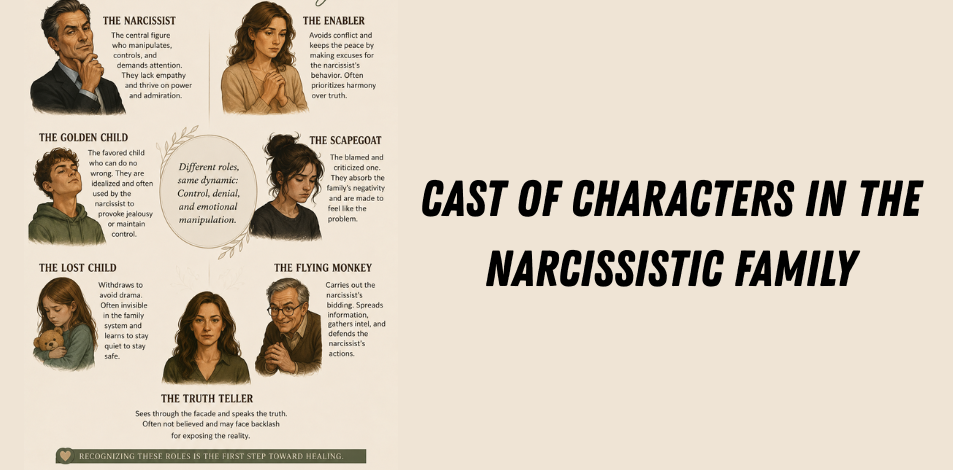
Similar to an alcoholic family, a narcissistic family assigns roles to its members, which can be likened to characters in a play, with the narcissist as the main character. To maintain control and ensure the success of this dysfunctional system, the narcissist assigns specific roles to other family members to support the dominant figure.
In most cases, the spouse justifies the narcissistic partner’s behavior, while the children unwittingly assume the roles of the favored child, the scapegoat, and the lost child. There is a favorite child, another who is bullied or harassed more than others, and a third who is ignored. Each of these roles serves the narcissist’s interests.
These roles may shift at different stages of a child’s life. For example, a child who is initially a scapegoat may become the favored child at some point, and vice versa. This all depends on what the parents need from their children at a given time. In this dysfunctional family system, these roles disrupt genuine intimacy and bonding, especially between siblings. The consequences of this sibling dynamic can lead to a permanent estrangement from their closest relatives—their brothers and sisters.
The Scapegoat Child
With a focus on children, let’s begin by better understanding the scapegoat role. When a narcissistic parent projects their feelings of insecurity, self-loathing, and self-criticism onto family members, the scapegoat child is the most vulnerable to this kind of suffering. This child becomes the family’s scapegoat, bearing the brunt of the blame. They are bullied and belittled by the narcissistic parent, are unpopular with their siblings, and often feel like the “black sheep” of the family.
The scapegoat child might be the rebellious one in the family, the critical thinker, the most independent, or the one who exposes the narcissist’s behavior when they witness it firsthand. They are often the first to reveal the narcissist’s need for control and their fabricated narrative. These children are also known for breaking the family’s narcissistic rules. For example, the scapegoat might say to her mother, “You say you love me, but you don’t act like it.” Or, “We have to pretend everything is fine when Grandma comes over, but this family has just experienced World War III within our walls. How can I pretend I’m emotionless?”
Related : 7 Hidden Principles That Motivate Narcissists
Unfortunately, the rest of the family may accept the idea of blaming the chosen child for the problems, thus becoming complicit in the narcissist’s behavior. The scapegoat often ends up bearing the burden of shame for the entire family, believing herself to be the bad child or the bad person. As one patient put it, “My sister and parents told me for a long time that everything was my fault, so I guess I believed them.”
What’s interesting about the child scapegoat is that they are often the most psychologically healthy in the family because they come to terms with the situation earlier than the others. They tend to break down dysfunctional patterns sooner than other family members and are often the only one in the family who works to undo the legacy of narcissism in adulthood.
The Spoiled Child
Being the spoiled child might seem wonderful, but this role comes with many challenges. While the narcissistic parent projects their negative feelings onto the spoiled child and the rest of the family, they also project their idealized self onto the child. This often leads to the spoiled child becoming more immersed in the narcissistic parent’s personality or even being enslaved by them than their siblings. Because of this intertwined relationship with the parent, the spoiled child finds it much harder to separate from them and build an independent personality, as this requires giving up the attention and admiration the narcissistic parent bestows upon them. In their desire to maintain the projected image of themselves as exceptional, the spoiled child usually struggles to develop their authentic self.
The spoiled child enjoys a privileged status and is often compared to their siblings. Following in the footsteps of the narcissistic parent in work or other activities further strengthens the spoiled child’s bond. Narcissists typically only interfere in their children’s lives if their interests align with their own. If a narcissistic parent is more interested in football than music, they are likely to attend football matches but not piano recitals.
Spoiled children tend to express conflicting feelings about being treated better than their siblings. Some become arrogant and conceited, expecting preferential treatment outside the family as well. But when they enter real life, they may feel confused and resentful as these feelings of entitlement backfire, since they don’t necessarily receive the same treatment they did in their original families. Some may become narcissists themselves if they don’t understand the dynamics of the narcissistic family and seek to recover. Others feel guilty about receiving preferential treatment from their narcissistic parent, recognizing that it is unfair. Perhaps the most negative consequence of spoiled parenting is the constant need for perfection to maintain the image instilled in them by the narcissistic parent. This pursuit of perfection can be a heavy burden throughout a person’s life. A spoiled child often talks about imposter syndrome or feeling like a fraud, which can lead to self-destructive behaviors.
One can understand the heavy burden a spoiled child carries. Their perfect role may seem appealing to their siblings or others, but it comes with a difficult emotional strain.