If you came out of a relationship with a narcissist feeling “too sensitive,” “too suspicious,” or “too intense,” there’s a good chance the opposite is true. You didn’t come out broken. You came out fluent in a language most people never have to learn.
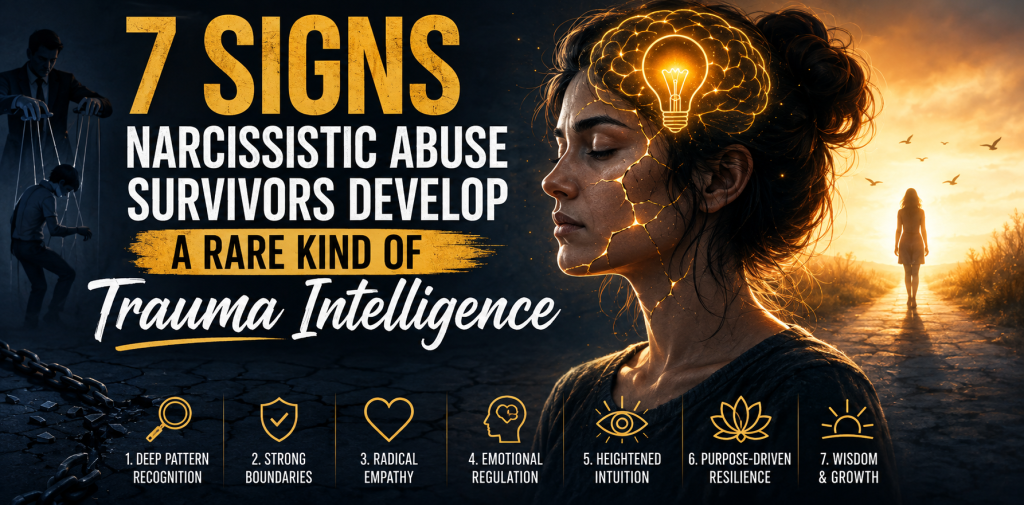
For years, the story around narcissistic abuse has focused almost entirely on the damage: the anxiety, the self-doubt, the shattered trust. All of that is real, and it deserves to be named. But survivors , and increasingly, the therapists who work with them , are also naming something else: a sharpened, almost uncanny perceptiveness that develops in the aftermath. Some call it hyper vigilance. Others call it intuition. A growing number of trauma-informed writers and coaches have started calling it trauma intelligence.
It’s not an official clinical diagnosis. Think of it more as a working name for a real pattern: a cluster of perceptual and emotional skills that forms when a nervous system spends years learning to detect danger in subtle shifts of tone, timing, and behavior. It costs something to build. But it can also become one of the most valuable forms of self-protection a person ever develops.
Here are seven signs you might have it.
1. You Spot Manipulation Almost Before It Starts
Most people need a pattern of bad behavior before they get suspicious. Survivors of narcissistic abuse often catch it in a single interaction , the compliment that’s really a test, the “joke” with a blade in it, the warmth that arrives suspiciously fast and hard (commonly known as love-bombing).
Related : Psychology Has a New Name for People Who Don’t Fit In
This isn’t paranoia. It’s pattern recognition built through repetition. When someone has lived through a relationship where charm was a precursor to control, their brain gets very, very good at noticing the gap between what a person says and what a person does.
2. You Read Tone and Micro-Expressions Like a Second Language
A slightly too-long pause. A smile that doesn’t reach the eyes. A voice that drops half a register right before the mood shifts. Survivors often pick up on these cues almost involuntarily, because in the relationship that shaped them, noticing early wasn’t a personality quirk , it was how you knew whether it was safe to relax or time to brace.
This kind of attunement is exhausting to live with, especially early in recovery. But it’s also a genuine skill: many survivors go on to be the person in the room who senses when something is “off” long before anyone else does.
3. You Can Tell a Real Apology From a Strategic One
“I’m sorry you feel that way” and “I’m sorry I did that” sound similar to most people. To a survivor, they’re worlds apart.
This sign is closely tied to a concept called DARVO , Deny, Attack, Reverse Victim and Offender , a term coined by psychologist Jennifer Freyd to describe how someone avoids accountability by denying wrongdoing, attacking the person who raised it, and recasting themselves as the real victim. Survivors of narcissistic abuse tend to develop an almost instant ear for this pattern, because they heard it so often aimed at them. A vague, blame-shifting non-apology rarely gets past them anymore.
4. You Have a Precise Radar for Boundary Violations
Ironically, the people whose boundaries were violated most often are frequently the ones who notice boundary violations most quickly , in others’ lives, if not always yet in their own. A friend who keeps overriding someone’s “no.” A partner who “jokes” past a clear limit. A coworker who apologizes and then does the exact same thing a week later.
Recognizing the violation is often the easy part for survivors. Enforcing their own boundaries is usually the harder, later stage of healing , but the radar itself tends to come first.
5. You Can Hold Empathy and Self-Protection at the Same Time
A common myth about empathetic people is that empathy requires self-sacrifice , that caring about someone means absorbing their behavior without complaint. Survivors of narcissistic abuse often unlearn that myth the hard way, and what emerges on the other side is more precise: compassion that doesn’t require self-erasure.
Related : Ego Strikes Out on Two Fronts
This looks like being able to say “I understand you’re struggling” and “this still isn’t okay” in the same breath. It’s a more mature, more sustainable form of empathy than the version many people start out with , one built specifically because the old version got exploited.
6. You Don’t Back Down as Easily When Your Reality Is Questioned
Gaslighting works by making a person doubt their own memory, perception, or judgment over time. Survivors who have lived through it often develop a strong internal alarm the moment someone tries to rewrite what actually happened , a flat “that’s not what occurred” instead of an anxious spiral of self-doubt.
This resistance to having their reality overwritten is one of the clearest markers of healing. It’s also a quiet form of protection against future manipulation, from anyone, not just the original source of harm.
7. You Can Turn the Pain Into Insight for Other People
This is where trauma intelligence often becomes something generative rather than just protective. Many survivors describe a pull toward helping others navigate similar situations , becoming the friend people call when something feels wrong, or moving into therapy, coaching, writing, or advocacy work.
Psychologists Richard Tedeschi and Lawrence Calhoun have written extensively about post-traumatic growth , the idea that significant adversity can, for some people, lead to positive psychological change over time: deeper relationships, a stronger sense of personal strength, and a clearer sense of what matters. Trauma intelligence, at its best, is one visible expression of that growth: pain that got converted into pattern recognition, and pattern recognition that got put to use helping someone else.
The Cost Behind the Skill
It’s worth being honest about where this “intelligence” comes from. It isn’t a gift in the way talent or curiosity is a gift. It’s an adaptation , a nervous system that learned, often in a threatening environment, to stay alert so it could stay safe. That’s why so many survivors describe these same traits as exhausting, not just useful. Hypervigilance that never switches off isn’t a superpower; it’s a nervous system still bracing for impact.
Related : The Strange Way Narcissists Organize Their Homes
Real healing isn’t about staying permanently sharp and suspicious. It’s about the nervous system slowly learning that it’s allowed to rest , while keeping the discernment that took so much to build. That shift usually goes better with support: trauma-informed therapy, somatic approaches, or EMDR are commonly used to help process the underlying activation, not just manage its symptoms.
If this article is resonating because you’re still in the middle of it , not just reflecting on the past , it may help to talk to a therapist who specializes in abuse recovery, or to reach out to a domestic violence or abuse helpline in your country for support and resources.
Frequently Asked Questions
Is “trauma intelligence” a real psychological term? It’s not a formal clinical diagnosis you’ll find in the DSM-5. It’s an informal term, increasingly used by trauma-informed writers, coaches, and survivor communities, to describe a real and well-documented set of adaptations , hypervigilance, heightened social threat-detection, and post-traumatic growth , that can follow chronic emotional abuse.
Will this heightened awareness fade if I heal from the abuse? The exhausting, anxious version of it , the part that never lets you relax , tends to soften with healing. The discernment itself, the ability to read a room or spot a red flag, often stays. Healing tends to change the cost of the skill, not erase the skill.
Is being highly perceptive just my personality, or is it trauma? It can be both, and it isn’t always possible , or necessary , to draw a hard line between them. What matters more is whether the perceptiveness feels like a tool you can put down when you don’t need it, or an alarm that never stops ringing. A therapist can help you sort out which parts of it were fine-tuned by adversity and which are simply who you are.