Most of us think of narcissism in terms of how someone talks — the bragging, the interrupting, the need to be the center of attention. But personality doesn’t stop at the front door. According to psychologists who study personality traits, the way a person arranges their living space can be just as revealing as the way they speak, because a home is one of the few environments a person controls completely.
That control is exactly where things get interesting. Here’s what experts say to look for.
Quick Takeaways
Narcissistic home organization tends to prioritize how a space looks to guests, not how it functions for the people who live there.
Public rooms are often flawless; private or shared rooms are frequently neglected.
Décor tends to center on the narcissist’s own image, achievements, and status.
Sentimental or “cluttered” items — especially ones tied to other family members — often get quietly removed.
None of this is a diagnosis. Being tidy, minimalist, or design-conscious does not make someone a narcissist.
Their Home Is Basically a Stage Set
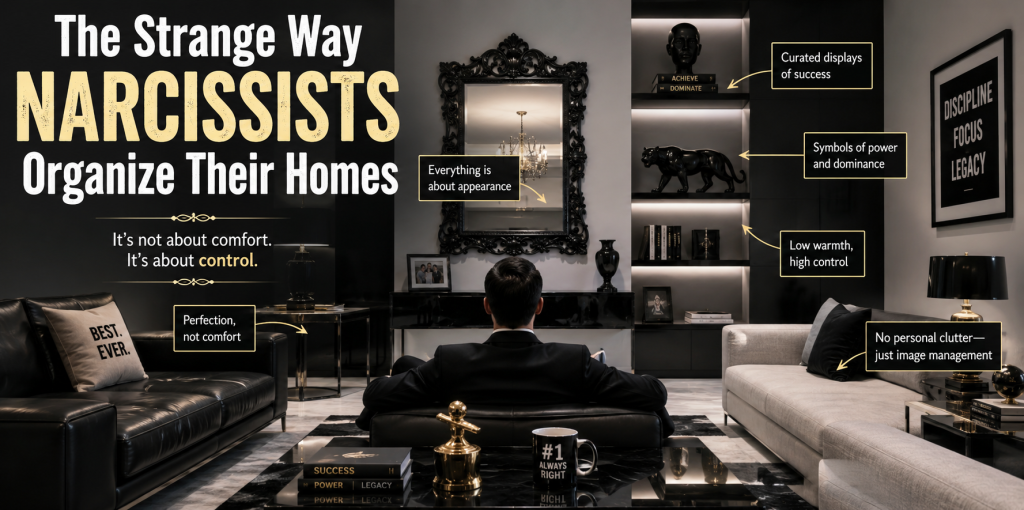
For many people, a living room is where life actually happens — kids’ toys, a blanket on the couch, mismatched mugs. In homes shaped by narcissistic tendencies, the rooms guests see are often staged like a showroom: symmetrical, spotless, and curiously impersonal. Psychologists who study narcissism point out that this comes from a deep investment in image management — the home isn’t decorated for comfort, it’s decorated for an audience.
The giveaway isn’t that the space is clean. It’s that it feels less like a home and more like a set designed to be admired.
The “Trophy Room” Effect
Walk through a narcissistically organized home and you’ll often find a wall, shelf, or entire room dedicated to the owner’s accomplishments — diplomas, awards, photos of them with notable people, or oversized portraits of themselves. This isn’t unusual on its own; plenty of people display achievements. What stands out, researchers note, is the proportion: the rest of the household — partners, kids, shared history — barely registers by comparison.
Nothing Personal Lives in Shared Spaces
A subtler pattern is what’s missing. Family photos that don’t flatter the narcissist, a child’s artwork, a partner’s favorite (but slightly worn) armchair — these items tend to disappear from common areas over time, migrating to bedrooms or storage. The living space slowly becomes a reflection of one person’s taste and history, even in a home shared by several people.
Obsessive Order in Public Rooms, Chaos Behind Closed Doors
One of the more counterintuitive patterns experts describe: the rooms visitors see — the entryway, the living room, the kitchen — are immaculate, while private areas like closets, garages, or home offices are cluttered or neglected. The order isn’t really about liking things clean; it’s about controlling the impression a specific, visible space creates.
Everything Is Arranged for an Audience
Look closely and you may notice the whole layout is optimized for how it photographs or how it reads to a visitor walking in — not for how the household actually uses the space day to day. Furniture faces an imaginary camera. Books are arranged by color instead of what anyone actually reads. Nothing is out of place because nothing was ever really lived in to begin with.
Your Belongings Don’t Really Belong
In shared households, this pattern can show up as a partner or roommate feeling like a guest in their own home. Their possessions get moved, minimized, or quietly discarded because they don’t fit “the look.” Requests to display something personal are often met with resistance or a redecorating “compromise” that still centers the narcissist’s preferences.
Related : What Your Therapist Won’t Tell You About Vulnerable Narcissism
Why They Organize Like This: The Psychology Behind It
Psychologists connect this pattern to a few well-documented narcissistic traits:
Need for admiration — the home becomes another audience-facing extension of the self, much like social media.
Grandiosity — achievements and status symbols are placed front and center because they reinforce a preferred self-image.
Low empathy for shared space — a home is meant to be co-created; that requires genuinely valuing another person’s preferences, which can be a struggle for someone high in narcissistic traits.
Image vs. intimacy — order becomes a substitute for warmth. Control over appearance can feel safer than emotional closeness.
A Word of Caution: Neat Isn’t the Same as Narcissistic
It’s worth saying clearly: loving a minimalist aesthetic, being house-proud, or wanting a tidy living room says nothing about someone’s character on its own. Plenty of neat, design-conscious people are simply neat, design-conscious people. What researchers describe isn’t a single habit — it’s a cluster of patterns, usually paired with other narcissistic behaviors (need for admiration, difficulty with empathy, reacting badly to criticism), that together suggest the home is being used as a tool for image control rather than shared living.
When This Pattern Is Worth Paying Attention To
If you recognize several of these signs and they’re paired with broader relational patterns — feeling unwelcome in your own space, having your belongings dismissed, or noticing your presence in the home slowly erased — it may be worth reflecting on the relationship as a whole, ideally with the support of a therapist or counselor who can look at the full picture rather than one household habit.
FAQ
Can a messy person be a narcissist too? Yes. Not every narcissist is a neat freak — some prioritize other forms of image control instead. The organizing pattern described here is one possible expression of narcissistic traits, not a universal rule.
Is this list a diagnostic tool? No. Only a licensed mental health professional can assess or diagnose narcissistic personality disorder. This article describes behavioral patterns some psychologists associate with narcissistic traits, meant for general understanding — not clinical evaluation of yourself or anyone else.
What should I do if this sounds like my home? Start with an honest, low-stakes conversation about shared space. If conversations consistently go nowhere, or you notice a broader pattern of control beyond decor, a therapist can help you sort out what’s actually going on.
Bottom Line
A home doesn’t lie, even when the person living in it curates every detail. When a living space consistently prioritizes appearance over comfort, image over intimacy, and one person’s preferences over everyone else’s — it’s not really about the furniture. It’s about who the home was designed to please.