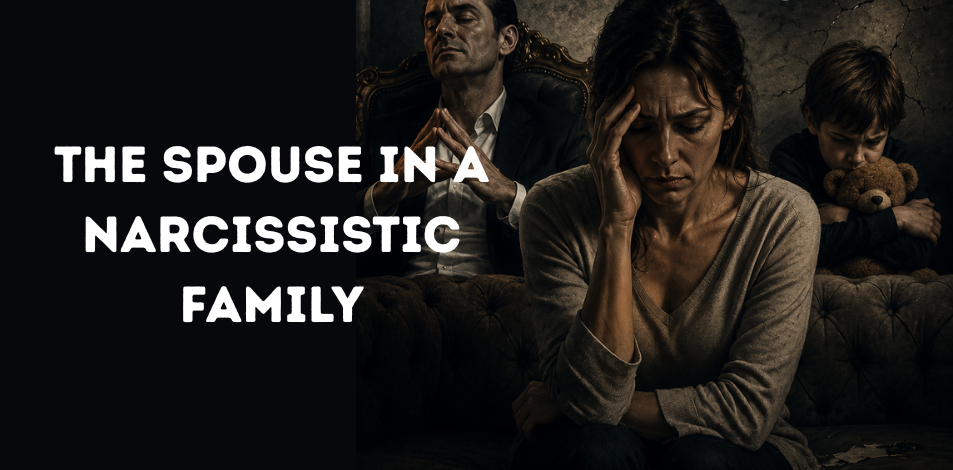
The spouse is the narcissist’s most loyal ally and helper, performing their routine tasks while maintaining a happy family image. The spouse reassures the narcissist of their own greatness by always being by their side, or rather, by revolving around them. As long as the narcissist knows their spouse is under their control, they feel secure.
However, the narcissist is constantly haunted by the fear of losing control.
This is why the narcissist isolates their spouse from the outside world through psychological manipulation. Without an external support network, the spouse’s emotional needs remain unmet. This puts the spouse in a difficult position; exhausted and caught between the needs of their children and the narcissist’s insatiable hunger for gratification and control.
The question that might cross any outside observer’s mind is: How did the spouse end up in this situation? Why are they putting up with all this? And, most importantly: How do they find the strength to endure such intense suffering?
Tragic Exile
The narcissist’s partner possesses something deep within them that is both their greatest strength and their eternal prison: an innate sense of worthlessness; a feeling of being flawed beyond redemption, unworthy of love and respect.
This profound sense of worthlessness often originates in childhood, where the partner was raised by an abusive, controlling, or narcissistic parent. Having been subjected to shame, humiliation, and control, stripped of their freedom, and denied the opportunity to protest or resist, the pressure became unbearable. Threatened with psychological annihilation, the partner created the image of the “bad child” within themselves and directed all the accompanying shame, anger, and fear back at themselves.
Finally, in an attempt to escape this horrific reality, the partner disowned the troubled child, banishing them deep into their unconscious darkness. What followed was a pattern of seeking “atonement” for their mistakes through obsequiousness and absolute submission. This began with the abusive parent and culminated with their narcissistic partner—who proved to be a carbon copy of the abusive parent.
Masochistic Love
For the rebellious child to heal and move on, the husband needs to feel all his repressed pain and confront the weight of what happened to him. But the reason he disowned this rebellious child in the first place is the realization that he cannot survive this experience. So, to maintain his psychological and emotional balance, the husband is forced to keep this rebellious child dormant.
But, like a beach ball trapped underwater, this rebellious child threatens to surface at any moment. When the husband met the narcissist, he saw in him someone superior and extremely self-confident. The husband was dazzled by the narcissist’s dazzling offer of salvation and happily entered his fantasy world, which promised to transform everything bad in the child into something good. Salvation finally seemed imminent when the husband dedicated himself to the narcissist.
But this illusion, of course, is nothing but a mirage. Deep down, the husband knows there is no salvation in illusion. And as time passes, the dark nature of the narcissist is revealed. However, instead of leaving, the spouse finds in the narcissist a partner in crime; someone who relieves them of the burden of keeping the rebellious child under control.
Related : How A Borderline Tortures A Narcissist
While the narcissist shames, humiliates, and attacks their partner, the spouse experiences a strange kind of masochistic comfort. The narcissist’s sadistic emotional abuse helps the spouse solidify the rebellious child, sparing them from confronting their own repressed pain. While the spouse consciously opposes the abuse, they subconsciously derive pleasure from it.
In extreme cases, the spouse may resort to projective identification, secretly provoking the narcissist to attack and humiliate them. The spouse may also frustrate the narcissist or acknowledge their own inadequacy and weakness, giving the narcissist a boost of ego and encouraging them to continue humiliating and ridiculing them.
Meanwhile, the spouse continues to support and care for their children as best they can, maintaining a strict discipline of cooperation and altruism. Compared to the moody, selfish narcissist, the spouse appears almost saintly, enduring an endless stream of seemingly unjustified abuse while giving everything they have to the family, creating an aura of self-sacrificing victimhood.
The Revered Saint
In many cases, the story ends there. Having been deprived of their freedom from a young age, the spouse silently sacrifices themselves, enduring their suffering. Often, the spouse dies before the narcissist due to the immense pressure they endure.
The narcissist’s partner frequently develops physical illnesses, such as cancer, stomach problems, or thyroid issues. This is due to the immense pressure resulting from family demands and the harsh narcissistic abuse.
In other cases, the partner seeks to alleviate this pressure. As mentioned earlier, projective identification is one strategy, where the narcissistic partner secretly provokes their children or grandchildren to attack them and then feigns ignorance. This might take the form of repeatedly asking the same question until the desired angry reaction is elicited.
Some partners of narcissists tend to play the victim, attacking their children for their perceived “selfishness” while making them feel guilty for not appreciating “everything the narcissist has done for them.”
In the early stages of a marriage, a partner might complain about the abuse they’ve suffered to anyone who will listen. However, no matter how sound the advice given, they won’t follow it or take any steps to improve their situation, choosing instead to endure the abuse.
Remember that the spouse has a “bad” child, coupled with a deeply held belief that they are inherently bad and therefore “deserve” punishment. While the husband/wife consciously protests, they subconsciously believe they are where they should be. Their stubbornness frustrates those trying to help. Their words say one thing, but their actions contradict it entirely.
Ultimately, the voice of protest fades away, and the husband/wife sits on their throne beside their unseen “king”/queen to spend the rest of their life. Powerless or unwilling to confront their troubled child, they remain trapped, while that masochistic voice whispers in their ear: “You deserve this. Don’t you feel good?” Meanwhile, their physical health continues to deteriorate, and they spend their final days without facing the shock that could have freed them from their prison in the first place.