
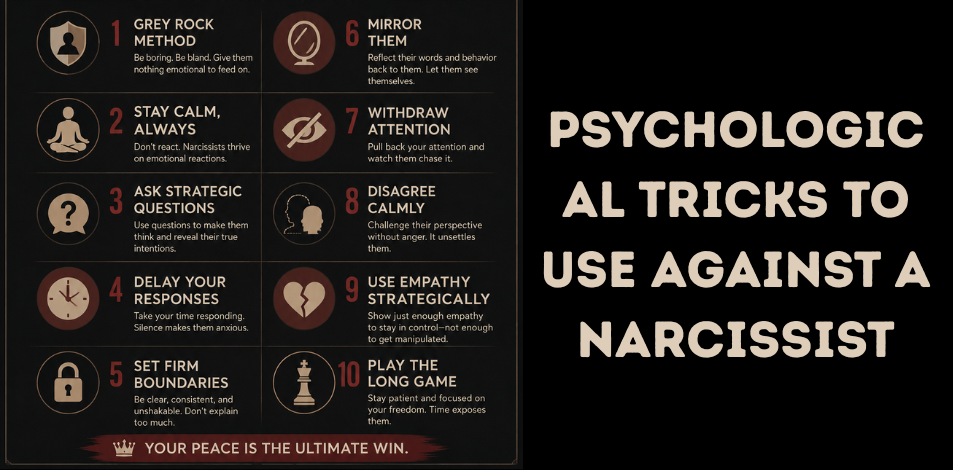
To exert control over you, convince you of their greatness, and keep you feeling ashamed and inferior, a narcissist must first manipulate and control your mind. But you have tools to distract yourself. The following tactics can be helpful when dealing with a narcissist’s cognitive attacks:
Change the Subject
The narcissist plays the victim, tries to manipulate you psychologically, and draws your attention through a series of complex concepts or focuses the focus on you and your perceived “desperation.”
In the middle of a narcissist’s speech or discourse, simply change the subject to something completely mundane. Do this without hesitation or warning. For example: the weather. Which shirt color looks better, black or green? What time do the shops close? What was the score of last night’s game?
The key here is to depersonalize the conversation, stop the heated argument the narcissist is leading, and return the conversation to its normal course. The narcissist will sense this change, but they’re unlikely to comment on it because it would spoil the “game” they’re playing.
Interrogation
If a narcissist is mocking your exercise routine, your room’s tidiness, or the book you’re reading, stay calm and ask them directly what they mean. Ask them how they would do things themselves, what they would choose, and why it would be better.
Ask them why their choice is better than yours, and finally, ask them what their opinion is based on. Do others agree with them? If so, who exactly? Have any studies been conducted on the best book to read or the best exercise routine? What were the criteria used in those studies?
Related : Does A Narcissist Know They Are A Narcissist?
Is it possible, even remotely, that everyone needs different solutions, and that these solutions might only become clear after you understand the other person’s perspective?
The possibilities for this type of question are endless, but its impact is significant: it can either thwart the narcissist’s attempts or trap them in a difficult situation. If you remain completely calm, it will be harder for them to get angry because they will appear to be the one at fault, not you.
Stability
When a narcissist blames you, tells a tragic story to elicit your sympathy, or explicitly or implicitly threatens to end the relationship, think carefully. Pay attention to their facial expressions, look them in the eyes, remain silent, and consciously reflect on this distorted perception.
Study them like a scientist, observe how they influence both of you, how they infiltrate your mind, and allow them to control you for a moment. Be aware and conscious, and if you feel yourself being manipulated, take a deep breath and focus on the narcissist’s facial expressions. Focus on the moment, and no matter how awkward the situation may seem, stand your ground.
This technique is effective because it shifts the emotional burden onto the narcissist, not you. As a result, the mirror gradually turns back on them, and their attempts fail. They might say things like, “I talk too much,” or “Maybe it’s not that bad,” or “You’re a weirdo, you know?” and then walk away.
Narcissists are masters at creating personas, especially psychological and emotional ones, and use them to manipulate others. The trick to dealing with a narcissist is recognizing these personas and finding creative ways to expose and highlight them. The narcissist is playing a game, and your job is either to withdraw completely or change the rules of the game in real time. Just be careful to avoid provoking angry narcissistic reactions.