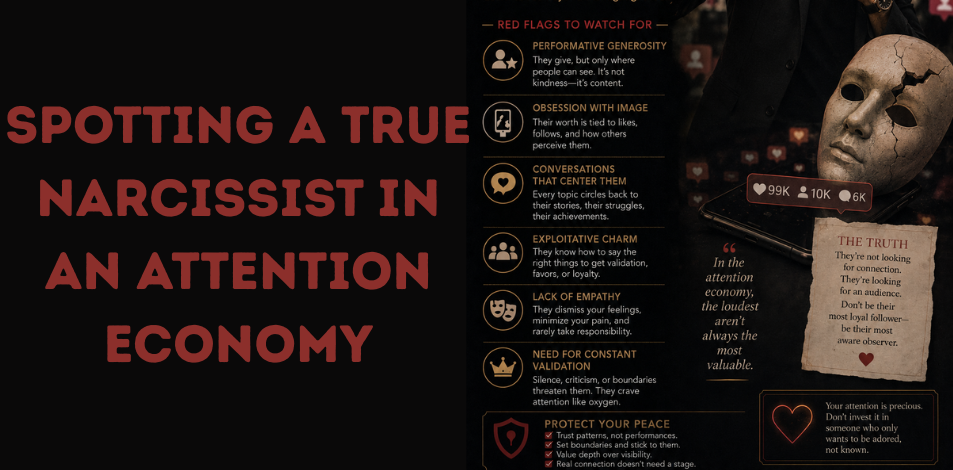
I recently created an Instagram account and started posting. I tried to be natural and include inspirational quotes that reflected my real experience as a writer. But after just three posts, I had an undeniable feeling that I was falling into the trap of narcissism. From this feeling sprang a chain of interconnected thoughts meant to reassure me. I started telling myself: This is the world we live in. There are millions of content creators online, competing for attention. This is how you promote your work. We live in an attention economy. This is normal.
Job Title: Professional Narcissist
When scrolling through Tik Tok and Instagram, it doesn’t take long to find someone dancing or doing something provocative. Provocative titles lead you to home-made comedy videos, often featuring a curvy woman in revealing clothing with her partner. Sometimes the video is simpler and more straightforward. A woman or man simply stands in a certain pose, makes subtle movements, or turns away to appear uninterested.
The rise of social media has made attention not only socially acceptable but also an indispensable part of our economy. Many people’s livelihoods now depend on audience engagement. For a narcissist, money may be desirable, but the sheer admiration of thousands or even millions of followers is the real deal. The constant stream of likes, notifications, and anonymous comments creates a kind of virtual narcissistic supply.
So, what happens if this virtual supply dries up? Even if the content creator or influence still has all the money in the world, how will they feel? Most likely, they’ll feel the same way as any narcissist: they’ll experience the pain of narcissistic withdrawal.
Reconciling with the World of Narcissism
As someone with complex PTSD, my need for attention is constrained by shame; I feel awkward receiving it. Attention triggers guilt, telling me I don’t deserve it. But what scares me is the feeling that I might actually enjoy it when I receive it. That inner voice of my psychiatric or narcissistic tendencies, lurking deep within me, pushes me forward and encourages me, reminding me how wonderful I am—if only I could let go of my doubts. Thank goodness for my conscience. Despite my impulsive reactions stemming from complex trauma, my conscience always alerts me when I regain my composure.
Related : What Makes A Narcissist Irresistible
A true narcissist is a narcissist from a young age. Because they are addicts, narcissists are known for their inability to control their impulses. Their conscience is deactivated. If they can exploit you to satisfy their desires, they will. All that restrains their psychological disorder is your personal boundaries, and the accountability and morality imposed by their society. Many narcissists adhere to these boundaries in traditional and conservative societies, or at least conduct their activities discreetly to avoid exposure.
Now, a new world has emerged that allows narcissists to flaunt their psychological disorder and turn it into a source of income. The parallels here with the pornography industry are striking, where society channels its sexual needs into an entire industry. In some ways, the attention economy may be the most suitable path for narcissists. If someone suffering from sexual repression can release their aggression in pornography instead of harassing others with it, isn’t that better? If a narcissist can gain prominence online and derive their narcissistic gratification from virtual admiration, isn’t that better than manipulating, defaming, and harming others to secure that gratification?
Perhaps. However, as with pornography, there is a clear and undeniable problem with the attention economy: it is corrupting our society. Pornography, especially explicit pornography, creates unrealistic expectations in the minds of young people who watch it.
For many sexually active individuals who want to connect and explore their desires in a healthy way, there seems to be an insatiable hunger in those they encounter, even to the point of distortion and perversion of their sexual tastes. The sexual behavior of someone influenced by pornography is completely detached from the needs and desires of their partner, driven primarily by the images in the videos they have watched. There is a terrifying gap between mind, body, and reality. Many men lose their sex drive specifically when their partner doesn’t live up to the standards of the women in explicit pornographic films. Others lose their libido entirely.
This same distortion can be observed in any normal or picturesque public setting. Amidst a crowd of people enjoying their surroundings and socializing, dozens of influences arrive in inappropriate clothing and with camera equipment, conduct a photo shoot, and then leave. The emptiness in their eyes is evident in every pose. They seem oblivious to their surroundings, their thoughts still wandering, imagining how this particular situation will be received. Unlike the bedroom, here the gap between mind, body, and reality is starkly apparent.
The Narcissist And The Egg
All of this raises the question: Did the environment create the narcissist, or did the narcissist simply adapt to it? To answer this question, we must return to the basics.
At its core, the narcissist is a constantly neglected child, whose true self is ignored. Hidden narcissists are completely neglected and ignored, receiving little attention or emotional support. Overt narcissists, on the other hand, have also had their true selves neglected, yet are acknowledged in certain contexts valued by their parents, such as their performance or appearance. Narcissistic parents “love” the child who makes them look good.
When we uncover the reality of the attention economy, one might be forgiven for calling it the “narcissism economy.” Instead of just parental expectations, as with the narcissistic child, the social media content creator faces countless expectations from others. This forces them to increasingly imagine which version of themselves will attract and maintain attention. To achieve this, the content creator needs their ego. Their personal life can become a burden, especially with the growing allure of millions of narcissistic followers.
Ultimately, the gap between the real self and the ego widens, and a dynamic similar to true narcissism develops. As their “fake” virtual persona receives all the attention, the influence’s real self remains chronically hidden. Thus, a new form of pathological narcissism is born—a product of the 21st-century economy.
I will keep this in mind when planning my future social media posts.