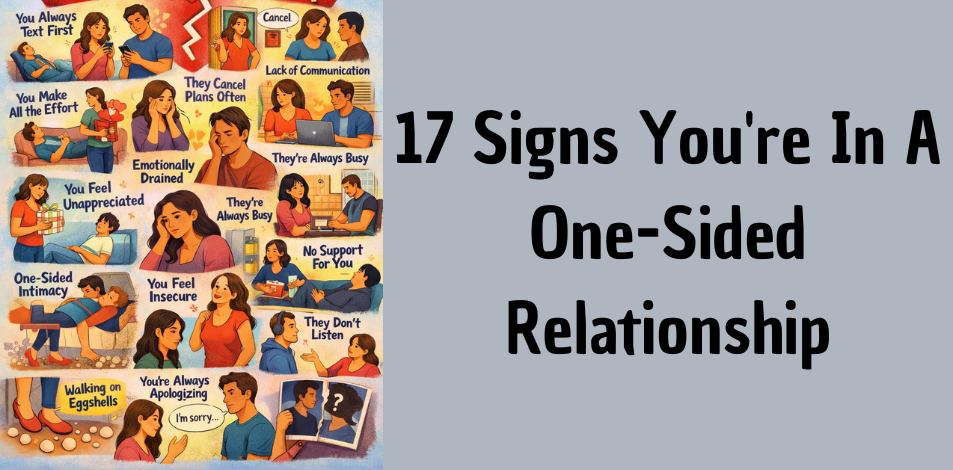
Have you ever felt like you’re performing a solo romantic show while your partner is somewhere out of the spotlight, scrolling through Instagram? You’re not alone. One-sided relationships are like an emotional marathon where you end up sweating it all alone, still waiting for your medal.
It’s messy, and sometimes tragically funny, but recognizing the signs is the first step to regaining your energy and confidence. So, relax with your favorite drink.
We’ll now look at 17 painful, sometimes funny, and always honest signs that your love life might be a one-sided show. If you find yourself in any of these, don’t worry—you’re not flawed. You’re just ready for something better.
- You’re always the one to start the conversation.
Have you ever noticed that you’re always the one to send the first message? Whether it’s a simple “Hey, how are you?” or sending that funny picture you spent 15 minutes searching for, you’re practically the social media manager of the relationship. Your phone notifications are mostly your attempts to start a conversation, while your partner’s responses are… sporadic at best.
Related : The Dark Side Of Dominance: 17 Ways Power Warps Relationships And Destroys Empathy
It’s like being an over-enthusiastic camp counselor, excited about the group games when everyone else just wants to nap. You start to wonder if you’re chasing a mirage, or simply addicted to texting.
The more you realize you’re carrying the greater emotional burden, the clearer it becomes: relationships should be interactive, not a one-on-one show. If you’re always the one initiating contact, maybe it’s time to put your phone down and see if your partner notices the silence. Warning: Sometimes, they don’t—and that speaks volumes.
- You’re the one planning (and booking) everything.
Is your schedule awash with romantic dates, while your partner just shrugs and says something vague like, “Whatever you want”? Maybe you should start your own event planning business. You know every restaurant menu by heart, yet your partner seems to have forgotten your anniversary.
It’s not just about booking dinner; you’re the one keeping the relationship alive, deep, and successful. Do you know what a “spontaneous weekend” really means? Of course not, because your partner thinks spontaneity means forgetting your birthday.
After a while, you’ll realize that planning should be a team effort, not a solo one. There’s a unique sense of freedom that comes from knowing you deserve a partner who shares in the planning, at least when it comes to choosing a restaurant.
- You’re the one who apologizes the most.
Somehow, you’ve become an inexhaustible source of apologies. Did you lose your temper after being ignored? You apologize. Did they forget your birthday? You still apologize—maybe you’re just overly sensitive, right? No. You’re caught in a cycle where the burden of keeping the peace always falls on you.
It’s a distorted version of responsibility: You’re constantly exhausting yourself trying to fix things, while your partner acts like the word “sorry” is foreign to them. This emotional strain is draining, and your attempts at reconciliation start to feel like bribes for the bare minimum of respect.
One day, you realize that apologizing for the sake of being there isn’t love—it’s an over-the-top attempt to please others. The moment you stop apologizing for things you’re not responsible for, you start to regain your self-respect. Surprise: It feels great.
- You’re sacrificing your happiness (and sanity)
Remember that time you missed your favorite concert because your partner “wasn’t in the mood”? Or when you watched three seasons of that show you hate, just for entertainment? If this describes you, you know the pain of sacrificing your own happiness for someone else’s comfort.
It’s not about compromise, it’s about disappearing. Your needs are erased like bad movie scenes, and you don’t even remember what you liked in the first place.
Here’s the surprise: Relationships are supposed to add to happiness, not take it away. Choosing yourself isn’t selfish; it’s a survival necessity. Allow yourself to put your happiness back on your priority list—enjoy it without guilt.
- You’re always questioning their feelings.
Have you ever found yourself trying to decipher text messages like they’re ancient hieroglyphs? Rereading each message, searching for hidden meanings, wondering if the “k” means “I love you” or “I’m over it.” This ambiguity is exhausting; you spend more time analyzing than truly connecting.
These emotional ups and downs make you feel like you’re auditioning for a role you’ll never get. Their feelings are a puzzle, and you’re always one wrong answer away from disaster. Trust me, we’ve all Googled “signs of their secret love” at least once.
And the most important thing: when you stop overthinking their every word, you’ll realize you deserve clarity and genuine affection, not a puzzle piece. Life’s too short to waste playing detective in your relationship.
- You feel like you’re talking to a wall.
Have you ever shared your deepest thoughts and received only a murmur or a distracted nod? It’s like talking to a piece of furniture. Meaningful conversations are replaced by casual chatter, and your emotional needs go unmet.
It’s not that you’re boring, but that your words don’t resonate with the other person. You begin to feel invisible, like a minor character in someone else’s story. Eventually, you find yourself talking less—what’s the point?
True communication requires two-way interaction. When you realize you deserve to be genuinely heard, silence becomes an unexpected gift, a space for your voice to rise.
- Your bank account is affected.
Your credit card knows your partner’s favorite coffee order better than you do. If you’re constantly footing the bill, covering impulse purchases, or bailing your partner out of financial straits, you’re not a generous partner; you’re an unpaid accountant.
Financial matters never seem to improve, and you end up feeling guilty just for bringing it up. Meanwhile, your savings dwindle, and your partner’s sense of entitlement grows. It’s like the worst investment in the world, except you’re not getting any returns.
Financial fairness is the foundation of improved relationships. Protecting your bank account isn’t selfish; it’s for your own good, and your future will thank you for it many times over.
- You are the source of their excuses.
“They’re so exhausted,” you repeat to your friends for the hundredth time. Even your dog starts whining. You find yourself making elaborate excuses for your partner’s mood swings, like you’re auditioning for an unsolicited drama series.
It’s exhausting to be both promoter and therapist. You end up feeling embarrassed, wondering if your friends are secretly counting your excuses. The truth is, when someone cares, their actions don’t need justification—they make sense.
Freedom comes when you stop making excuses for their absence. Suddenly, you have space for friends who meet your needs and partners who don’t need justifications. That’s a transformation worth celebrating.
- You leave dates feeling drained.
Have you ever left a date feeling like you’ve run a marathon through an emotional swamp? Healthy relationships replenish your energy, while one-sided relationships drain it. You give it your all, then leave feeling even emptier than when you arrived.
It’s not about being introverted or needing more sleep; it’s about the emotional strain, the constant giving, and the lack of genuine reciprocation. Even silence feels heavy instead of comforting.
Recognizing this, you begin to crave encounters that energize you, not exhaust you. The right people will energize you, not drain you, and that’s the kind of energy you deserve.
- Your efforts go unnoticed (or unappreciated)
You’ve gone to great lengths—homemade gifts, surprise dinners, remembering rare occasions—only to receive a fleeting “thank you,” or worse, complete silence. Your gestures are met with ingratitude, and you begin to wonder if you’re just another one of the world’s great mysteries.
It’s not about grand gestures; it’s about feeling valued. Everyone deserves recognition (a little or a lot) for their efforts. When everything revolves around you, it loses its magic.
Have you ever considered directing that energy toward yourself? Suddenly, you become your own biggest advocate, and self-appreciation becomes a daily habit, without needing a partner.
- Every conversation is about them.
Have you ever had a conversation where you could disappear mid-sentence without anyone noticing? Welcome to the “main character syndrome” in one-sided relationships. Your partner’s stories, problems, and opinions dominate every conversation, while your own thoughts fade into the background.
It’s like being a guest star on someone else’s show, waiting your turn for five seconds on screen. After a while, you stop participating—why compete with a monologue?
Conversations should be two-way, not a one-sided broadcast. When you realize the importance of your voice, you start looking for people who genuinely want to hear it, and that’s where a real relationship begins.
- You compromise too much to fit their schedule.
You’re a living embodiment of Google Calendar—rescheduling, rearranging, or even canceling your appointments to fit into your partner’s world. Their schedule, on the other hand, is fixed, unchanging, and sacrosanct.
After a while, your life starts revolving around their whims, and you realize you can’t remember the last time your own needs were your priority. It’s complete disappearance: your life now plays out in the background.
Reclaiming your time feels daring, almost rebellious. The more you prioritize your own plans, the more you remember the sweet taste of freedom—without needing approval.
- You Can’t Talk About the Future
Bringing up the topic of “the future” is like setting off a landmine in the relationship. Your partner dodges, jokes, or changes the subject, as if commitment is contagious. You’re left wondering what will happen next, while they act as if tomorrow is just a rumor.
It’s not about rushing things; It’s about the comfort that comes from knowing you’re building something together. Uncertainty becomes an intruder, and dreams of shared plans remain locked away.
Once you embrace your own vision for the future—whether working alone or with someone new—the world feels wide open again, and hope becomes a habit, not a risk.
- They suddenly become more attentive… when they need something.
Notice how affection levels skyrocket when your partner asks for a ride, a loan, or a last-minute favor? Suddenly, they become the most romantic character in a Shakespearean play, until their needs are met. This magic vanishes as quickly as it appeared.
It’s a classic case of selective attention: you only matter when you’re useful. Otherwise, it’s just emotional chaos and silence. This inconsistency makes genuine intimacy seem impossible.
One day, you’ll realize that your worth isn’t tied to how much you help others. When attention is limited to fulfilling requests, it’s not love; it’s mere convenience, and you deserve so much more.
- You’re the only one initiating physical affection.
If holding hands, hugging, or any other display of warmth always comes from you, you might feel like you’re competing for the title of “world champion of asking for help.” Affection should be a dance, not a solo performance.
When your gestures are met with lukewarm responses, you start to question your own attractiveness. The absence of reciprocity is deeply unsettling, and the resulting loneliness is almost worse than loneliness itself.
Reclaiming touch, just for yourself, empowers you. You’re not “overrated”—you simply know what you need, and that’s something to celebrate, not run from.
- One-Sided Sacrifices (On Your Side)
If you’ve ever given up something you love to make your partner’s life easier, congratulations—you’ve mastered the art of one-sided sacrifice. It’s rarely, if ever, reciprocated.
You tell yourself it’s “just this once,” but it quickly becomes a habit. Your partner reaps the benefits while you suffer the consequences of the compromise. It’s generosity turned into a one-sided act.
Recognizing this, you begin to accept yourself, even if just this once. There’s a profound sense of liberation in reclaiming your right to say “no” and witnessing your boundaries set you free.
- Your needs are being ignored.
Your needs—big, small, or medium—are met with mockery, laughter, or outright rejection. It’s as if you’re talking to a void. You start to reduce your requests, hoping they’ll be less “urgent,” but the silence only grows more intense.
Eventually, you realize that true love is about having your needs met in full, not settling for scraps. Your feelings aren’t exaggerated, and your needs aren’t a burden.
When you begin to respect your needs, things change. The relationship might not last, but your self-worth will—and that’s the best happy ending.