At the beginning of any relationship, everything can seem exciting and full of promise. An attractive partner may appear confident, caring, and incredibly charming. However, some personality traits may take time to emerge. One of the most difficult traits to detect early on is narcissism.
People with narcissistic tendencies often seem attractive and caring at first. But over time, their behavior may reveal patterns of control, manipulation, and a desperate need for admiration. The difficulty lies in the fact that these signs are often subtle at first.
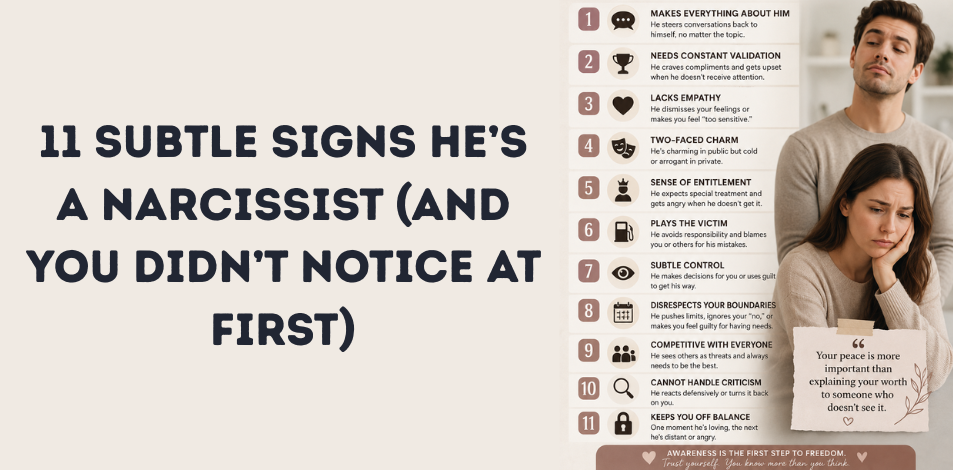
Understanding these early warning signs can help you protect your mental health and make better relationship choices. Here are 11 subtle signs that may indicate a narcissist—even if you don’t notice them at first.
- They seem perfect at first.
In the early stages, they may seem almost too perfect. They might shower you with praise, attention, and promises about the future.
While affection is a natural part of relationships, narcissists often rush to build a strong emotional bond. This intense attention might make you feel special, but it could actually be a way for him to gain your trust and admiration.
Over time, this attention might lessen once he feels secure in the relationship.
- Conversations are always about him
At first, you might enjoy listening to his stories or his accomplishments. But gradually, you might notice that conversations constantly revolve around his life, his problems, and his achievements.
Related : 9 Ways a Narcissistic Man Manipulates His Partner Without Her Realizing
Even when you try to talk about your own experiences, he might steer the conversation back to himself. A healthy partner shows curiosity and interest in your life as well.
If he’s constantly the center of attention, it could be a subtle indicator of his narcissistic tendencies.
- He craves constant validation
Everyone enjoys recognition from time to time. However, someone with narcissistic traits often seeks constant praise and reassurance.
He might talk a lot about his successes or expect recognition even for the smallest actions. If he doesn’t receive the admiration he expects, he may become upset or withdrawn.
Over time, you might feel pressured to constantly boost his ego to keep him calm.
- He rarely takes responsibility
When something goes wrong, he rarely admits his mistake. Instead, he might blame circumstances or other people.
Even minor disagreements might be attributed to you in one way or another. You might find yourself apologizing for things you didn’t do just to end the argument.
A partner who struggles with taking responsibility often has difficulty with self-reflection, a common trait among narcissistic personalities.
- He often ignores your feelings
Another subtle sign is minimizing or ignoring your feelings.
If you share something that hurts you, he might respond by saying you’re overreacting or being too sensitive. Instead of trying to understand your perspective, he might dismiss it entirely.
Over time, you may feel unheard and emotionally unsupported.
- He needs to be the center of attention
Whether you’re with friends, family, or colleagues, he often tries to be the most talked-about person.
He might dominate conversations, tell exaggerated stories, or seek admiration. While self-confidence is healthy, a constant need for attention can indicate a deeper need for validation.
If the attention is diverted from him, he may appear upset or frustrated.
- Compliments often come with veiled criticism
Narcissists sometimes disguise criticism within compliments. For example, he might say something like, “You look great today—much better than usual.” At first, the comment might seem harmless, but subtle remarks like this can slowly erode your self-confidence.
Over time, these seemingly minor criticisms can breed self-doubt without you even realizing it.
- They struggle to show genuine empathy.
Empathy is fundamental to any healthy relationship; it allows partners to support each other through difficult times.
A narcissistic partner may appear empathetic at times, but their responses are often superficial or brief. When you face challenges, they may quickly shift the focus to their own experiences.
You may eventually feel that your struggles don’t truly matter to them.
- They become defensive very quickly.
Constructive criticism is an integral part of any relationship. However, a person with narcissistic tendencies may react strongly even to gentle criticism.
Related : What is Adult Narcissism And The Symptoms Involved?
Instead of listening calmly, they may become defensive or upset. In some cases, they may even turn the tables and accuse you of being unfair.
This reaction often stifles open communication, making it difficult to resolve issues together.
- He tries to control the small decisions.
This control isn’t always obvious; sometimes it starts with small things.
He might insist on choosing your destination, your activities, or even how you make plans. At first, he might simply seem to enjoy taking the lead.
But if your wishes are consistently ignored, this subtle control can gradually erode your independence.
- You feel emotionally drained in his presence.
One of the clearest signs of a problem is how you feel after spending time with him.
Relationships should provide comfort, support, and happiness. If you frequently feel drained, anxious, or insecure after interacting with him, it could be a sign of emotional imbalance in the relationship.
You should never sacrifice your mental health to maintain a relationship.
Final Thoughts
Narcissistic behavior can be difficult to recognize, especially in the early stages of a relationship. Many traits of narcissism are hidden behind charm, self-confidence, and strong first impressions.
However, patterns gradually emerge. Paying attention to subtle behaviors—such as a constant need for admiration, a lack of empathy, or a disregard for your feelings—can help you better understand the dynamics of the relationship.