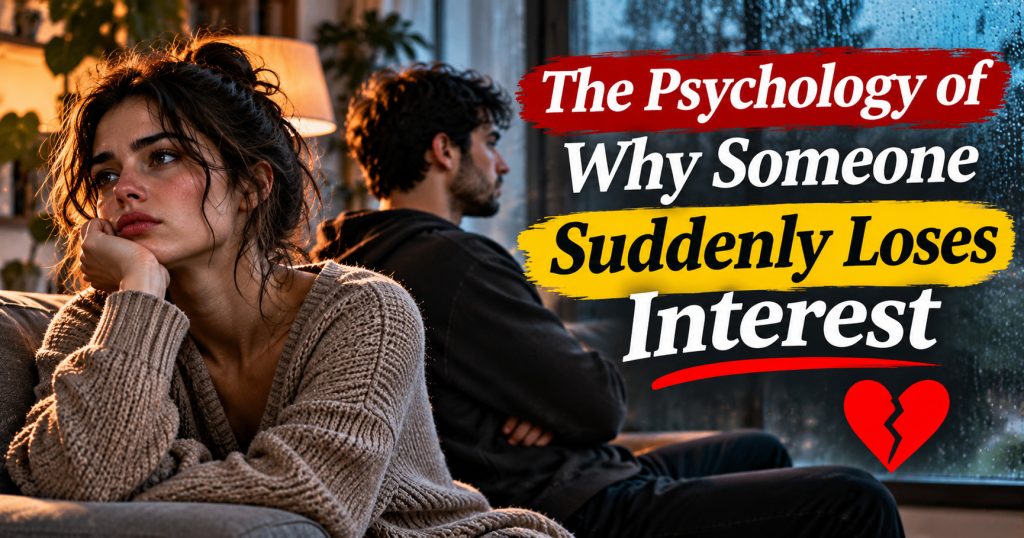
Everything seems to be going well. Someone texts you every morning, asks about your day, remembers the little things you tell them, and makes you feel like you’re genuinely important to them.
Then, without any clear explanation, something changes.
Their messages become shorter. They take hours to respond. Conversations that once lasted all night suddenly feel forced. They stop making plans, and the excitement they once showed seems to disappear.
You start asking yourself questions you never thought you would have to ask.
Did I say something wrong? Did they meet someone else? Was everything they said in the beginning genuine?
One of the most confusing experiences in dating and relationships is watching someone go from emotionally invested to seemingly indifferent.
But the psychology behind why someone suddenly loses interest is more complicated than simply deciding they don’t like you anymore.
Sometimes, emotional distance develops because attraction changes. Sometimes, people struggle with intimacy, have unrealistic expectations, or realize they aren’t ready for a serious relationship.
And sometimes, their initial interest was never as deep as it appeared.
Understanding these psychological patterns can help you stop blaming yourself and recognize what’s actually happening.
Here are 10 psychological reasons why someone might suddenly lose interest in you.
Related : 10 Psychological Truths About Being Deeply in Love
1. The Excitement of the Chase Has Disappeared
Some people become extremely interested in someone during the early stages of attraction.
They enjoy the flirting, the uncertainty, the anticipation of receiving a message, and the excitement of discovering someone new.
But once the relationship starts becoming more predictable, their enthusiasm begins to fade.
Why does this happen?
Novelty can be highly rewarding. New experiences and romantic uncertainty can create excitement because the outcome isn’t yet known.
For certain individuals, the anticipation of getting someone’s attention becomes more exciting than actually building a relationship.
Once they know you’re interested, they may stop putting in the same effort.
This doesn’t necessarily mean everyone who enjoys the early stages of dating is emotionally immature. Initial excitement naturally changes as people become more familiar with each other.
The problem arises when someone is only interested while things feel new, uncertain, or challenging.
Real connection requires more than enjoying the beginning. It requires the willingness to build something after the excitement settles.
2. They Enjoyed the Attention More Than the Connection
Not everyone who gives you attention is looking for an emotional relationship.
Some people enjoy feeling wanted, admired, attractive, and important to someone else.
They like receiving good morning messages, compliments, affection, and constant attention.
But when the relationship requires emotional responsibility, consistency, and genuine effort, they begin to withdraw.
Psychologically, external validation can become an important source of self-esteem for some individuals.
They may seek romantic attention because it temporarily makes them feel more valuable or desirable.
This can create a confusing experience for the other person.
At first, they seem incredibly interested. They initiate conversations, ask personal questions, and make you feel special.
But once they receive the attention they wanted, their motivation changes.
The difficult part is realizing that someone can enjoy how you make them feel without being equally interested in who you are.
Pay attention to whether someone is genuinely curious about your life or simply enjoys being the center of your attention.
3. Emotional Intimacy Starts Making Them Uncomfortable
Sometimes, people lose interest when a relationship begins moving beyond surface-level attraction.
At first, everything feels easy.
There are jokes, flirting, romantic conversations, and exciting plans.
But eventually, emotional intimacy requires something different.
You begin discussing personal experiences, expressing your needs, talking about commitment, and allowing someone to see parts of yourself that you normally keep private.
For people who struggle with emotional closeness, this transition can feel uncomfortable.
Some individuals with avoidant attachment tendencies may feel overwhelmed when a partner seeks greater intimacy or reassurance.
They might respond by creating emotional distance, avoiding serious conversations, or focusing on the relationship’s imperfections.
This doesn’t mean everyone who becomes distant has an avoidant attachment style.
However, attachment patterns can influence how people respond when romantic relationships become emotionally significant.
Sometimes, what looks like a sudden loss of interest is actually discomfort with emotional vulnerability.
4. They Were More Attached to the Idea of You Than the Real Person
During the early stages of dating, people often create an idealized image of someone.
They notice your attractive qualities, imagine what a relationship could become, and sometimes fill in the gaps with their own expectations.
They might believe you’re exactly the person they’ve been searching for.
But as they get to know you better, they begin discovering differences in personality, values, habits, or future expectations.
The fantasy starts becoming reality.
And reality doesn’t always match the image they created.
This is one reason why someone might appear intensely interested at the beginning and gradually become distant.
They weren’t necessarily connected to the complete person standing in front of them. They were partly attached to an imagined version of that person.
Healthy relationships develop when two people accept each other as real human beings rather than expecting each other to match an ideal fantasy.
5. Their Priorities or Feelings Have Changed
Not every loss of interest has a hidden psychological explanation.
Sometimes, people simply change their minds.
They might initially feel attracted to someone but gradually realize that their feelings aren’t developing into something deeper.
They may also be dealing with personal responsibilities, emotional difficulties, career changes, or circumstances that affect their availability for a relationship.
Attraction isn’t always permanent, and emotional compatibility cannot be forced.
The important distinction is how someone communicates that change.
A mature person should try to be honest rather than leaving someone confused through unexplained silence or inconsistent behavior.
You deserve clarity, even when the answer isn’t what you hoped to hear.
6. They Are Afraid of Commitment
Some people enjoy romantic relationships until commitment becomes a realistic possibility.
They might talk about the future, express strong feelings, and behave like they’re ready for something serious.
But when the relationship reaches a point where decisions and responsibilities become necessary, they start pulling away.
This can happen for different reasons.
Some people fear losing their independence. Others have unresolved relationship experiences, uncertainty about what they want, or anxiety about making long-term decisions.
For individuals who struggle with commitment, keeping emotional distance can feel safer than allowing someone to become an important part of their life.
You might notice that they become affectionate when the relationship feels casual but distant when you discuss exclusivity or future plans.
However, commitment concerns should not automatically be confused with a psychological attachment disorder.
The important thing is to recognize whether your relationship expectations are compatible.
You cannot build a stable relationship with someone who consistently avoids the kind of connection you’re looking for.
7. They Have Started Taking Your Effort for Granted
In the beginning, both people might make an effort to communicate, plan dates, and show affection.
But gradually, one person begins doing most of the work.
You’re always starting conversations. You’re the one suggesting plans. You’re constantly checking whether everything is okay.
Meanwhile, the other person becomes increasingly passive.
When someone becomes accustomed to receiving attention without giving much in return, the relationship can become unbalanced.
This doesn’t always mean they deliberately planned to take you for granted.
Sometimes, people become comfortable with a dynamic without realizing how much emotional effort the other person is contributing.
But a healthy relationship requires mutual participation.
If you’re constantly trying to maintain a connection that the other person barely invests in, it’s worth asking whether the relationship is genuinely reciprocal.
You shouldn’t have to carry an entire relationship by yourself.
8. They Are Emotionally Invested Somewhere Else
Another possibility is that their attention has shifted toward another person or another part of their life.
Sometimes, someone begins dating while still emotionally connected to an ex-partner.
They might enjoy getting to know you but haven’t fully processed their previous relationship.
In other situations, they may be exploring multiple romantic connections and eventually decide to focus on someone else.
This can lead to noticeable changes in communication, availability, and enthusiasm.
However, don’t automatically assume there’s another person simply because someone replies less frequently.
There can be many explanations for changes in behavior.
Rather than building conclusions from assumptions, pay attention to consistent patterns and communicate directly when something feels different.
9. They Don’t Know How to Communicate Their Feelings
Some people find it difficult to have uncomfortable conversations.
Instead of saying that their feelings have changed, they gradually reduce communication.
They reply less often, avoid making plans, and hope the relationship will naturally disappear.
This behavior is sometimes called ghosting when someone suddenly stops communicating without explanation.
Psychologically, avoiding difficult conversations can be a way of escaping discomfort.
They might fear confrontation, feel guilty about disappointing someone, or simply lack the communication skills needed to handle emotional situations maturely.
Unfortunately, avoiding an honest conversation doesn’t eliminate the emotional consequences for the other person.
It often creates more confusion.
You deserve someone who can communicate honestly, even when the conversation is uncomfortable.
10. They Were Never Looking for the Same Kind of Relationship
One of the most important reasons someone suddenly loses interest is that both people may have entered the relationship with different expectations.
One person wants emotional intimacy, stability, and a long-term connection.
The other wants casual dating, companionship, or something that doesn’t involve serious commitment.
At first, these differences might not be obvious.
Both people enjoy spending time together, share romantic moments, and feel attracted to each other.
But eventually, their expectations become impossible to ignore.
One person starts asking where the relationship is going, while the other becomes uncomfortable with the idea of defining it.
This doesn’t necessarily make either person a bad person.
But it does mean they may not be compatible.
Being attracted to someone doesn’t guarantee that you want the same future.
Sometimes, the healthiest decision is accepting that two people can genuinely enjoy each other’s company without being right for each other.
7 Signs Someone Is Slowly Losing Interest in You
Sometimes, changes in behavior are more revealing than words.
Here are some common signs that someone may be emotionally withdrawing from a relationship:
- They rarely initiate conversations. You’re almost always the person starting the interaction.
- Their communication becomes noticeably different. Messages become shorter, less personal, or less frequent.
- They stop making future plans. They avoid discussing upcoming dates or shared experiences.
- They show less curiosity about your life. They no longer ask questions or remember the details you share.
- They become emotionally unavailable. Conversations about feelings and relationship concerns are frequently avoided.
- They make less effort to spend time together. Plans are repeatedly postponed without meaningful attempts to reschedule.
- Their actions no longer match their words. They say they care but consistently fail to demonstrate it.
One sign alone doesn’t prove that someone has lost interest. People can become busy, stressed, or distracted.
What matters is the overall pattern and whether they’re willing to communicate about it.
What Should You Do When Someone Suddenly Loses Interest?
Realizing that someone is becoming distant can trigger anxiety, especially when you still have strong feelings for them.
You might feel tempted to send more messages, ask for reassurance, or work harder to restore the connection.
But chasing someone who is withdrawing can leave you emotionally exhausted.
Here are some healthier ways to handle the situation.
Related : Why We Love People Who Hurt Us
1. Stop Blaming Yourself for Everything
When someone’s feelings change, it’s easy to assume you did something wrong.
You start analyzing every conversation and questioning your personality.
But attraction and compatibility involve two people.
You cannot control another person’s feelings, expectations, or emotional availability.
2. Communicate Instead of Guessing
If something feels different, have an honest conversation.
You can ask whether their feelings or expectations have changed.
You don’t need to accuse them or demand an immediate answer.
A direct conversation can help you understand whether you’re dealing with temporary distance or a genuine change in the relationship.
3. Stop Trying to Convince Someone to Choose You
You can express your feelings and communicate what you want.
But you cannot force someone to become emotionally invested.
Constantly proving your worth to someone who isn’t making an effort can damage your self-esteem.
A healthy relationship should involve mutual interest, not a continuous competition for someone’s attention.
4. Pay Attention to Actions, Not Just Promises
Someone might tell you that they miss you, care about you, or want to see you.
But if their behavior consistently communicates the opposite, pay attention.
Meaningful relationships require consistency between words and actions.
5. Know When to Walk Away
You don’t need to wait until someone completely rejects you before deciding that a relationship isn’t meeting your needs.
If you’ve communicated your concerns and the same pattern continues, it’s reasonable to reconsider your investment.
Walking away doesn’t mean you didn’t care.
It means you’re no longer willing to ignore your own emotional needs.
Final Thoughts: Why Someone Suddenly Loses Interest
When someone suddenly loses interest, the hardest part is often not losing the relationship itself.
It’s losing the version of the future you imagined with that person.
You remember the excitement, the conversations, the affection, and all the possibilities that seemed so real.
And you wonder how someone who once made you feel so important can suddenly behave like you’re no longer a priority.
But someone’s changing feelings don’t automatically mean you weren’t attractive enough, interesting enough, or worthy of love.
Sometimes, people aren’t emotionally available. Sometimes, their expectations change. Sometimes, the connection simply isn’t what they thought it would be.
You may never know every reason behind their behavior.
And that’s okay.
What matters is learning not to measure your value through someone else’s level of attention.
The right connection shouldn’t require you to constantly chase the attention that was once given freely.
You deserve a relationship where interest is mutual, communication is honest, and affection doesn’t disappear every time emotional closeness becomes real.