
Key Points
Hostility among women in the workplace stems from limited opportunities, which fuels competition for collaboration.
The damage to the group, such as hostility among women in the workplace, may run deeper than mere systemic sexism.
Women leaders can dismantle hierarchical structures and foster professional, collaborative work environments.
For decades, the phrase “women supporting women” has been a recurring cultural aspiration invoked in keynote speeches, LinkedIn posts, and corporate mission statements. However, many women tell a different story, as the desired workplace culture often doesn’t align with the actual climate. This discrepancy is particularly damaging when it contradicts the ideals of “women supporting women.”
Organizational culture is the downward perspective—the set of intentions that an organization seeks to instill in its employees. Workplace climate is the upward perspective—the actual impact of how policies and workplace interactions affect individuals’ feelings.
Related : The Key to a Healthy Mind
As a psychologist who focuses on the importance of systems and relational factors, I’m more concerned with the work environment than its aspirational culture. I’ve never met anyone who left a job because they disagreed with the organization’s stated mission or cultural values. But I know many (myself included) who left because they felt the mission wasn’t reflected in workplace interactions, expectations, and standards.
Women In The Workplace
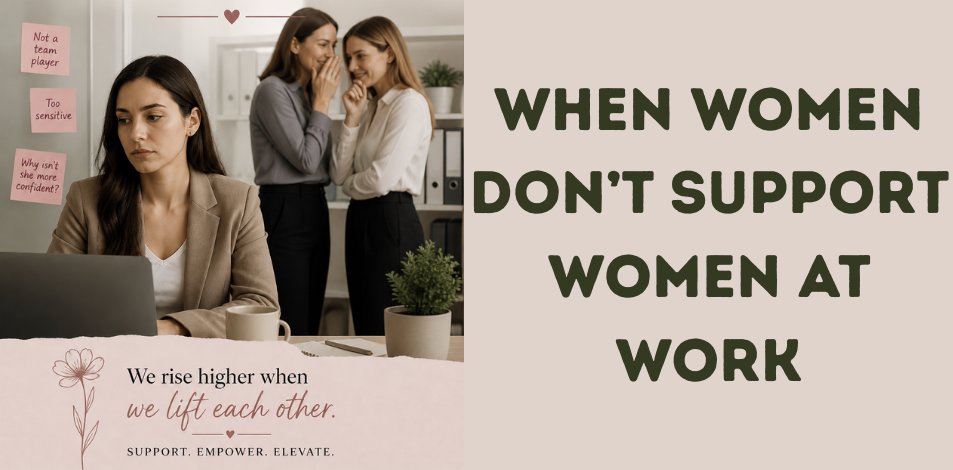
Women often share their complaints about overt and covert sexism in the workplace with clients, colleagues, and friends. What’s less discussed, however, is that some of the most damaging professional wounds are inflicted by the subtle actions of other women. There’s a common belief that working with female managers is better than working with male managers, but this isn’t always true. It’s not always like the movie “The Devil Wears Prada,” but the cumulative effect of small instances of women not supporting each other can be psychologically devastating.
So why does this happen? The hostility between women in the workplace often stems from the psychological and personal repercussions of scarcity-based systems, where women have historically been given a limited number of seats in decision-making positions.
When opportunities are perceived as limited, solidarity becomes a threat to livelihoods, and competition replaces cooperation.
This scarcity mindset and the monopolization of resources undermine the progress women have fought for. Research consistently shows that organizations with higher levels of collaboration and female mentoring achieve better employee retention rates, stronger leadership pathways, and improved organizational performance (Barbara, Ely, & Kalb, 2013). When women actively support one another, they create ripple effects that extend far beyond individual career paths. But the reverse can also be true, and this isn’t because women are inherently competitive or unsupported.
Psychologists refer to this phenomenon as the “queen bee,” a pattern in which successful women in male-dominated environments distance themselves from other women and may even reinforce the very barriers they previously faced (Dirks, Van Lara, and Elmer, 2016). Research suggests that this behavior often stems not from hostility, but from survival strategies that have evolved in systems that unintentionally teach women that helping other women threatens their status.
In the vast majority of these cases, the problem lies not with the “queen bee” itself, but with the “hive” and the impact of a scarcity mindset and resource insecurity on generations.
Among the particularly damaging dynamics is managerial abuse, which includes behaviors such as public criticism or condescension, withholding support, belittling performance in front of others, exclusion from opportunities, and forms of intimidation or retaliation. Research shows that abusive or destructive supervision significantly increases work stress, burnout, and psychological distress (Pepper, 2000).
In some cases, this situation may escalate into what employees describe as psychological manipulation by supervisors—a pattern in which legitimate concerns are ignored, experiences are re framed as misunderstandings, or employees are made to doubt their competence or perceptions of events. While psychological manipulation is not a formal clinical diagnosis in organizational psychology, studies of workplace employee abuse show that manipulative communication by supervisors can undermine employees’ self-confidence and increase their emotional exhaustion (Hirsch and Darling, 2010).
When this behavior occurs among women, the impact is particularly painful, akin to betrayal or abandonment. For women who have experienced traumatic relationships, these experiences can be both highly stimulating and destabilizing.
From a relational psychology perspective, this is a logical reaction. Humans are inherently predisposed to trust within a group. When the hurt comes from someone we consider part of our shared identity, the rift can be deeply personal. This dynamic is particularly evident in professions where women have recently gained power, including medicine, academia, and mental health. Instead of guidance and mentorship, young women may sometimes encounter subtle or overt forms of resource hoarding: withholding referrals, concealing knowledge, or excluding them from professional networks.
There is also a psychological cost to women who engage in resource hoarding. Living in such a defensive position reinforces a sense of scarcity, which in turn increases their anxiety.
Collaboration Creates More Opportunities Than Competition
The psychology of abundance suggests that when people share opportunities, the network expands, leading to greater collective success (Covey, 1989). Mentorship programs, referral networks, collaborative projects, and public awareness campaigns are essential mechanisms for the growth of professional work environments. When these channels close, innovation slows, and burnout accelerates.
Related : How to Stop Falling for the Wrong Things
The future of women’s leadership depends on changing this prevailing cultural pattern. Instead of reproducing exclusionary hierarchical models, women leaders have the opportunity to design collaborative professional work environments. This means openly exchanging referrals, mentoring emerging talent, supporting each other’s efforts, and creating collaborative platforms where expertise is shared rather than monopolized.
None of this requires perfection, but it does require an awareness and understanding of vulnerability.
The truth is that women’s advancement has never been a zero-sum game. But when women replicate the dynamics of scarcity within their ranks, everyone loses.
The evidence is clear: when women support each other, sectors become more innovative, organizations become more resilient, and leadership becomes more representative of the communities it serves. The most powerful change we can effect is broadening participation rather than clinging to a single position. The true measure of leadership is not how high we rise alone, but how many rise with us.